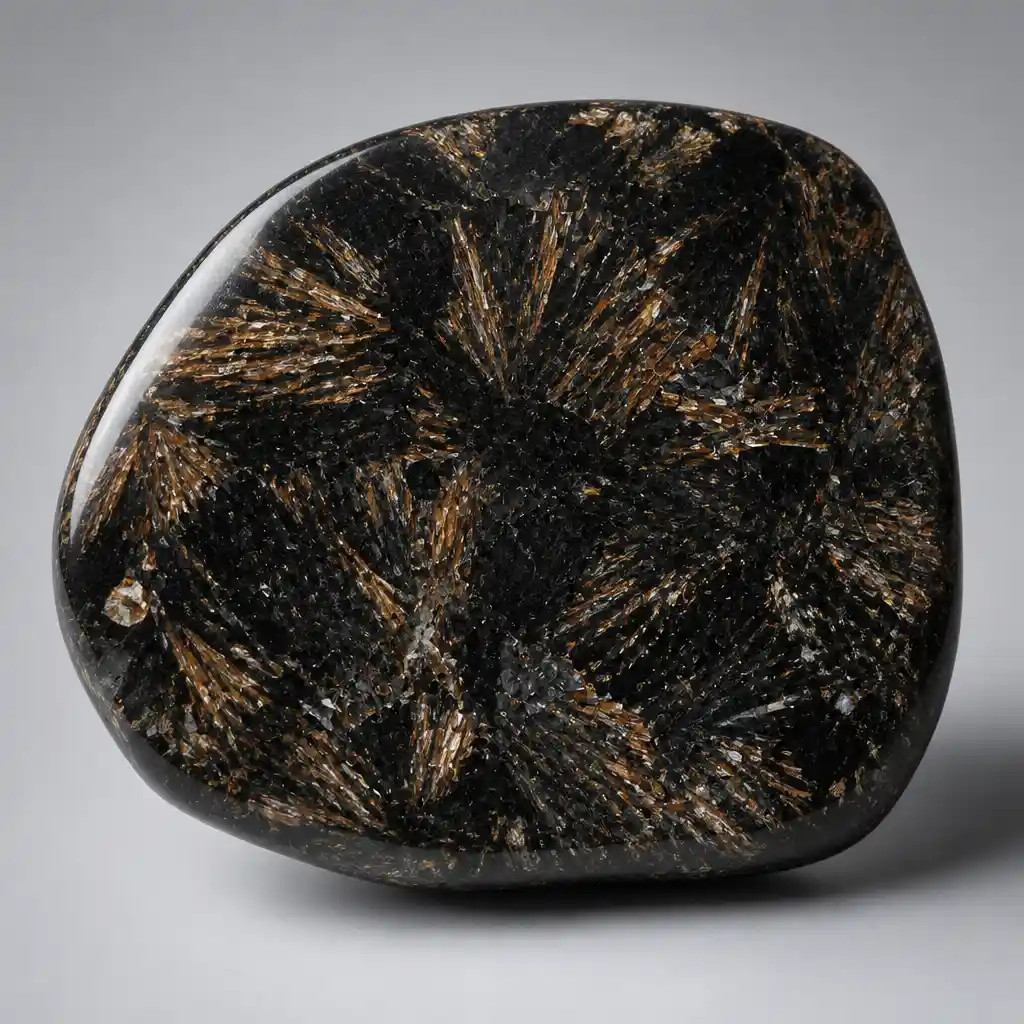
Astrophyllite at a Glance
Astrophyllite is a rare titanium crystal with star-like golden blades that facilitate deep transformation, astral travel, and soul-level self-knowledge. It illuminates your cosmic purpose.
Serious spiritual seekers, those exploring astral travel, and anyone searching for deeper meaning, soul purpose, or cosmic understanding
“I am a being of starlight. My soul's purpose shines clearly, and I walk my path with cosmic awareness and grounded presence.”
Cleanse with moonlight or sound; handle carefully due to softness (Mohs 3); store separately in soft pouch; avoid water and chemicals
Astrophyllite Quick Answers
What is Astrophyllite used for spiritually?
Astrophyllite is primarily used for deep spiritual work — astral travel, soul-level self-knowledge, and connecting with higher consciousness. It activates the Crown and Third Eye chakras while grounding through the Root, which makes it one of the few stones that facilitates profound spiritual expansion without leaving you feeling unmoored or disconnected. It also comes up for discovering soul purpose, accessing past-life information, and understanding your place in the cosmic order. This is a stone for serious spiritual practitioners, not casual dabblers.
Is Astrophyllite rare?
Yes, Astrophyllite is relatively rare. It is a titanium silicate mineral that forms in specific geological environments, primarily in alkaline igneous rocks such as nepheline syenites. While not the rarest mineral on Earth, high-quality specimens with prominent golden-blade crystal formations are uncommon and sought after by collectors. The most desirable material comes from Russia (Kola Peninsula) and Norway (Langesundsfjord). The rarity, combined with its striking visual appeal and powerful metaphysical reputation, makes fine Astrophyllite specimens relatively expensive compared to more common crystals.
What is the Meaning & History of Astrophyllite?
Core Meaning
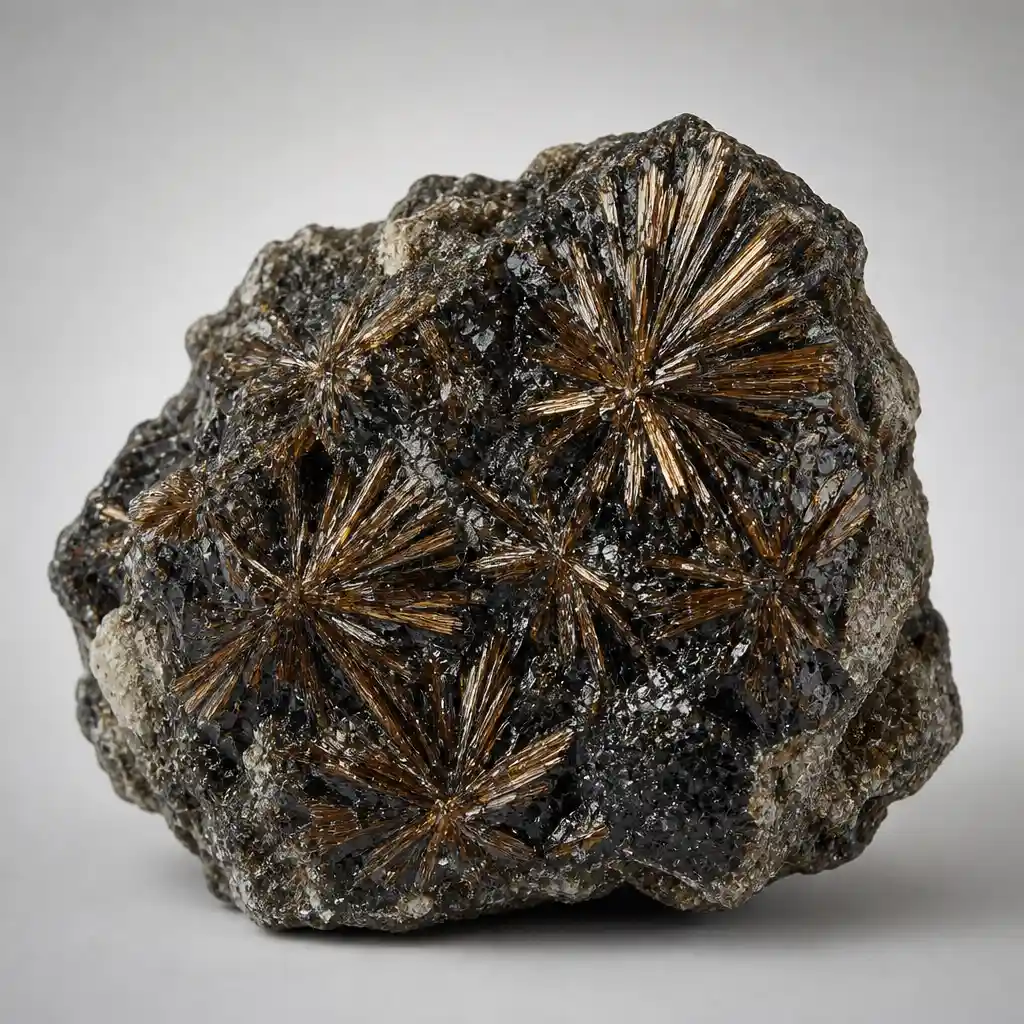
The Stone of Soul Starlight — Astrophyllite carries a vibration that is simultaneously cosmic and deeply personal. Its energy connects individual consciousness to the vast expanse of universal awareness, but rather than producing a vague sense of cosmic oneness, it brings back specific, useful insight about the soul's unique purpose and path. The stone activates the Crown Chakra as its primary resonance point, opening a channel to higher consciousness and cosmic intelligence. Then it stimulates the Third Eye for spiritual vision and the Root for grounding, creating a complete circuit from the highest spiritual realms down to the physical body. This triple activation sets Astrophyllite apart: profound spiritual experiences while keeping you firmly anchored in your body and present reality. The golden-blade inclusions serve as a visual metaphor for the stone's action — each blade represents a ray of inner light, a facet of the soul's truth, radiating outward from the deep dark matrix of the unconscious mind.
Historical & Cultural Significance
Astrophyllite was first described scientifically in 1854 from specimens found at Langesundsfjord, Norway. Its name, from the Greek "astron" (star) and "phyllon" (leaf), was chosen to describe the blade-like crystal habit that resembles radiating stars. The mineral remained relatively obscure outside mineralogical circles for over a century. Significant deposits were later discovered in the Kola Peninsula of Russia, which became the primary source of specimen-grade material. Canadian and American (Colorado) deposits are also known but produce less material. Astrophyllite entered the metaphysical crystal community in meaningful numbers during the late 1990s and 2000s, when its powerful spiritual properties began to be recognized through practitioner experience. It has since gained a reputation as one of the more potent stones for advanced spiritual work.
Symbolism
- ✦Starlight and cosmic consciousness — the golden blades resemble stars radiating from the void
- ✦Soul purpose — illuminating the unique light each person carries within
- ✦Deep transformation — the fiery golden blades catalyzing change at the deepest levels
- ✦Astral travel — safe passage between dimensions and states of consciousness
- ✦Self-knowledge — the courage to see oneself completely, including the hidden parts
- ✦Cosmic grounding — anchoring universal awareness in the physical body
Folklore & Legends
As a mineral that was only scientifically described in 1854, Astrophyllite does not carry ancient folklore in the traditional sense. However, modern crystal practitioners have developed a rich body of lore around it. Some associate the golden-blade formations with the Norse concept of Bifrost — the rainbow bridge connecting Midgard (Earth) to Asgard (the realm of the gods) — because Astrophyllite similarly bridges ordinary consciousness and higher cosmic awareness. In contemporary crystal practice, it is sometimes called "the stone of the star soul" or "the cosmic mirror," reflecting its reputation for revealing the soul's stellar origins and deepest purpose. Practitioners who work extensively with Astrophyllite often describe experiences of seeing themselves as part of a vast cosmic pattern, with their individual life serving a specific role in the larger design.
Geological Profile
Formation Process
Astrophyllite is a rare titanium potassium sodium iron manganese silicate hydroxide mineral that forms in alkaline igneous rocks, particularly nepheline syenites and their pegmatites. It crystallizes during the late stages of magma cooling, when residual fluids enriched in titanium, potassium, and rare elements become concentrated enough to precipitate this unusual mineral. The characteristic blade-like or radiating starburst crystal habit forms as the crystals grow outward from nucleation points in open cavities within the host rock. The golden to bronze color comes from iron and titanium in the crystal structure. Astrophyllite is often found in association with other rare minerals including eudialyte, aegirine, and nepheline. Its formation requires a very specific combination of elements and conditions that is relatively uncommon in nature.
Varieties
Radial Astrophyllite
The most sought-after form, featuring starburst-like sprays of golden-blade crystals radiating outward from central points. Found primarily in Russia (Kola Peninsula) and Norway. The radiating pattern is the characteristic "star" formation that gives the mineral its name.
Astrophyllite in Matrix
Specimens where the golden astrophyllite blades are embedded in dark nepheline syenite or other alkaline host rock. The contrast between the golden blades and the dark matrix creates the most dramatic visual effect. These are the most common specimens available to collectors.
Polished Astrophyllite Slabs
Thin slabs cut and polished to reveal the internal pattern of golden blades within the dark matrix. Polishing brings out the chatoyant shimmer of the blades and makes the starburst patterns more visible. Popular for jewelry and display pieces.
Notable Origins
Russia (Kola Peninsula, Lovozero Massif)
The world's premier source for specimen-grade Astrophyllite. Produces dramatic specimens with large, well-formed golden-blade crystals radiating in starburst patterns from dark matrix. The alkaline pegmatites of the Kola Peninsula are world-famous for rare minerals, and their Astrophyllite is considered the finest available.
Norway (Langesundsfjord)
The type locality where Astrophyllite was first described in 1854. Produces excellent specimens with sharp blade crystals, though generally smaller than the Russian material. Historically significant and valued by collectors for its type-locality status.
Canada (Quebec, Ontario)
Canadian deposits produce Astrophyllite in nepheline syenite formations. Material tends to have smaller blade crystals than Russian specimens but is still suitable for collectors and metaphysical use. More accessible to North American buyers.
USA (Colorado, St. Peter's Dome)
American Astrophyllite is found in the alkaline complexes of Colorado. Specimens tend to be smaller and less dramatic than Russian or Norwegian material but are valued by American mineral collectors. Limited commercial availability.
Mineral data verified via Mindat.org
Physical Properties
| Hardness | 3 on the Mohs scale |
| Chemical Formula | (K,Na)₃(Fe,Mn)⁷Ti₂Si₈O₂₄(O,OH)₇ |
| Crystal System | Triclinic |
| Primary Color | Brown/Black (with golden-blade inclusions) |
| Origin | Russia, Norway, Canada, USA (Colorado) |
| Transparency | Translucent to opaque (blades can be translucent at thin edges) |
| Luster | Submetallic to vitreous (golden blades), dull to earthy (matrix) |
| Specific Gravity | 3.2-3.4 |
What Are the Healing Properties of Astrophyllite?
Emotional & Mental Well-being
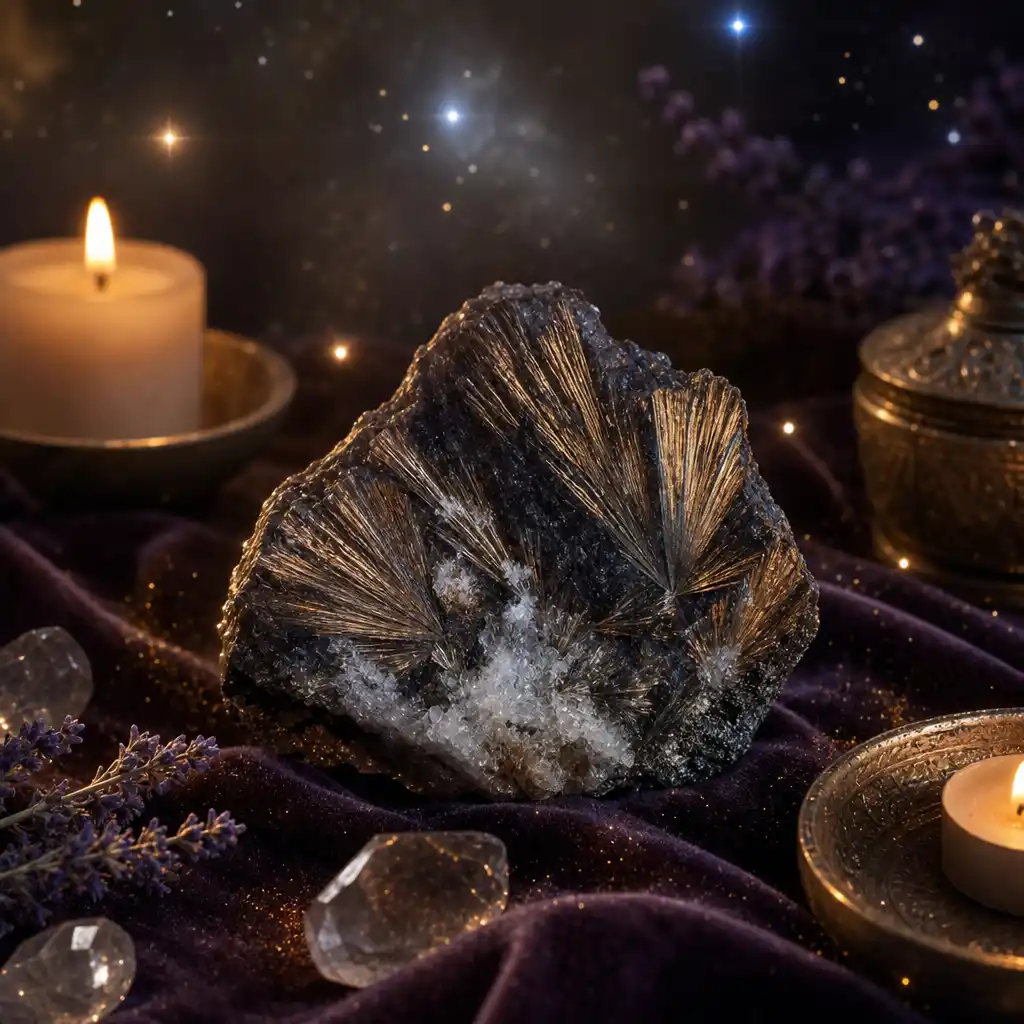
Astrophyllite is a stone of deep emotional honesty and transformation.
- ◆Its energy doesn't comfort in the conventional sense — it illuminates emotional patterns with such clarity that you can no longer avoid seeing them.
- ◆Uncomfortable?
- ◆Sometimes.
- ◆Liberating?
- ◆Always — it dissolves self-deception and emotional denial.
- ◆Crystal workers turn to Astrophyllite for people stuck in repetitive emotional loops, for those who sense there's something they need to understand about themselves but can't quite grasp it, and for anyone ready to confront their deepest fears and insecurities head-on.
- ◆Because the stone connects to both the Crown and Root chakras, this emotional excavation comes with a sense of spiritual purpose and physical safety — the process stays grounded rather than spiraling into overwhelm.
Spiritual Properties
Astrophyllite ranks among the most powerful stones for accessing higher consciousness and cosmic awareness.
- ◆Its primary resonance with the Crown Chakra opens a direct channel to universal intelligence, facilitating experiences of cosmic oneness, contact with spirit guides, and access to akashic records.
- ◆The stone shines particularly bright for astral travel and out-of-body experiences — its simultaneous Root Chakra activation provides an anchor cord, so you can travel safely and return fully grounded.
- ◆Soul purpose work is another forte: many practitioners report that meditating with Astrophyllite produces clear insights about why they're here and what they're meant to do.
- ◆Given its intensity, experienced practitioners with an established grounded practice tend to get the most from this stone — the effects can be disorienting for beginners.
Physical Healing Traditions
Traditional crystal healing links Astrophyllite to the nervous system, the endocrine system, and cellular regeneration.
- ◆Healers place it at the Crown to support brain function and neurological health, and at the Root for adrenal support and overall vitality.
- ◆It also comes up during periods of intense spiritual work, when the nervous system can get taxed by expanded states of consciousness.
- ◆Some practitioners connect it to healthy cell division and tissue repair, drawing a metaphor between its star-like crystal formations and the body's regenerative processes.
- ◆These uses draw from folk healing tradition, not clinical research — always seek out a healthcare professional for medical concerns.
Note: These properties are based on metaphysical traditions and are not a substitute for medical advice.
What Science Says
Mineralogically, Astrophyllite is a complex titanium potassium sodium iron manganese silicate hydroxide with the chemical formula (K,Na)3(Fe,Mn)7Ti2Si8O24(O,OH)7.
- ◆It crystallizes in the triclinic system, one of the least symmetrical crystal systems.
- ◆The blade-like crystal habit results from its layered crystal structure, which promotes growth in two dimensions while remaining thin in the third.
- ◆Iron and titanium in the crystal lattice produce the golden to bronze color.
- ◆Astrophyllite qualifies as a rare mineral because of its specific formation requirements — it only forms in alkaline igneous environments where titanium, potassium, and sodium are concentrated in late-stage magmatic fluids.
- ◆Clinical studies don't support the metaphysical claims, but the mineral's rarity and striking appearance give it genuine psychological and spiritual significance for the people who work with it.
Which Chakras Does Astrophyllite Connect To?
Which Zodiac Signs Match Astrophyllite?
How Do You Use Astrophyllite?
Meditation
Place Astrophyllite on your Crown Chakra (top of head) while lying down for deep meditation. Close your eyes and picture the golden-blade crystals radiating light through your skull and into your consciousness, illuminating the depths of your awareness. Working on soul purpose? Hold the stone at your heart and ask to see the unique light you carry within. For astral travel, place Astrophyllite at your Crown and a grounding stone (Black Tourmaline or Hematite) at your Root to maintain the anchor cord while you travel.
Daily Wear
A pendant at the throat or chest keeps Astrophyllite's cosmic energy in your field throughout the day. Given its softness (Mohs 3), go with protective bezel settings over prongs, and take the piece off before any physical activity. For daily spiritual practice, carrying a small tumbled piece in a pocket pouch (not loose — it scratches easily) provides a subtle but steady connection to its energy.
Home Placement
Keep Astrophyllite in your meditation space or sacred area to build an atmosphere of cosmic awareness and spiritual depth. A specimen on your altar makes a strong focal point for Crown Chakra work and astral travel practice. Keep it away from high-traffic areas where it might get bumped or scratched. In a study or creative space, Astrophyllite can spark visionary thinking and a broader cosmic perspective.
Crystal Grids
Use Astrophyllite as the center stone in a cosmic consciousness or soul purpose grid. Surround it with Moldavite (for transformation and cosmic connection), Labradorite (for Third Eye activation), and Black Tourmaline (for grounding and protection). For an astral travel grid, place Astrophyllite at the crown position with grounding stones at the base to maintain the connection to the physical body.
How Do You Cleanse & Charge Astrophyllite?
Moonlight Bathing
RecommendedSound Healing
RecommendedVisualization Cleansing
RecommendedSmudging
RecommendedMoon Phase Charging: Astrophyllite responds beautifully to moonlight charging, particularly during the full moon when its cosmic energy is most amplified. Place it in direct moonlight overnight for a full cleansing and recharge. The new moon phase is also powerful for Astrophyllite, aligning with its theme of new beginnings and soul-level revelation. Avoid sunlight charging, which is too intense for this mineral.
Avoid the following:
- ✗Water immersion — Astrophyllite's low hardness and complex chemistry make water exposure potentially damaging over time
- ✗Salt and salt water — abrasive and potentially corrosive to the delicate blade crystals
- ✗Ultrasonic cleaners — the vibration can damage or dislodge the fragile blade crystal formations
- ✗Harsh chemical cleaners — ammonia, bleach, acids, and commercial jewelry cleaners should be avoided
- ✗Physical scrubbing or abrasive cleaning methods — the blade crystals are too delicate for any mechanical cleaning
What Crystals Pair Well with Astrophyllite?
Best Combinations
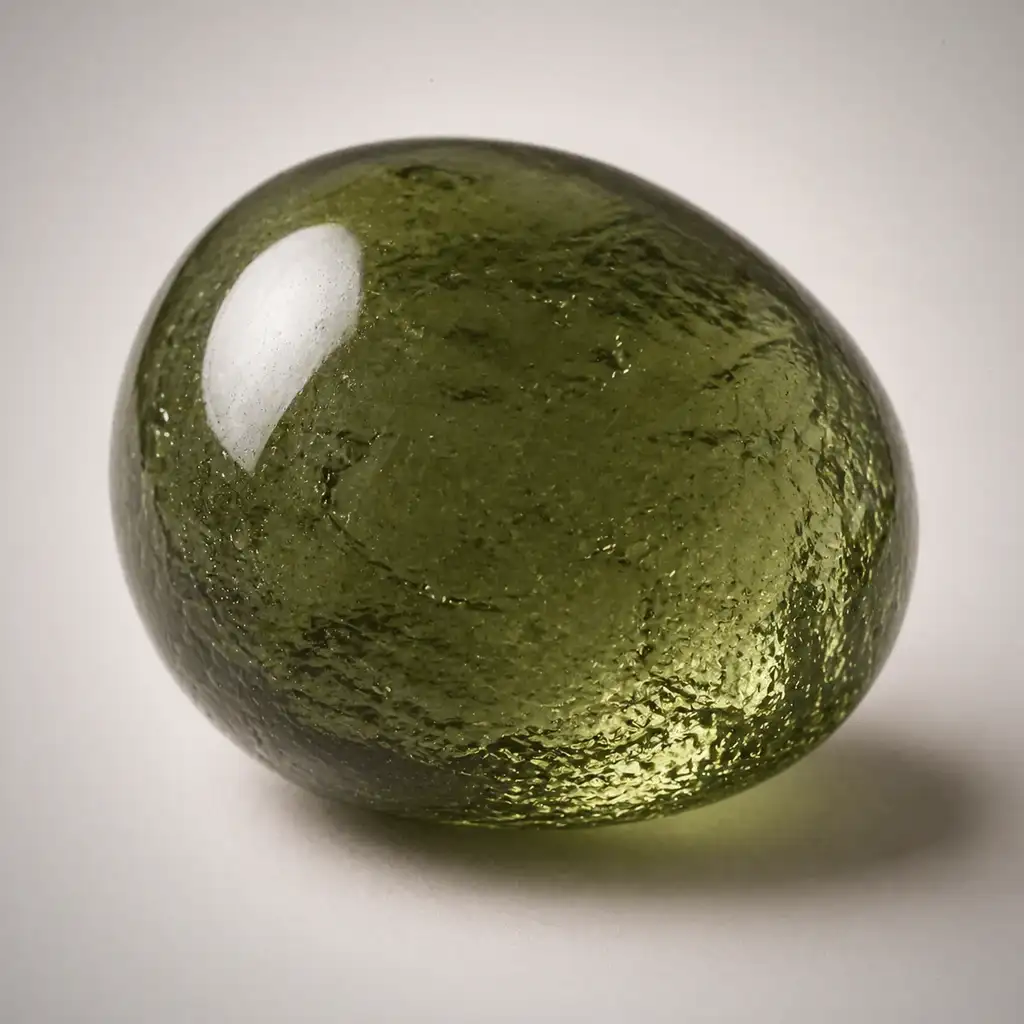
Moldavite
Moldavite and Astrophyllite form an extraordinarily powerful cosmic pair — Moldavite's extraterrestrial transformation energy combined with Astrophyllite's star-soul consciousness creates the most intense spiritual acceleration combination available in the crystal kingdom.
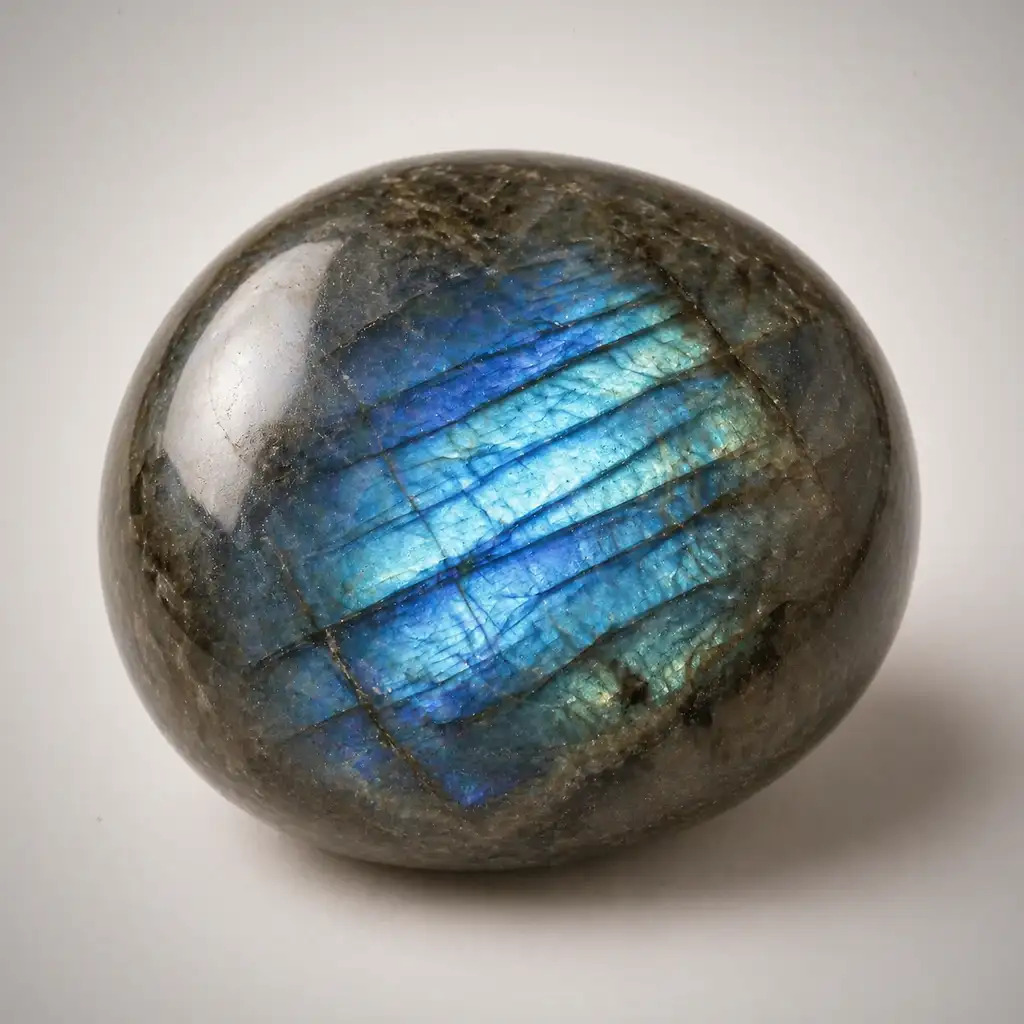
Labradorite
Labradorite amplifies Astrophyllite's Third Eye activation and adds its own protective, mystical quality. Together they create a powerful combination for expanding spiritual vision while maintaining energetic safety.
Black Tourmaline
Black Tourmaline provides essential grounding and protection that balances Astrophyllite's intense cosmic energy, ensuring that deep spiritual work remains safely anchored in the physical body. This grounding stone is almost essential when working with Astrophyllite.
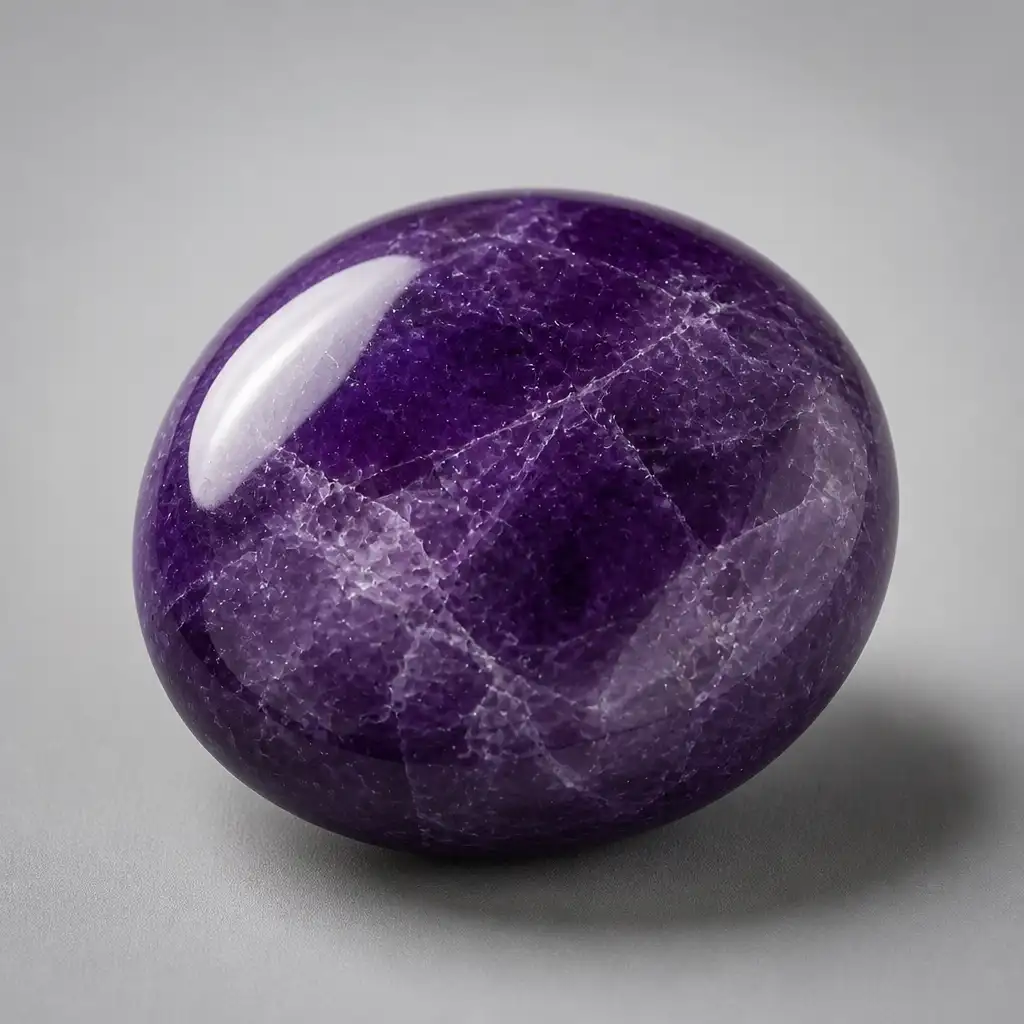
Sugilite
Sugilite's high-vibration spiritual protection and love energy complements Astrophyllite's cosmic consciousness, creating a combination that supports both deep spiritual exploration and emotional safety during the process.
If You Like Astrophyllite, Also Try
How Can You Tell if Astrophyllite is Real or Fake?
Common Imitations
Identification Tests
1.Visual Inspection of Crystal Habit
Examine the specimen carefully under good lighting with a 10x loupe. Look for the characteristic blade-like, radiating crystal formations in golden to bronze colors embedded in a dark matrix.
Genuine Astrophyllite shows naturally formed blade-like crystals that radiate outward in starburst or spray patterns from the dark matrix. The blades have a submetallic to vitreous luster and range from golden yellow to bronze to coppery brown. Synthetic resin imitations often show metallic flakes rather than true blade crystals, and the "blades" lack the natural crystal faces and terminations of genuine material.
2.Hardness Test
Attempt to scratch the golden blade crystals with a copper coin (hardness ~3) or your fingernail (hardness ~2.5) on an inconspicuous area.
Astrophyllite has a Mohs hardness of approximately 3, meaning a copper coin may scratch it with moderate pressure, and your fingernail will not. Resin imitations are typically softer (1-2) and can be scratched easily with a fingernail. The matrix rock will be harder than the blades, which is consistent with genuine specimens.
3.Specific Gravity and Density Assessment
Assess the weight of the specimen relative to its size. Astrophyllite has a moderate specific gravity (3.2-3.4) due to its iron and titanium content.
Genuine Astrophyllite specimens should feel noticeably heavy for their size due to the iron and titanium content. Resin imitations will feel significantly lighter. This is a relative test best calibrated by comparing with known genuine specimens or with other rocks of similar size.
Price Reference
Small
$15-40
Medium
$40-120
Large
$120-500+
Astrophyllite prices vary significantly based on the size and quality of the golden-blade crystal formations. Specimens with large, well-formed radial sprays of golden blades command premium prices. Polished slabs and cabochons are more affordable than raw specimens with prominent crystal formations. Russian material from the Kola Peninsula commands the highest prices, while Canadian and American material is generally more affordable.
Is Astrophyllite Safe? Care & Precautions
Toxicity Warning
Astrophyllite contains titanium, iron, manganese, and potassium in its crystal structure. In solid form, it poses no health risk through normal handling. Avoid ingesting or creating elixirs through direct immersion. As with all minerals containing multiple metallic elements, use the indirect method for gem elixirs. Dust from cutting or grinding should be avoided — use proper respiratory protection during any lapidary work.
Storage
Store Astrophyllite separately from harder minerals in a soft cloth pouch or wrapped in soft material. Its low hardness (Mohs 3) means it can be scratched by almost any other crystal, including common quartz. Handle specimens carefully to avoid breaking the delicate golden-blade crystal formations. Avoid stacking or piling specimens on top of each other.
Special Warnings
- ⚠Astrophyllite is very soft (Mohs 3) — it can be scratched by most other minerals and even by a copper coin. Handle and store with care.
- ⚠The golden-blade crystal formations are fragile and can break off if the specimen is dropped or struck. Always handle specimens by the matrix rock, not the crystal blades.
- ⚠Avoid using Astrophyllite in direct-contact gem elixirs due to its complex chemistry with titanium and manganese — use the indirect method instead.
- ⚠Its energy is potent — practitioners recommend starting with short meditation sessions (10-15 minutes) before extending the duration.
What is Astrophyllite Best For?
Astrophyllite FAQ — Common Questions Answered
What is Astrophyllite used for spiritually?+
Astrophyllite is primarily used for deep spiritual work — astral travel, soul-level self-knowledge, and connecting with higher consciousness. It activates the Crown and Third Eye chakras while grounding through the Root, which makes it one of the few stones that facilitates profound spiritual expansion without leaving you feeling unmoored or disconnected. It also comes up for discovering soul purpose, accessing past-life information, and understanding your place in the cosmic order. This is a stone for serious spiritual practitioners, not casual dabblers.
Is Astrophyllite rare?+
Yes, Astrophyllite is relatively rare. It is a titanium silicate mineral that forms in specific geological environments, primarily in alkaline igneous rocks such as nepheline syenites. While not the rarest mineral on Earth, high-quality specimens with prominent golden-blade crystal formations are uncommon and sought after by collectors. The most desirable material comes from Russia (Kola Peninsula) and Norway (Langesundsfjord). The rarity, combined with its striking visual appeal and powerful metaphysical reputation, makes fine Astrophyllite specimens relatively expensive compared to more common crystals.
Can I sleep with Astrophyllite?+
You can use Astrophyllite as a sleep companion for dreamwork and astral travel, but its energy packs a punch and may be too activating at night for some. If you want to try it for dream recall or astral experiences, start by placing it on your nightstand rather than under your pillow, and pay attention to how you respond. Sensitive to its energy? Morning meditation with Astrophyllite might work better than nighttime use. If you do sleep with it, set a clear intention for your dreamwork before turning in.
How do I care for Astrophyllite?+
Astrophyllite requires careful handling due to its low hardness (Mohs 3). It can be easily scratched by most other minerals and should be stored separately in a soft pouch or wrapped in cloth. Avoid water immersion, which can damage some specimens over time, and never use ultrasonic cleaners or harsh chemicals. Clean it gently with a soft, dry brush or a barely damp cloth. For energetic cleansing, moonlight bathing, sound healing, and visualization are preferred over water-based methods. Handle specimens carefully to avoid breaking the delicate golden-blade crystal formations.
What does Astrophyllite look like?+
Astrophyllite is immediately recognizable by its striking golden-blade or star-like crystal formations that radiate outward from a dark brown to black matrix. The blade-shaped crystals range from metallic gold to bronze to coppery yellow and often form in radial sprays or starburst patterns. The matrix rock is typically dark (brown, black, or dark gray), providing dramatic contrast with the golden crystals. The overall effect resembles a frozen explosion of celestial light — stars or sunbursts embedded in dark stone. Polished cabochons and slabs reveal the internal blade patterns beautifully.
Was this helpful?