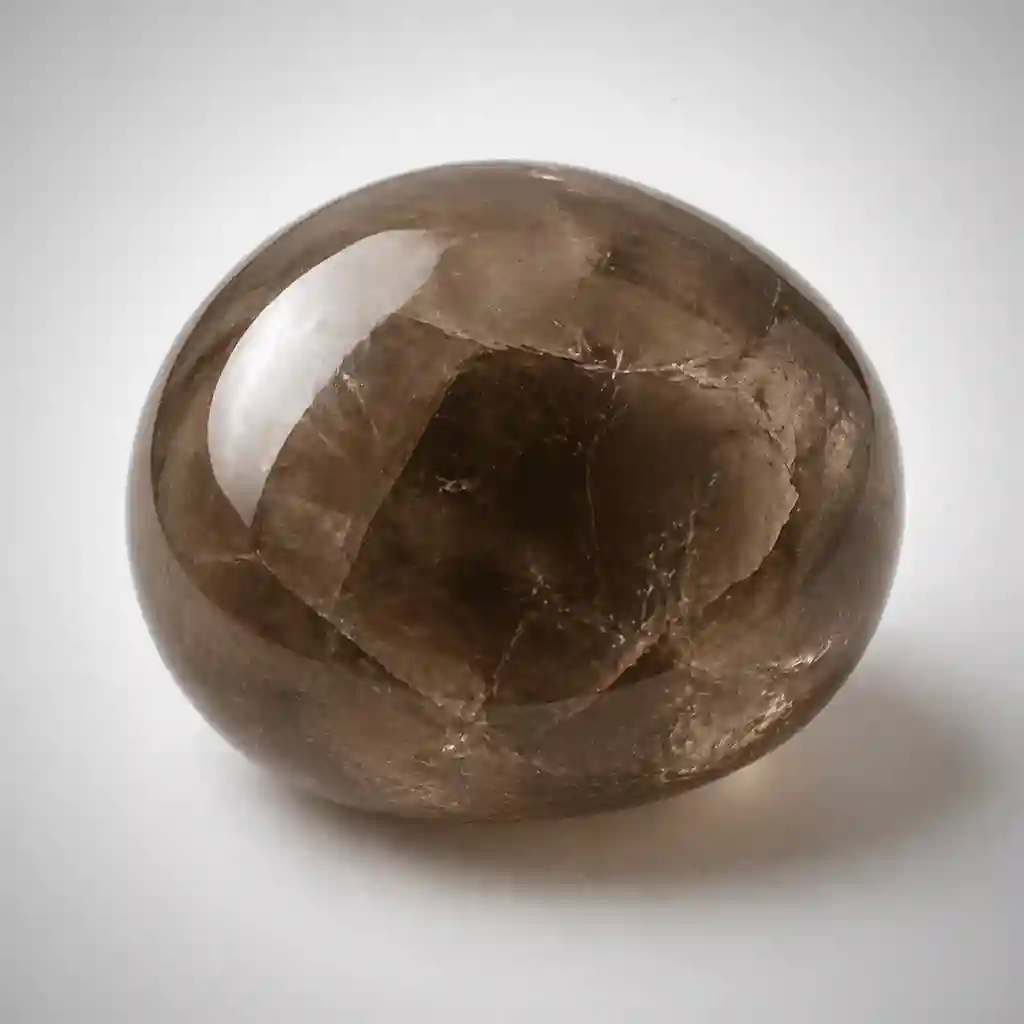
Smoky Quartz at a Glance
Smoky Quartz is a translucent brown grounding stone that transforms negative energy into something more useful while helping turn spiritual intentions into real, tangible results.
People dealing with chronic stress, shadow work practitioners, Capricorns and Sagittarians, and anyone who needs to stay grounded while doing spiritual or emotional work
“I am rooted in solid ground. I meet challenges directly and turn what is difficult into something I can work with.”
Rinse under cool running water; charge in moonlight overnight; smudge with sage or palo santo; bury in earth for deep cleansing
Smoky Quartz Quick Answers
What is Smoky Quartz good for?
Smoky Quartz is one of the best stones for grounding, protection, and stress relief. It connects you to the Earth's stabilizing energy, neutralizes negativity, promotes practical and clear thinking, and helps turn intentions into real results. It is especially useful for anxiety, fear, and emotional overwhelm. Smoky Quartz also supports detoxification on all levels and is considered one of the most effective stones at absorbing and transmuting negative energy into something more positive.
Is Smoky Quartz irradiated?
Natural Smoky Quartz gets its color from natural radiation in the Earth acting on aluminum impurities in the crystal over millions of years — this is completely safe. Some commercial Smoky Quartz is artificially irradiated (often from clear Quartz) to produce a darker color, which is also safe as the radiation does not remain in the stone. Both natural and treated Smoky Quartz are non-radioactive and completely safe to handle, wear, and use. If you want guaranteed natural Smoky Quartz, look for specimens from Scotland or Brazil.
What is the Meaning & History of Smoky Quartz?
Core Meaning
The Stone of Grounding and Manifestation — Smoky Quartz is one of the best grounding stones available. It connects you to the Earth's energy and creates a stable foundation for spiritual and practical work alike. It neutralizes negative vibrations gently, detoxifies on all levels, and encourages a pragmatic, clear-headed approach to life. The energy is protective without being heavy, and grounding without being restrictive. It helps you stay rooted in the physical world even while you are reaching for something more.
Historical & Cultural Significance
Smoky Quartz has been valued across cultures for its grounding and protective qualities. The ancient Celts and Druids treated it as a sacred earth stone and used it in their rituals. In Scotland, it has been the national gem for centuries, known as "cairngorm" after the Cairngorm Mountains. It was set into traditional Scottish dirks, sgian-dubhs, and kilt pins. The ancient Romans used Smoky Quartz to ease grief and calm the emotions. In Chinese culture, it was associated with the earth element and used to ground spiritual energy into action. During the Victorian era, it was popular in mourning jewelry because of its somber, elegant color.
Symbolism
- ✦Earth connection — the stabilizing bond between human awareness and the physical world
- ✦Transmutation — turning negative energy into positive force
- ✦Shadow integration — working with the darker parts of yourself without fear
- ✦Patience and persistence — the understanding that real change comes from steady effort
- ✦Protection without aggression — shielding that stays gentle and receptive
- ✦Ancestral wisdom — carrying the memory of earth processes spanning millions of years
Folklore & Legends
In the Scottish Highlands, Smoky Quartz was called "Stone of Power" and set into sword pommels to give warriors courage and protection in battle. Ancient Germans and Scandinavians associated it with their earth deities and used it in funeral rites to guide souls safely to the underworld. Some Native American traditions used brown and smoky stones in earth-healing ceremonies to restore balance to disrupted land. Victorian spiritualists brought Smoky Quartz into seances, believing its grounding energy helped spirits communicate more clearly.
Geological Profile
Formation Process
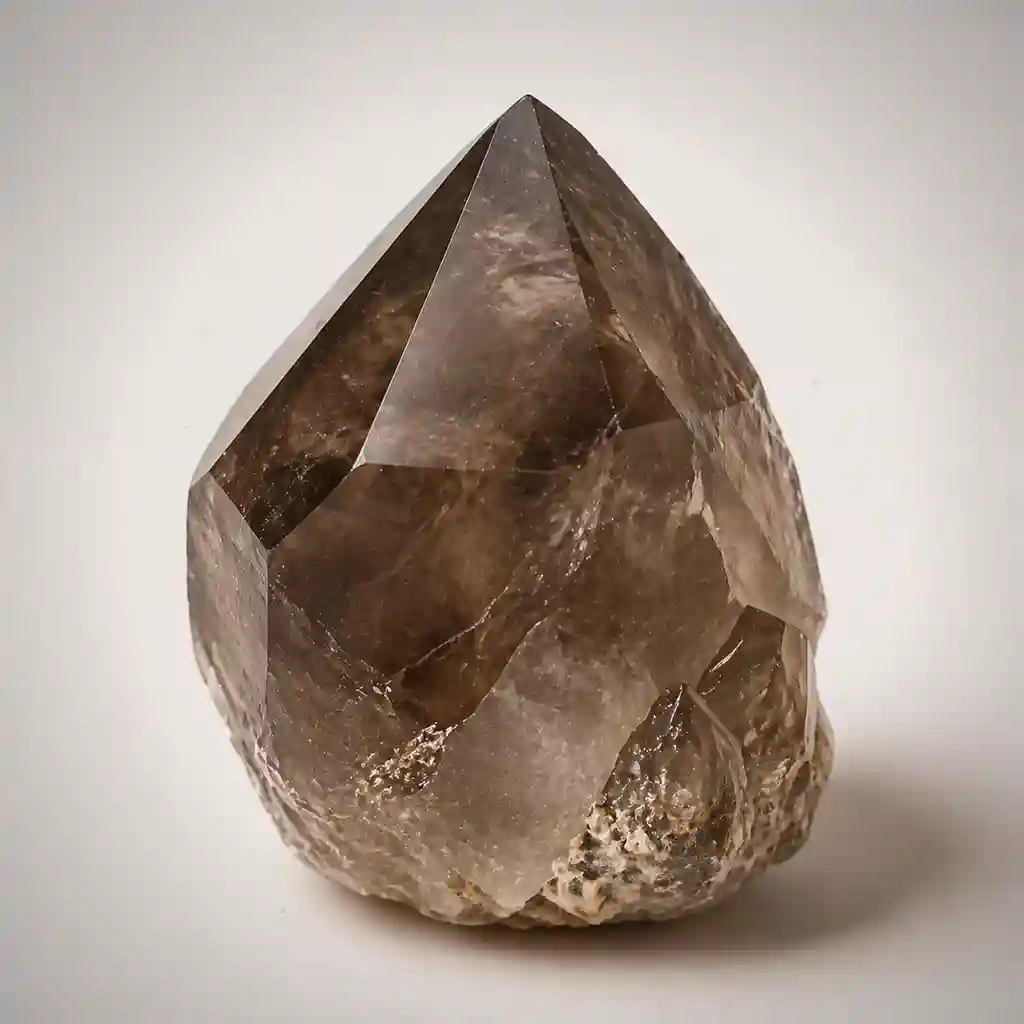
Smoky Quartz forms when natural radiation in the Earth, from radioactive minerals like uranium, thorium, and potassium-40 in the surrounding rock, interacts with aluminum impurities inside the Quartz crystal lattice. The radiation creates color centers: electrons get displaced from their normal positions and trapped near aluminum atoms, producing the characteristic smoky brown to grey color. The process takes millions of years. Most Smoky Quartz forms in igneous rocks (granite, pegmatites) and metamorphic rocks (gneiss, schist) where both Quartz and trace radioactive minerals are present. Some commercial Smoky Quartz is made by artificially irradiating pale Quartz to darken it.
Varieties
Cairngorm
The Scottish variety, named after the Cairngorm Mountains. Usually a warm yellowish-brown to dark brown. This is the historically prestigious variety and the national gem of Scotland.
Morion
A very dark, nearly opaque black variety. Prized for intense protective energy. The name goes back to the Latin "mormorion" and has been in use since Pliny the Elder's time.
Brandberg Smoky Quartz
A sought-after variety from the Brandberg Mountains of Namibia, often containing phantoms, enhydros (water bubbles), or other inclusions. Collectors consider it among the most energetically potent Smoky Quartz available.
Notable Origins
Scotland (Cairngorm Mountains)
The historic source of the finest Smoky Quartz. Cairngorm specimens are typically warm yellowish-brown with excellent clarity. Scottish material is considered the benchmark for natural Smoky Quartz and carries deep cultural significance.
Brazil (Minas Gerais)
The world's largest producer of Smoky Quartz, yielding specimens in a range of colors from light brown to nearly black. Brazilian material often forms large, well-formed crystals suitable for cutting and carving.
Switzerland (Alps)
Alpine Smoky Quartz is prized by collectors for its exceptional clarity and well-formed crystal shapes. Found in the spectacular alpine clefts of the Swiss Alps alongside Rutile and Adularia.
Mineral data verified via Mindat.org
Physical Properties
| Hardness | 7 on the Mohs scale |
| Chemical Formula | SiO₂ |
| Crystal System | Hexagonal (Trigonal) |
| Primary Color | Brown/Grey |
| Origin | Brazil, Madagascar, Scotland, Switzerland, United States |
| Transparency | Transparent to translucent |
| Luster | Vitreous |
| Specific Gravity | 2.65 |
What Are the Healing Properties of Smoky Quartz?
Emotional & Mental Well-being
Smoky Quartz is one of the best stones for emotional grounding and stress relief.
- ◆It absorbs and transmutes negative emotions, fear, anger, jealousy, resentment, into something more constructive.
- ◆The process is gentle and gradual, which makes it a good fit for people who are emotionally sensitive or easily overwhelmed.
- ◆It is particularly beneficial for anyone who has been through trauma, because it provides a safe, grounded container for processing difficult emotions without getting swallowed by them.
- ◆Smoky Quartz builds emotional resilience by showing you that pain can be transformed into strength.
- ◆It is especially helpful during grief, divorce, job loss, or other major life transitions, offering stability and calm when things are turbulent.
- ◆Many practitioners recommend it for people who dissociate or feel "unreal" under emotional stress, because its grounding energy reconnects you to your body and the present moment.
Spiritual Properties
In spiritual practice, Smoky Quartz is the go-to stone for grounding spiritual energy into physical form.
- ◆It is useful for anyone doing energy work, meditation, or any practice that expands consciousness, because it keeps that expanded awareness connected to the body and the Earth.
- ◆Smoky Quartz is particularly valued for shadow work, the process of exploring and integrating the rejected or hidden parts of yourself.
- ◆Its energy creates a safe, grounded space where you can confront difficult truths without losing your center.
- ◆The stone is also used to seal and protect the auric field after energy healing sessions, which helps prevent energy leakage and maintain the benefits of the work.
- ◆For people who tend toward "spiritual bypassing," using spiritual practices to avoid dealing with real emotional issues, Smoky Quartz brings things back down to earth and encourages a more honest, embodied approach.
Physical Healing Traditions
In crystal healing traditions, Smoky Quartz is associated with the lower body: the legs, hips, and lower back.
- ◆It is said to support the adrenal glands during chronic stress and help the body manage cortisol more effectively.
- ◆Practitioners recommend it for tension headaches, especially ones caused by jaw clenching or neck tension.
- ◆The stone is also traditionally linked to reproductive system support and easing menstrual cramps.
- ◆Its detoxifying energy is said to help the kidneys and assist the body in clearing toxins more efficiently.
Note: These properties are based on metaphysical traditions and are not a substitute for medical advice.
What Science Says
Smoky Quartz is well-characterized as a color variety of Quartz (SiO2) whose brown-to-grey color comes from color centers created by natural radiation interacting with aluminum impurities.
- ◆Both natural and artificially irradiated Smoky Quartz are non-radioactive and completely safe.
- ◆The radiation that created the color does not stay in the stone.
- ◆The color is stable under normal conditions but can fade if exposed to strong UV light for a long time.
- ◆Spectroscopic studies have confirmed the aluminum-based color center mechanism, and electron paramagnetic resonance (EPR) spectroscopy can tell the difference between natural and artificially irradiated specimens.
Which Chakras Does Smoky Quartz Connect To?
Which Zodiac Signs Match Smoky Quartz?
How Do You Use Smoky Quartz?
Meditation
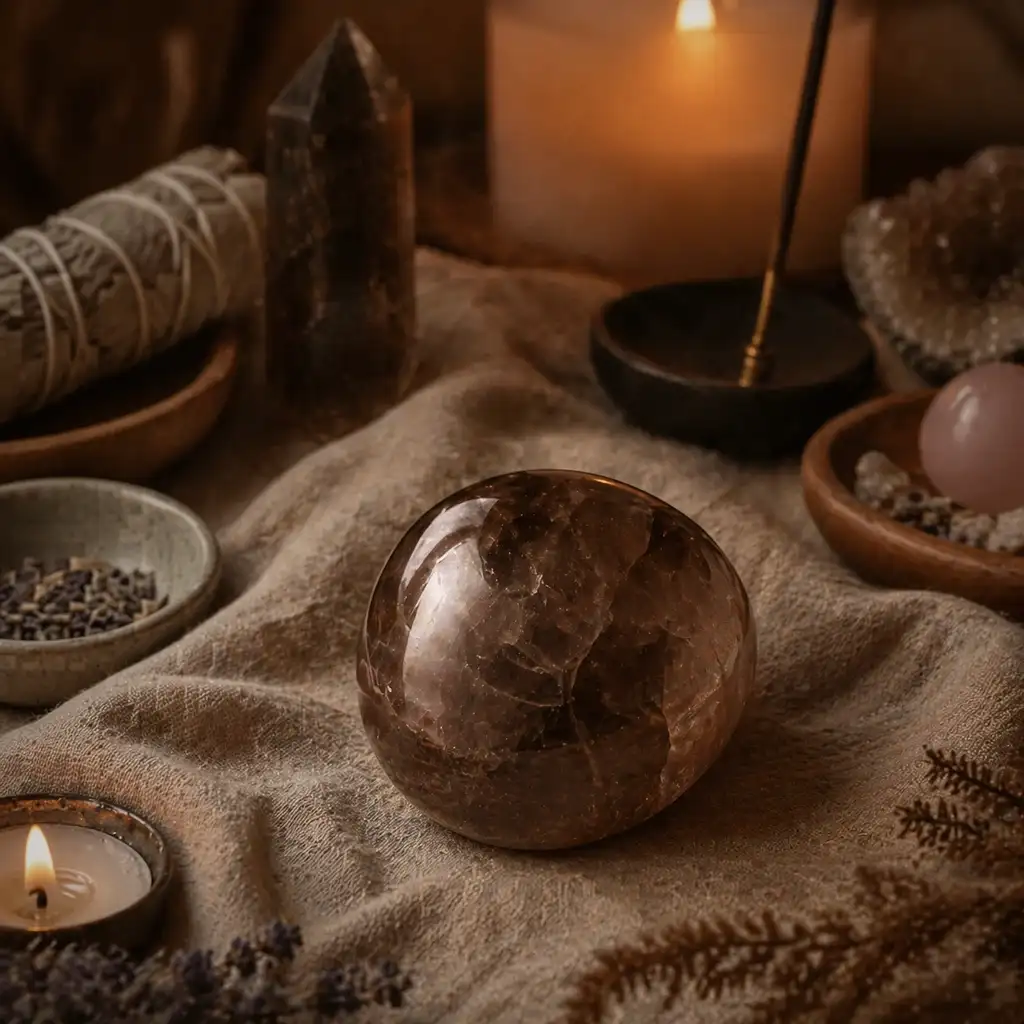
Hold Smoky Quartz in both hands or place it at your Root Chakra (base of the spine) during meditation. Visualize its warm brown energy flowing down through your body like tree roots, connecting you to the Earth's core. For a stress relief meditation, breathe into the stone and imagine it absorbing your tension and converting it into warm, grounding energy. This works best in direct contact with the earth, sitting on grass or bare ground.
Daily Wear
Wear Smoky Quartz as a pendant near the Solar Plexus or as a ring to stay grounded through the day. It is especially helpful in high-stress environments like offices, hospitals, or courtrooms, anywhere emotional composure matters. Bracelets work well as tactile grounding tools. Touch the stone when you feel anxious or scattered. The earthy brown color goes with most professional attire without standing out.
Home Placement
Put Smoky Quartz clusters in your workspace to absorb electromagnetic smog from computers and electronics and help you concentrate. Near the bed, it supports restful sleep and processes the day's accumulated stress overnight. Keep a piece near the entrance of your home to absorb negative energy before it comes in. For Feng Shui, the north (career) and northeast (knowledge) sectors are traditional placements.
Crystal Grids
Use Smoky Quartz as the center stone in a grounding or protection grid. Pair with Black Tourmaline for layered protection, Clear Quartz to amplify and clarify intentions, and Citrine for manifestation. For a shadow work grid, surround Smoky Quartz with Labradorite for transformation and Amethyst for spiritual protection, creating a safe container for deep inner work.
How Do You Cleanse & Charge Smoky Quartz?
Running Water
RecommendedMoonlight Bathing
RecommendedSmudging
RecommendedEarth Burial
RecommendedMoon Phase Charging: Charge Smoky Quartz in moonlight overnight for a gentle recharge. The full moon is best for releasing absorbed negative energy, while the new moon works well for setting fresh grounding intentions. Earth burial is the strongest cleansing method for Smoky Quartz. Bury it in soil for 24 hours to fully discharge whatever it has accumulated.
Avoid the following:
- ✗Prolonged direct sunlight — can fade the smoky color over time, especially in lighter specimens
- ✗Salt water — while Quartz is hard enough to tolerate brief salt exposure, prolonged soaking in salt water can dull the surface
- ✗Harsh chemical cleaners — can damage the surface polish
- ✗Ultrasonic cleaners — generally safe for Smoky Quartz but avoid if the specimen has internal fractures or inclusions
- ✗Boiling water — thermal shock can crack the stone, especially if it has internal inclusions
What Crystals Pair Well with Smoky Quartz?
Best Combinations
Clear Quartz
Clear Quartz amplifies Smoky Quartz's grounding energy and adds clarity of intention, making a strong manifestation pair for turning ideas into reality
Black Tourmaline
Black Tourmaline actively repels negativity while Smoky Quartz absorbs and transmutes it, giving you energetic protection from both external and internal sources
Citrine
Citrine's warm, abundant energy lightens Smoky Quartz's seriousness, balancing earth-level grounding with optimism and wealth attraction
If You Like Smoky Quartz, Also Try
How Can You Tell if Smoky Quartz is Real or Fake?
Common Imitations
Identification Tests
1.UV Light Fade Test
Place the specimen in strong, direct UV light (a UV lamp or intense sunlight) for 24-48 hours.
Artificially irradiated Smoky Quartz often fades noticeably or completely under UV exposure, while natural Smoky Quartz is more color-stable. Note: this test is slow and may not fully distinguish all treated stones.
2.Temperature Test
Hold the specimen against your cheek or inner wrist and note how quickly it reaches skin temperature.
Genuine Quartz (high thermal conductivity) feels distinctly cool and takes several seconds to warm. Glass imitations warm up much faster. This test distinguishes natural Quartz from glass, but not natural from treated Quartz.
3.Inclusion Examination
Examine the specimen under 10x magnification with a jeweler's loupe.
Natural Smoky Quartz often contains characteristic inclusions: tiny fractures, fluid inclusions, rutile needles, or growth lines. Glass imitations are typically perfectly clean or contain round bubbles. However, natural and irradiated Quartz can both have these inclusions.
Price Reference
Small
$5-20
Medium
$20-60
Large
$60-300
Smoky Quartz is generally affordable. Prices increase significantly for specimens with exceptional clarity, large crystal formations, or specific origins (Scottish Cairngorm commands premium pricing). Brandberg specimens with phantoms or enhydros are collector pieces.
Is Smoky Quartz Safe? Care & Precautions
Toxicity Warning
Smoky Quartz is non-toxic and safe for all standard crystal healing practices, including handling, wearing, and elixir preparation.
Storage
Store Smoky Quartz away from prolonged direct sunlight to prevent color fading, especially for lighter specimens. It can be stored safely with other Quartz varieties (hardness 7). Keep separated from harder stones (topaz, sapphire, diamond) to prevent scratching of those stones.
Special Warnings
- ⚠Prolonged UV exposure can cause the smoky color to fade — store away from direct sunlight if color preservation is important
- ⚠While both natural and artificially irradiated Smoky Quartz are non-radioactive, some sellers misrepresent the treatment status of their stones
- ⚠Very dark "Morion" specimens should be verified as natural Quartz rather than dyed glass or other materials
What is Smoky Quartz Best For?
Smoky Quartz FAQ — Common Questions Answered
What is Smoky Quartz good for?+
Smoky Quartz is one of the best stones for grounding, protection, and stress relief. It connects you to the Earth's stabilizing energy, neutralizes negativity, promotes practical and clear thinking, and helps turn intentions into real results. It is especially useful for anxiety, fear, and emotional overwhelm. Smoky Quartz also supports detoxification on all levels and is considered one of the most effective stones at absorbing and transmuting negative energy into something more positive.
Is Smoky Quartz irradiated?+
Natural Smoky Quartz gets its color from natural radiation in the Earth acting on aluminum impurities in the crystal over millions of years — this is completely safe. Some commercial Smoky Quartz is artificially irradiated (often from clear Quartz) to produce a darker color, which is also safe as the radiation does not remain in the stone. Both natural and treated Smoky Quartz are non-radioactive and completely safe to handle, wear, and use. If you want guaranteed natural Smoky Quartz, look for specimens from Scotland or Brazil.
How does Smoky Quartz differ from Black Tourmaline?+
Both are strong grounding and protective Root Chakra stones, but they work differently. Black Tourmaline is denser and more actively deflective. It repels negativity like a shield. Smoky Quartz is gentler and more about transmutation. It absorbs negativity and converts it into positive energy rather than pushing it away. Black Tourmaline is the better choice for acute protection in hostile environments. Smoky Quartz is better for ongoing grounding, stress relief, and emotional processing. They work well together.
How does Smoky Quartz ground Capricorn through the Root Chakra?+
Smoky Quartz works primarily through the Root Chakra, where its anchoring energy connects you to the Earth's stable, supportive frequency. Capricorn is an ambitious, pragmatic earth sign, and this is a birthstone for them because that grounding energy is a natural fit. It supports their steady, disciplined climb with a stable energetic foundation, and it helps transform stress and negativity into productive focus rather than burnout.
Where does Smoky Quartz come from and is it natural?+
Natural Smoky Quartz gets its distinctive brown-to-grey color from natural radiation acting on aluminum impurities within the quartz crystal over millions of years. Major deposits are found in Brazil (the largest commercial source), Madagascar, Scotland (where it is the national gem), Switzerland, and the United States. Some commercially sold Smoky Quartz is artificially irradiated clear Quartz, which produces a darker but still safe stone. Genuine natural Smoky Quartz from Scotland or the Swiss Alps is especially prized by collectors. The stone is quite affordable and widely available in both natural and treated forms.
Was this helpful?