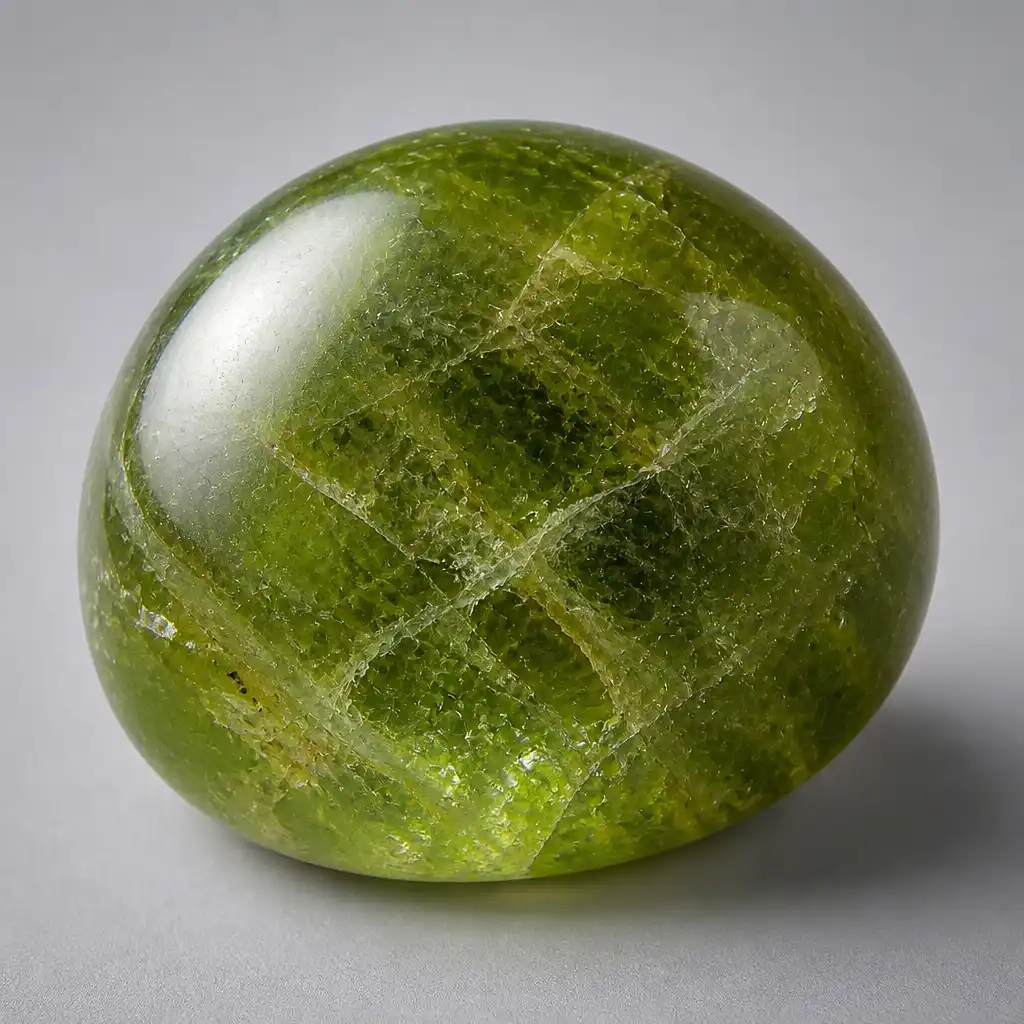
Vesuvianite at a Glance
Vesuvianite is the stone of will and desire — a volcanic crystal that aligns what your heart wants with the willpower to make it happen, empowering courage, creativity, and personal sovereignty.
Those who know what they want but struggle to act on it, creative professionals needing inspiration and drive, and anyone reclaiming personal sovereignty after periods of self-doubt
“I honor my heart's deepest desires and have the courage and willpower to bring them into reality.”
Cleanse with moonlight or sage smoke; avoid prolonged water exposure; store separately from harder stones
Vesuvianite Quick Answers
What is Vesuvianite good for?
Vesuvianite is best known for aligning the heart's desires with the willpower to pursue them. It bridges the Heart and Solar Plexus Chakras, making it valuable for anyone who struggles to turn emotional truth into concrete action. It supports courage, creativity, confidence, and the manifestation of goals that come from genuine desire rather than external pressure.
Is Vesuvianite the same as Idocrase?
Yes, Vesuvianite and Idocrase are two names for the same mineral species. "Vesuvianite" refers to the stone's discovery at Mount Vesuvius, while "Idocrase" is an older name derived from Greek words meaning "mixed form," reflecting the mineral's variable crystal habits. Both names are used interchangeably in mineralogy and crystal healing, though "Vesuvianite" has become the more commonly used name in recent decades.
What is the Meaning & History of Vesuvianite?
Core Meaning
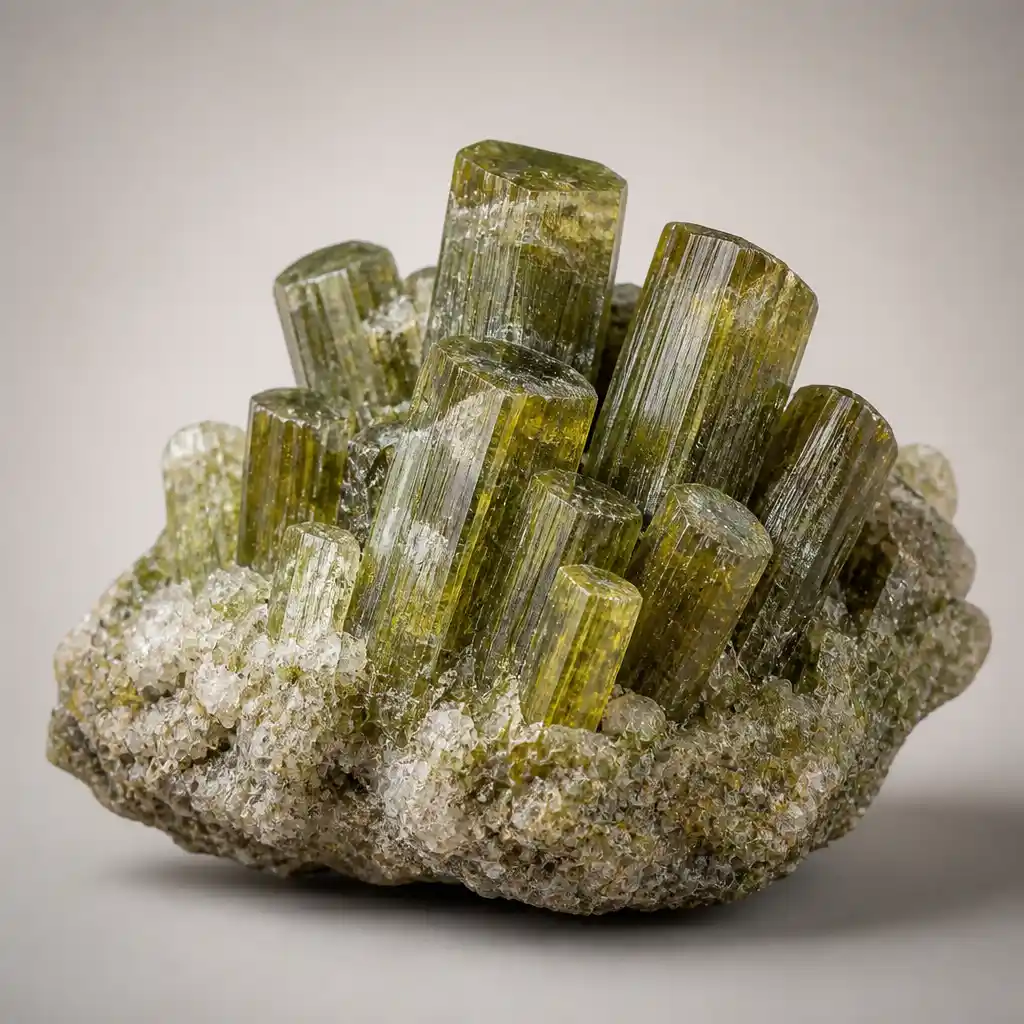
The Stone of Will and Desire — Vesuvianite's core energy centers on the alignment of desire and will. Where many crystals work primarily with either the emotional or the action-oriented aspects of the self, Vesuvianite bridges both, creating a channel between the Heart and Solar Plexus Chakras that allows genuine feeling to flow directly into purposeful action — a stone of personal sovereignty — the state of being fully aligned with your own truth and acting from that place consistently. When your heart and will are in agreement, manifestation becomes less forced and more natural, courage becomes less about overcoming fear and more about being grounded in what you genuinely want.
Historical & Cultural Significance
Vesuvianite was first identified in 1795 by the German mineralogist Abraham Gottlob Werner, who named it after Mount Vesuvius where it was discovered embedded in volcanic limestone blocks ejected during eruptions. The volcano's fame from the destruction of Pompeii and Herculaneum made the name evocative and memorable. The alternative name "Idocrase" was proposed earlier by Rene Just Hauy, one of the founders of crystallography, based on the mineral's mixed and variable crystal forms. Significant deposits have since been found in Canada, the United States, Switzerland, Russia, and Kenya. The rare blue variety known as "cyprine" was first described from deposits in Norway and remains highly prized by collectors.
Symbolism
- ✦Volcanic creation — born from destruction, representing transformation and rebirth
- ✦Heart-will alignment — the union of desire and action, feeling and doing
- ✦Personal sovereignty — the state of being governed by one's own authentic truth
- ✦Courage and confidence — the fire element within the stone fuels bold self-expression
- ✦Creativity unlocked — earth energy provides the structure while fire energy provides the spark
- ✦Emotional release — the volcanic origin symbolizes pressure released in constructive ways
Folklore & Legends
While Vesuvianite does not have the ancient mythological associations of stones like lapis lazuli or emerald, its volcanic origin has given it a powerful symbolic connection to transformation and creation emerging from destruction. In Italian folk traditions near Mount Vesuvius, stones found in volcanic deposits were sometimes carried as talismans of resilience — proof that something beautiful could come from catastrophe. The people living in the shadow of Vesuvius understood destruction and renewal intimately, and stones crystallized from volcanic activity held a special significance as physical evidence of nature's capacity to create even in the most extreme conditions. Modern crystal lore points to this volcanic birth story as the source of the stone's transformative energy.
Geological Profile
Formation Process
Vesuvianite forms primarily in contact metamorphic and metasomatic environments, where hot, silica-rich fluids interact with calcium-rich rocks such as limestone and dolomite. When magma intrudes near carbonate rock formations, the intense heat and chemically active fluids cause recrystallization, producing skarn deposits where Vesuvianite commonly occurs alongside garnet, diopside, epidote, and wollastonite. The mineral crystallizes in the tetragonal system, typically forming prismatic crystals with pyramidal terminations, though massive and columnar habits are also common. The various colors result from trace element substitutions in the crystal lattice: chromium and iron produce green, titanium and manganese can produce brown or yellow, and copper is responsible for the rare blue variety.
Varieties
Green Vesuvianite
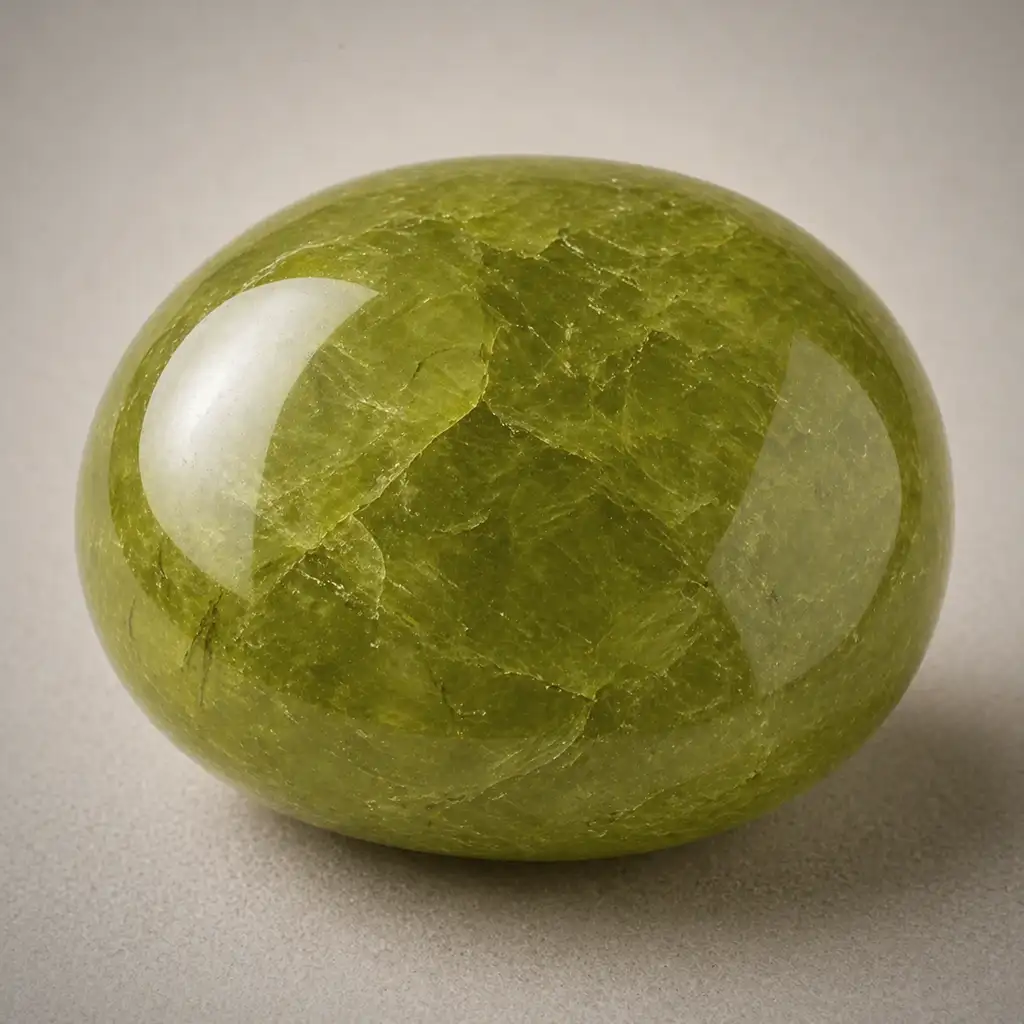
The most common and widely available variety, ranging from pale yellow-green to deep forest green. The green color comes from iron and chromium content. This is the variety most commonly used in crystal healing practice.
Cyprine (Blue Vesuvianite)
A rare blue to violet-blue variety colored by trace amounts of copper. First described from Norway, cyprine is highly sought after by mineral collectors and commands premium prices. The blue color can range from pale lavender to deep sapphire blue.
Californite
A massive, compact variety of Vesuvianite found in California that resembles jade. It is typically green with white or yellowish veining and has been used as a jade substitute in carvings and ornamental objects. Despite its jade-like appearance, it is distinctly Vesuvianite in composition.
Notable Origins
Italy (Mount Vesuvius region)
The type locality, producing the original specimens that defined the species. Italian material occurs in volcanic limestone blocks ejected during eruptions, often as well-formed prismatic crystals with pyramidal terminations. Colors range from green to brown.
Canada (Quebec and Ontario)
Canadian deposits produce fine crystalline specimens, particularly from the asbestos mines of Quebec where Vesuvianite occurs in skarn deposits. The material ranges from green to brown and can form attractive, well-terminated crystals suitable for collectors.
Kenya
Kenyan deposits produce transparent to translucent green material that is sometimes faceted for gemstone use. This material is notable for its clarity and vibrant color, making it suitable for both mineral specimens and lapidary work.
Mineral data verified via Mindat.org
Physical Properties
| Hardness | 6.5 on the Mohs scale |
| Chemical Formula | Ca₁₀Mg₂Al₄(SiO₄)₄(Si₂O⁷)₂(OH)₄ |
| Crystal System | Tetragonal |
| Primary Color | Green/Yellow/Brown/Blue |
| Origin | Italy, Canada, USA, Switzerland, Russia, Kenya |
| Transparency | Transparent to translucent |
| Luster | Vitreous to resinous |
| Specific Gravity | 3.32-3.43 |
What Are the Healing Properties of Vesuvianite?
Emotional & Mental Well-being
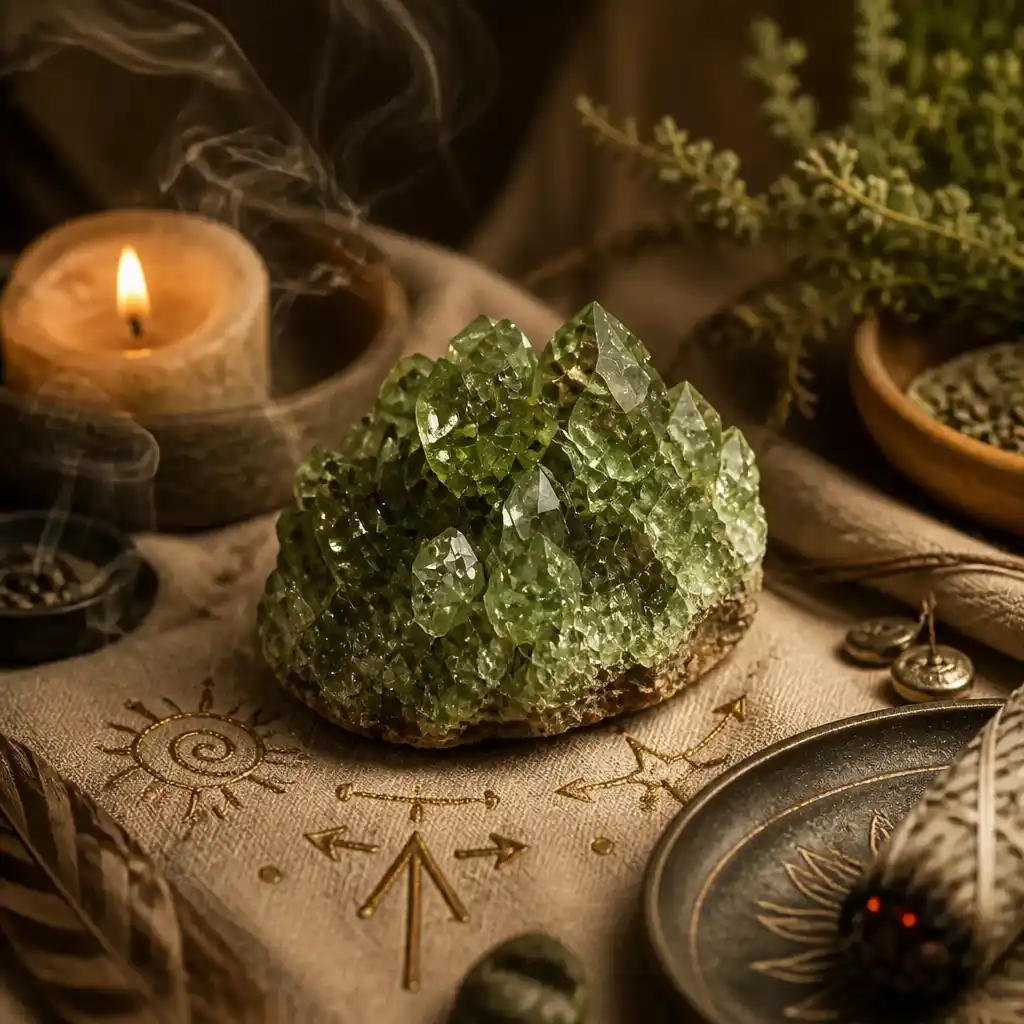
Vesuvianite shines as an ally for emotional release and heart-centered courage.
- ◆It has a knack for surfacing emotions you've pushed down, especially the ones tied to desires you've ignored or situations where you've betrayed your own feelings to keep the peace.
- ◆But it doesn't do this harshly — more like a trusted friend who looks you in the eye and tells you the truth.
- ◆The stone stands out for anyone who has spent years putting everyone else first, gently but firmly turning your attention back to what your own heart has been trying to say.
- ◆What sets it apart is the Solar Plexus activation: this isn't just about feeling your feelings, it's about turning those emotional insights into real changes in how you show up and where you draw lines.
Spiritual Properties
Spiritually, Vesuvianite bridges the gap between receiving guidance and actually acting on it.
- ◆The Heart Chakra opening lets intuitive wisdom flow in, while the Solar Plexus activation gives you the confidence and drive to bring that wisdom into the real world.
- ◆If you've ever gotten crystal-clear insight during meditation only to lose it the moment you open your eyes, Vesuvianite is built for exactly that problem.
- ◆Its volcanic roots also link it to the cycle of destruction and rebirth — useful for spiritual work around letting go of old identities and stepping into new ones.
Physical Healing Traditions
In traditional crystal healing, Vesuvianite is associated with supporting the digestive system, particularly the stomach and intestines, which aligns with its Solar Plexus Chakra connection.
- ◆Some practitioners also recommend it for supporting the heart and circulatory system, reflecting its Heart Chakra affinity.
- ◆The stone is linked to healthy absorption of nutrients and the efficient processing of both physical and energetic nourishment.
- ◆These are traditional correspondences, not medical advice.
- ◆Consult a healthcare professional for any health concerns.
Note: These properties are based on metaphysical traditions and are not a substitute for medical advice.
What Science Says
Vesuvianite is a well-characterized sorosilicate mineral with a complex chemical formula.
- ◆Its crystal structure has been thoroughly studied using X-ray diffraction, confirming its tetragonal symmetry and complex unit cell containing multiple silicate groups.
- ◆The various colors are well understood as resulting from trace element substitutions: iron and chromium for green, manganese for yellow and brown, and copper for the rare blue variety.
- ◆The mineral's occurrence in contact metamorphic environments is consistent with its geochemical formation requirements.
- ◆As with all crystals, the metaphysical properties attributed to Vesuvianite come from crystal healing tradition and lack controlled scientific validation.
Which Chakras Does Vesuvianite Connect To?
Which Zodiac Signs Match Vesuvianite?
Sagittarius
recommended
Supports Sagittarius's adventurous spirit with heart-centered courage and the willpower to turn expansive vision into tangible action
Capricorn
recommended
Enhances Capricorn's natural discipline with emotional alignment, ensuring ambition is driven by genuine heart desire rather than obligation
How Do You Use Vesuvianite?
Meditation
Hold Vesuvianite in your receiving hand or place it over your Heart Chakra during meditation. Begin by breathing into the heart space and noticing what feelings and desires arise without judgment. Once you have a clear sense of what your heart is calling for, move the stone to your Solar Plexus and visualize energy building there — the willpower and confidence to pursue what your heart revealed. This two-stage meditation mirrors the stone's dual chakra activation and is most effective when practiced regularly.
Daily Wear
Wear Vesuvianite as a pendant that rests between the heart and solar plexus to maintain alignment between your desires and your willpower throughout the day. For those in leadership or creative roles, wearing it as a ring on the index finger (associated with Jupiter and authority) can support confident, heart-aligned decision making. Carry a tumbled stone in your pocket for meetings or conversations where you need to speak your truth with courage and clarity.
Home Placement
Place Vesuvianite in your workspace to support creative thinking and confident action. In the center of your home or living space, it can help align the household's collective energy toward shared goals. For Feng Shui applications, the south area (fame and reputation) or the center (health and harmony) are ideal placements that leverage the stone's fire and earth element energies respectively.
Crystal Grids
Use Vesuvianite as a bridge stone in grids that involve both Heart and Solar Plexus intentions — for example, a grid for manifesting a career that you are genuinely passionate about. Place it between a Heart Chakra stone like Rose Quartz and a Solar Plexus stone like Citrine to create a pathway for desire to flow into action. You can also use it as the center stone in a courage or confidence grid.
How Do You Cleanse & Charge Vesuvianite?
Moonlight Bathing
RecommendedSmudging
RecommendedSound Healing
RecommendedEarth Burial
Brief contact only; prolonged burial may dull polished surfaces
Use CautionMoon Phase Charging: Charge Vesuvianite under the full moon to clear accumulated energy and restore its natural vibration. Place it on a windowsill or outside in direct moonlight overnight. The waxing moon phase is particularly aligned with Vesuvianite's manifestation properties, as the growing lunar energy mirrors the building momentum of desire aligned with action.
Avoid the following:
- ✗Prolonged salt water immersion — salt can be abrasive to polished surfaces over time
- ✗Harsh chemical cleaners — ammonia and bleach can damage the surface luster
- ✗Ultrasonic cleaners — while generally safe for Vesuvianite, avoid them if the specimen has internal fractures or inclusions
- ✗Boiling water or steam cleaning — sudden temperature changes may stress the crystal
What Crystals Pair Well with Vesuvianite?
Best Combinations
Citrine
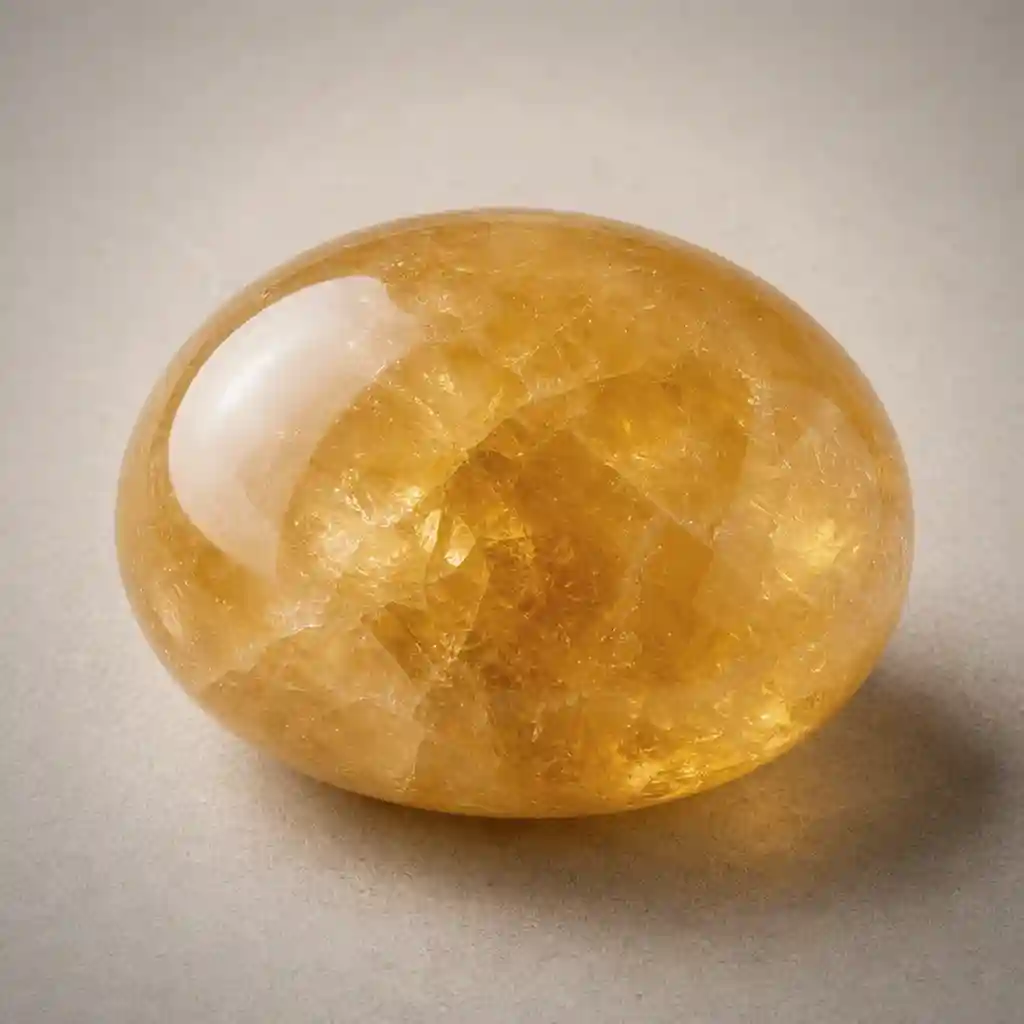
Citrine amplifies Vesuvianite's Solar Plexus activation with its own solar energy, creating a powerful combination for confidence, manifestation, and turning creative ideas into tangible results.
Rose Quartz
Rose Quartz softens Vesuvianite's intensity with gentle, unconditional love energy, creating balance between bold action and compassionate self-acceptance in heart-centered work.
Carnelian
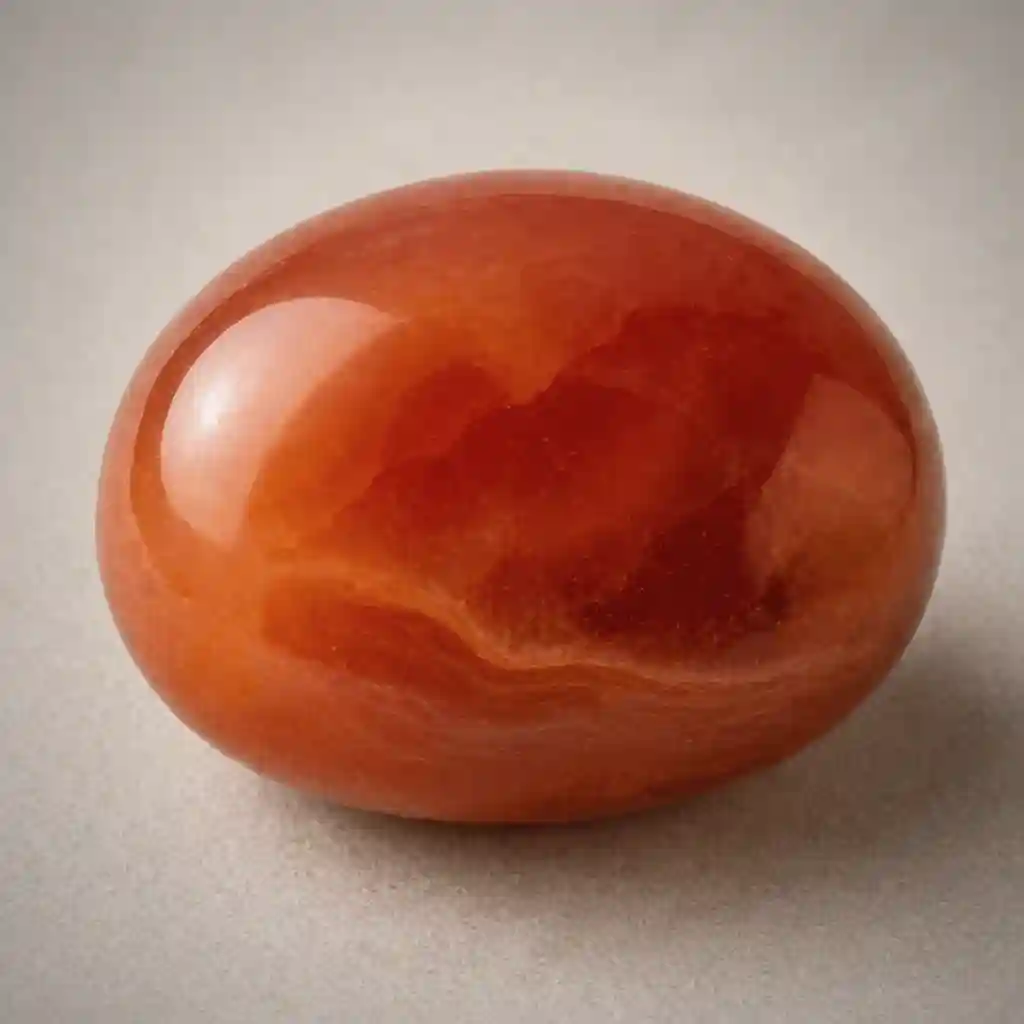
Carnelian's fiery creative energy synergizes with Vesuvianite's courage and willpower, making this an excellent pairing for creative professionals and anyone needing a motivational boost.
Clear Quartz
Clear Quartz amplifies Vesuvianite's heart-will alignment and can be programmed to focus the combined energy on specific manifestation goals.
If You Like Vesuvianite, Also Try
How Can You Tell if Vesuvianite is Real or Fake?
Common Imitations
Identification Tests
1.Hardness Test
Test the specimen against reference materials of known hardness. Try scratching glass and being scratched by a steel file.
Vesuvianite has a hardness of 6-7 on the Mohs scale, meaning it can scratch glass but will be scratched by quartz. Epidote (6-7) has similar hardness, so this test alone is not definitive but can rule out softer imitations like glass (5-5.5) and dyed calcite (3).
2.Refractive Index Test
Use a standard gemological refractometer to measure the specimen's refractive index.
Vesuvianite has a refractive index of 1.700-1.752 with birefringence of 0.001-0.008. This is distinct from epidote (1.715-1.797 with higher birefringence), green tourmaline (1.616-1.634), and glass (1.50-1.55). The low birefringence is a key distinguishing characteristic.
3.Visual Examination Under Magnification
Examine the specimen under 10x magnification, looking at crystal structure, inclusions, and color zoning.
Genuine Vesuvianite often shows natural color zoning, characteristic crystal habit (prismatic with pyramidal terminations), and natural inclusions. Dyed stones will show color concentrated in surface fractures and along grain boundaries. Glass imitations lack natural crystal structure and may contain spherical bubbles.
Price Reference
Small
$5-25
Medium
$25-80
Large
$80-300
Vesuvianite is generally affordable and widely available. The rare blue cyprine variety commands significantly higher prices. Faceted gem-quality material is more expensive than rough or tumbled specimens. Californite carved pieces are moderately priced and make attractive display specimens.
Is Vesuvianite Safe? Care & Precautions
Toxicity Warning
Vesuvianite is non-toxic and safe for normal handling, skin contact, and display. It is chemically stable under normal conditions and does not pose health risks through casual contact.
Storage
Store Vesuvianite separately from harder minerals to prevent scratching. While it has moderate hardness (6-7), it can be scratched by quartz, topaz, and corundum. A soft pouch or lined compartment is adequate for most specimens.
What is Vesuvianite Best For?
Vesuvianite FAQ — Common Questions Answered
What is Vesuvianite good for?+
Vesuvianite is best known for aligning the heart's desires with the willpower to pursue them. It bridges the Heart and Solar Plexus Chakras, making it valuable for anyone who struggles to turn emotional truth into concrete action. It supports courage, creativity, confidence, and the manifestation of goals that come from genuine desire rather than external pressure.
Is Vesuvianite the same as Idocrase?+
Yes, Vesuvianite and Idocrase are two names for the same mineral species. "Vesuvianite" refers to the stone's discovery at Mount Vesuvius, while "Idocrase" is an older name derived from Greek words meaning "mixed form," reflecting the mineral's variable crystal habits. Both names are used interchangeably in mineralogy and crystal healing, though "Vesuvianite" has become the more commonly used name in recent decades.
What chakras does Vesuvianite work with?+
Vesuvianite primarily activates the Heart Chakra and secondarily the Solar Plexus Chakra. This dual activation is central to the stone's metaphysical reputation — the Heart Chakra connection ensures you know what you truly want and feel, while the Solar Plexus activation gives you the willpower, confidence, and drive to act on those feelings. Some practitioners also use it with the Root Chakra for grounding during transformation.
How can I tell real Vesuvianite from imitations?+
Genuine Vesuvianite has a characteristic vitreous to resinous luster and a hardness of 6-7 on the Mohs scale, meaning it can scratch glass but not quartz. Its colors are natural and often show zoning or gradients within a single crystal. Common green imitations include dyed quartz or glass, which will have different refractive indices and lack the natural crystal structure visible under magnification. A qualified gemologist can distinguish Vesuvianite from similar-looking minerals like epidote or diopside using standard gemological testing.
Can Vesuvianite help with manifestation?+
Yes, Vesuvianite is considered an effective manifestation stone specifically because it bridges desire and action. Many manifestation stones focus on intention-setting or visioning, but Vesuvianite's unique Heart-Solar Plexus connection ensures that your manifestation work is both emotionally authentic and energetically charged with the willpower to follow through. For best results, use it during meditation while clearly visualizing your goal, then carry it with you as a reminder to take concrete steps toward that vision.
Was this helpful?