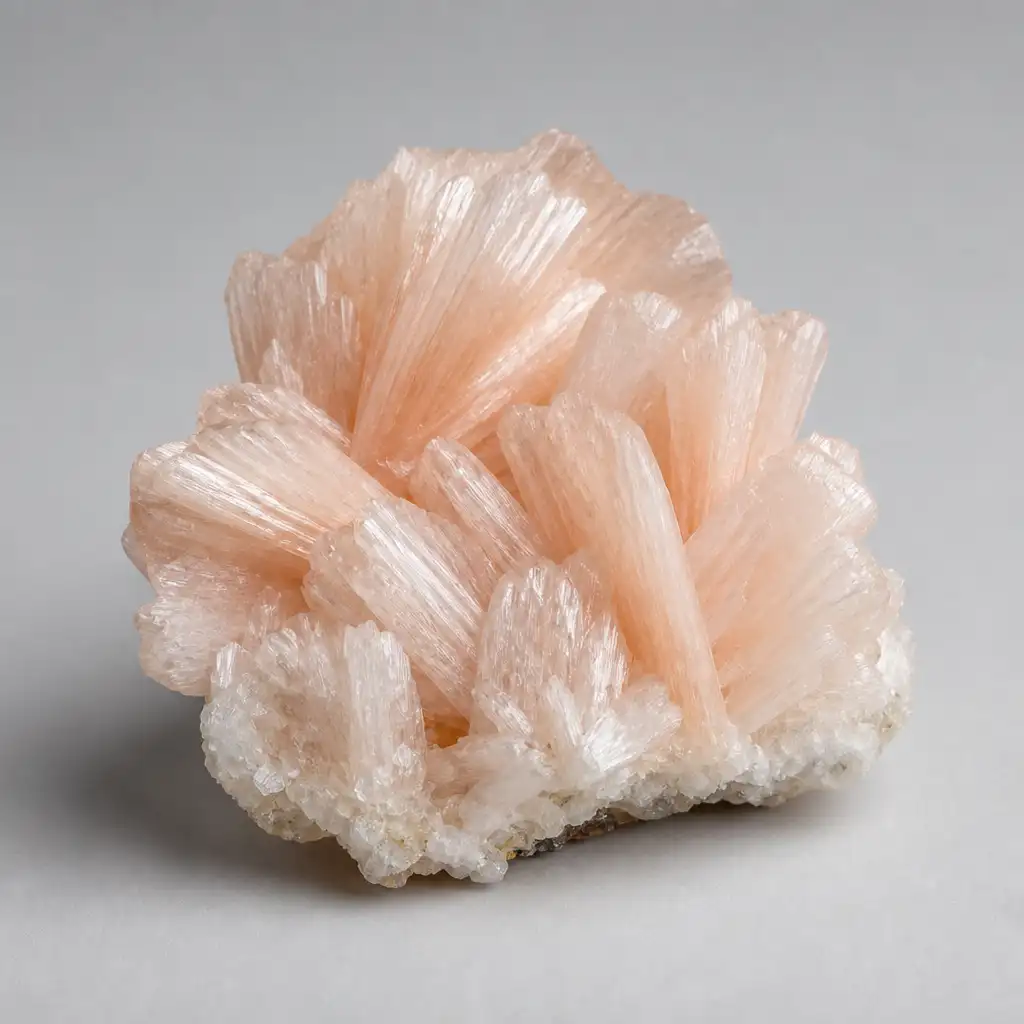
Stilbite at a Glance
Stilbite is the Stone of Inner Peace — a gentle, luminous zeolite crystal that calms the mind, soothes the heart, and opens the door to restful sleep, creative dreams, and quiet spiritual connection.
Those struggling with anxiety, insomnia, or racing thoughts; creative practitioners seeking to enhance visualization; anyone who needs gentle, non-overwhelming crystal energy
“I am at peace within myself. My mind is calm, my heart is open, and I rest in the gentle stillness of my own being.”
Charge under moonlight; cleanse with sage or sound; keep completely dry — this is a delicate, water-sensitive stone requiring careful handling
Stilbite Quick Answers
What is Stilbite good for?
Stilbite is excellent for promoting deep inner peace, emotional tranquility, and restful sleep. It calms anxiety and racing thoughts, enhances creative visualization, and supports lucid dreaming. Its gentle energy makes it ideal for those who find stronger stones overwhelming and for anyone seeking to establish a peaceful, meditative atmosphere. It is also valued for heart-centered healing and for connecting with spiritual guidance through gentle, receptive states of awareness.
How do I cleanse Stilbite?
Stilbite is a soft zeolite mineral and must be cleansed very gently. Moonlight bathing is the ideal method — place it in direct moonlight overnight during the full moon. Smudging with sage or palo santo and sound healing with singing bowls are also safe and effective. Avoid all water exposure (Stilbite can be damaged by moisture), salt, chemical cleaners, ultrasonic cleaners, and any abrasive treatment. Handle with care as it is relatively fragile.
What is the Meaning & History of Stilbite?
Core Meaning
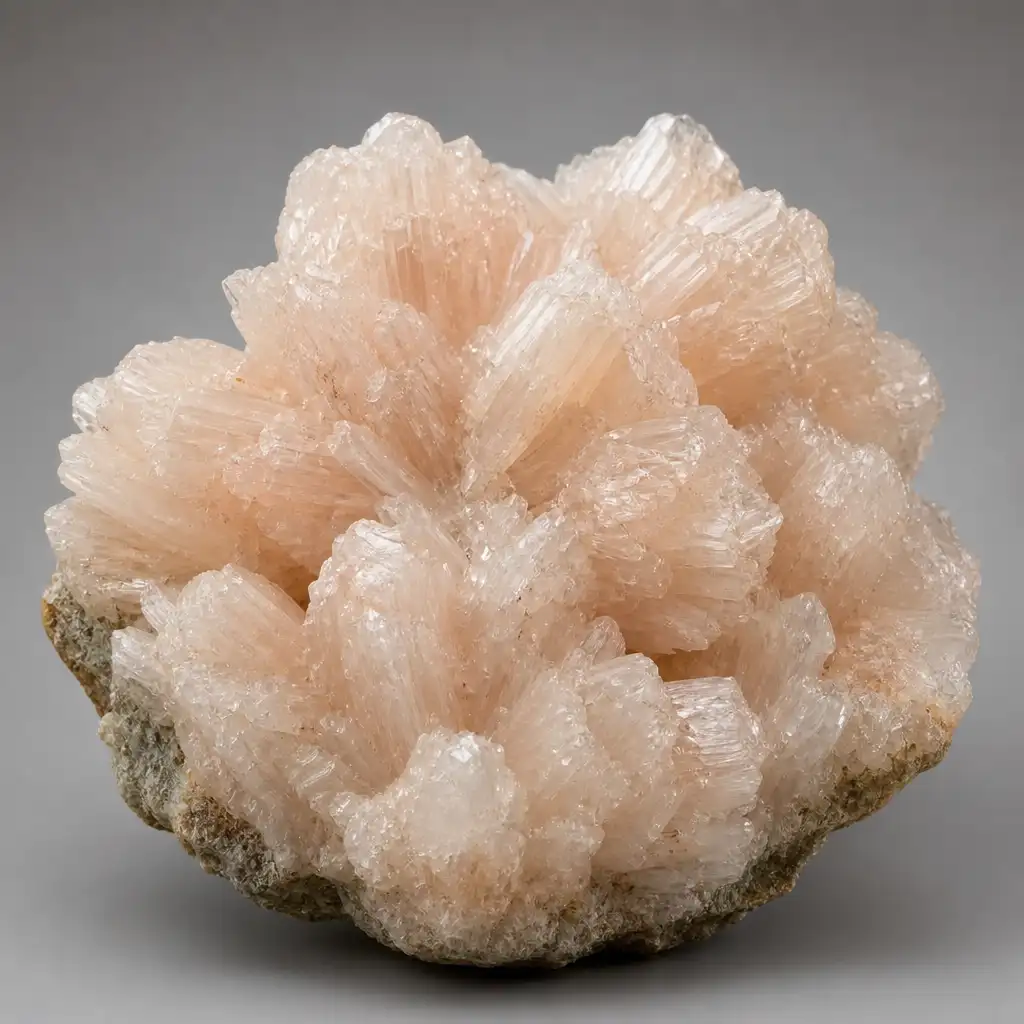
The Stone of Inner Peace — Stilbite embodies the quality of gentle, pervasive peace — not the dramatic, transformative peace of stones that shatter old patterns, but the quiet, nourishing peace that comes from feeling fundamentally safe, accepted, and at home in oneself. Its energy is maternal and tender, wrapping the aura in a soft, protective cocoon that buffers against the harshness and noise of the external world. Stilbite teaches that true peace is not the absence of turmoil but the presence of a deep inner stillness that remains undisturbed regardless of outer circumstances. Its connection to both the Heart and Crown Chakras creates a bridge between emotional warmth and spiritual transcendence, facilitating a state where love and awareness are seamlessly integrated. The stone's zeolite structure — porous, absorbent, and naturally purifying — mirrors its metaphysical function of absorbing negativity and releasing calm, making it an excellent environmental cleanser as well as a personal healing stone.
Historical & Cultural Significance
Stilbite was first described scientifically in 1756 by the Swedish mineralogist Axel Fredrik Cronstedt, who also coined the term "zeolite" (from the Greek "zeo" meaning to boil and "lithos" meaning stone) after observing that these minerals appeared to boil when heated with a blowpipe due to their high water content. The name "Stilbite" comes from the Greek "stilbe" meaning "to shine" or "luster," referring to the mineral's distinctive pearly to vitreous sheen. The mineral has been collected and admired for its attractive crystal formations for centuries, with notable specimens from Iceland's volcanic regions, the Deccan Traps of India, and the Scottish island of Skye earning places in major mineral collections worldwide. In India, where enormous quantities of beautiful Stilbite specimens have been recovered from the basalt formations of the Deccan Plateau, the mineral has been used in local spiritual practices as a meditation aid and dream stone.
Symbolism
- ✦Inner peace — radiates a gentle, pervasive calm that quiets the mind and soothes the emotions
- ✦Creative visualization — enhances the vividness and emotional depth of inner imagery
- ✦Dreamwork — supports lucid dreaming, meaningful dream recall, and the symbolic interpretation of dreams
- ✦Emotional nurturing — provides a maternal, comforting energy that helps heal emotional exhaustion
- ✦Spiritual receptivity — opens the Crown Chakra to gentle spiritual guidance and inspiration
- ✦Gentle transformation — facilitates change through softness and acceptance rather than force
Folklore & Legends
In Iceland, where Stilbite occurs in the cavities of ancient volcanic basalts alongside other zeolites, local tradition held that these crystalline formations were gifts from the hidden folk (huldufolk) — the elves and spirits who were believed to inhabit the volcanic landscape. The belief was that keeping Stilbite in the home would maintain harmony between the human and spirit worlds and ensure peaceful dreams. In Indian spiritual tradition, Stilbite from the Deccan Plateau is sometimes placed on altars dedicated to gentle, nurturing deities and used in meditation practices that emphasize surrender, receptivity, and the cultivation of inner silence.
Geological Profile
Formation Process
Stilbite forms primarily in cavities (amygdules) within volcanic basalt flows, where it crystallizes from silica-rich hydrothermal fluids that permeate the cooling volcanic rock. It is one of the most common and visually distinctive members of the zeolite group, forming under low-temperature, low-pressure conditions typical of burial metamorphism in volcanic sequences. The characteristic sheaf-like crystal aggregates develop as multiple thin, tabular crystals grow outward from a common point, creating the distinctive fan or wheat-sheaf shapes that make Stilbite specimens so recognizable and attractive. Stilbite commonly occurs in association with other zeolite minerals including apophyllite, heulandite, and calcite, as well as with quartz and chalcedony. The high water content in its crystal structure (28 molecules of water per formula unit) is responsible for its relatively low hardness and sensitivity to dehydration at elevated temperatures.
Varieties
Stilbite-Ca (Stilbite)
The calcium-dominant variety and the most common form encountered. Displays the classic sheaf-like crystal aggregates in white, cream, pink, and peach colors with a distinctive pearly luster. This is the variety most commonly available in the metaphysical market.
Stilbite-Na (Stellerite)
The sodium-dominant variety, less common than calcium Stilbite. It occurs in similar crystal forms and colors but is distinguished mineralogically by its sodium content. Metaphysical properties are considered similar to standard Stilbite.
Peach Stilbite
A particularly attractive color variety displaying warm peach to salmon-pink hues. The color is caused by trace amounts of iron within the crystal structure. Peach Stilbite is especially popular for its warm, heart-centered energy and is widely used in crystal healing.
Notable Origins
India (Maharashtra — Nashik, Pune, Jalgaon)
India is the world's most prolific producer of Stilbite specimens, with the Deccan Traps volcanic province yielding enormous quantities of large, well-formed crystal sprays in white, cream, pink, and peach. Indian Stilbite often occurs in spectacular association with colorless to green apophyllite, creating cabinet-sized specimens of extraordinary beauty that are affordable and widely available.
Iceland (Breiddalur, Teigarhorn)
Iceland produces historically important Stilbite specimens from the cavities of Tertiary basalts. Icelandic material is known for its well-formed, transparent crystal sprays and has been collected and studied since the 18th century.
USA (Oregon, New Jersey, Connecticut)
The United States has several notable Stilbite occurrences. Oregon produces attractive specimens from the volcanic formations of the Pacific Northwest, while historic localities in New Jersey and Connecticut have yielded fine specimens from trap rock quarries.
Scotland (Isle of Skye)
The Isle of Skye in Scotland's Inner Hebrides produces attractive Stilbite specimens from the Tertiary volcanic formations that dominate the island's geology. Scottish Stilbite is valued by collectors for its distinctive locality and attractive crystal forms.
Mineral data verified via Mindat.org
Physical Properties
| Hardness | 3.75 on the Mohs scale |
| Chemical Formula | NaCa₄Al₈Si₂₈O₇₂·28H₂O |
| Crystal System | Monoclinic |
| Primary Color | White/Pink |
| Origin | India, Iceland, USA, Brazil, Scotland, Italy |
| Transparency | Translucent to transparent (crystals), opaque (massive) |
| Luster | Pearly on cleavage surfaces, vitreous on crystal faces |
| Specific Gravity | 2.15 |
What Are the Healing Properties of Stilbite?
Emotional & Mental Well-being
Stilbite ranks among the gentlest and most effective emotional soothers in the crystal world.
- ◆Its energy feels like a warm, reassuring embrace — calming anxiety, easing emotional exhaustion, and creating a sense of fundamental safety that lets deep relaxation actually happen.
- ◆Unlike stones that process or transform emotional energy through intensity, Stilbite just wraps everything in peace and lets emotions naturally settle and find their equilibrium.
- ◆That makes it especially valuable for anyone who is emotionally overwhelmed, burned out, or simply too exhausted for the deeper processing work that some other stones demand.
- ◆Healers frequently recommend Stilbite for acute anxiety because its calming effect tends to kick in quickly and noticeably.
- ◆It also supports grief — helping the bereaved find genuine moments of peace amid their sorrow without suppressing or denying the reality of their pain.
Spiritual Properties
Spiritually, Stilbite excels at facilitating a state of deep, receptive stillness that's ideal for receiving guidance and inspiration.
- ◆Its Crown Chakra activation is gentle and unforced — rather than blasting the crown open, it softly invites connection with higher consciousness, which makes it a great choice for anyone who finds more intense crown stones disorienting or overwhelming.
- ◆Where Stilbite really shines is creative visualization: it enhances the vividness, emotional depth, and symbolic richness of inner imagery.
- ◆Artists, writers, and other creative practitioners who use guided imagery or visualization as part of their process often reach for this stone.
- ◆In dreamwork, Stilbite supports lucid dreaming and strengthens the ability to recall and interpret dreams upon waking.
Physical Healing Traditions
Traditional crystal healing links Stilbite to the nervous system, restful sleep, and tension release throughout the body.
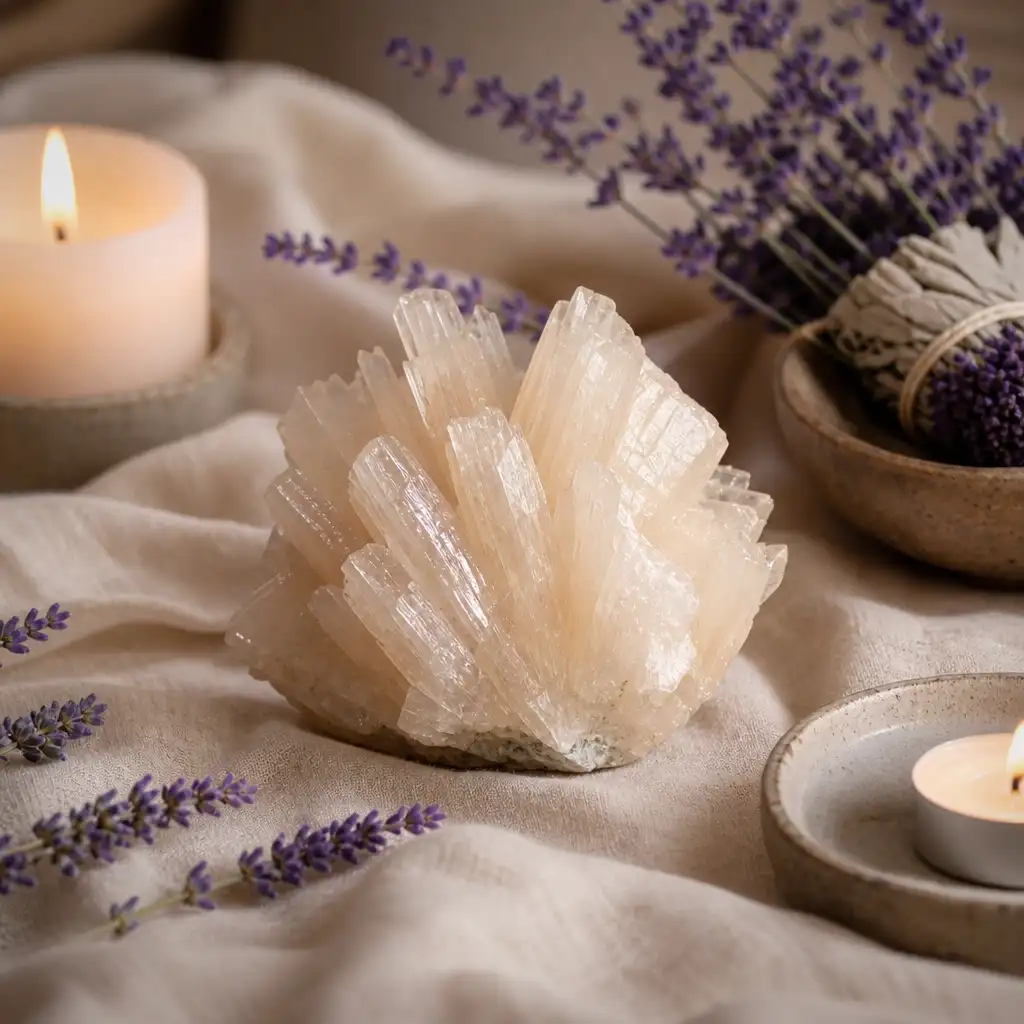
- ◆Healers often place it under the pillow or on the nightstand for insomnia and disturbed sleep, where its calming energy is said to ease the transition into deep, restorative sleep cycles.
- ◆Folk healing traditions also connect it to the throat and larynx, and some practitioners recommend it for clearing energetic pathways related to verbal expression.
- ◆These are folk and metaphysical traditions, not clinical treatments.
- ◆Crystal healing works well as a complement to conventional healthcare but should never replace professional medical advice.
Note: These properties are based on metaphysical traditions and are not a substitute for medical advice.
What Science Says
Stilbite is a well-characterized zeolite tectosilicate (NaCa4Al8Si28O72·28H2O).
- ◆The zeolite family is famous for porous crystal structures that absorb and release small molecules — a property extensively studied for industrial uses in water purification, catalysis, and gas separation.
- ◆Those distinctive sheaf-like crystal aggregates come from the monoclinic crystal system and the tendency of thin tabular crystals to grow in radiating sprays.
- ◆No clinical studies have tested Stilbite's metaphysical properties, but research on relaxation techniques, guided imagery, and sleep hygiene shows significant benefits for anxiety reduction, sleep quality, and creative performance — outcomes that line up closely with what Stilbite has traditionally been used for.
Which Chakras Does Stilbite Connect To?
Which Zodiac Signs Match Stilbite?
How Do You Use Stilbite?
Meditation
Place Stilbite on your Heart Chakra or hold it in both hands while seated in a comfortable, quiet space. Close your eyes and breathe slowly and deeply, allowing the stone's calming energy to wash through you like a gentle wave. For creative visualization, hold Stilbite while visualizing your desired outcome in as much sensory detail as possible — the stone enhances the vividness and emotional resonance of the imagery. For dream preparation, meditate with Stilbite for 10-15 minutes before sleep, setting an intention to remember your dreams and receive any guidance they may contain. Stilbite's energy is soft and receptive — there is no need to force or strain during meditation with this stone.
Daily Wear
Stilbite is best used in stationary settings rather than daily wear due to its softness (Mohs 3.5-4) and fragility. However, a small tumbled piece carried in a soft pouch in a pocket or bag can provide a calming energetic presence throughout the day. For those who experience social anxiety or workplace stress, holding the tumbled stone discreetly during challenging moments can provide an immediate calming anchor. Avoid wearing Stilbite in jewelry that receives impact or exposure to moisture.
Home Placement
Place Stilbite on your nightstand to promote peaceful sleep and meaningful dreams. In a meditation space or sacred area, it creates an atmosphere of tranquility and receptivity. On a desk or creative workspace, Stilbite supports imaginative thinking and reduces the mental agitation that blocks creative flow. A cluster placed in the living room or common area helps maintain a peaceful, harmonious atmosphere in the home. Keep Stilbite away from humid areas like bathrooms and kitchens, and avoid placing it in direct sunlight which can cause color fading in pink and peach varieties.
Crystal Grids
Create a peace and sleep grid with Stilbite as the center stone, surrounded by Lepidolite (anxiety relief), Moonstone (intuition and dreams), and Amethyst (spiritual protection). For a creative inspiration grid, combine Stilbite with Citrine (creativity and joy), Clear Quartz (amplification), and Lapis Lazuli (visionary insight). For an emotional healing grid, arrange Stilbite with Rose Quartz (unconditional love), Rhodonite (emotional balance), and Celestite (angelic comfort) in a circular pattern.
How Do You Cleanse & Charge Stilbite?
Moonlight Bathing
RecommendedSmudging
RecommendedSound Healing
RecommendedSelenite Charging
RecommendedMoon Phase Charging: Stilbite has a natural affinity for lunar energy and benefits greatly from moonlight charging. Place your Stilbite in direct moonlight overnight during the full moon for a thorough cleanse and recharge. The waning moon is particularly supportive for using Stilbite to release anxiety, stress, and mental agitation. The waxing moon supports using Stilbite to build peace, creativity, and restful sleep habits. The new moon is ideal for setting intentions related to inner peace and dreamwork with your Stilbite.
Avoid the following:
- ✗All water exposure — Stilbite is water-sensitive and can deteriorate with prolonged moisture contact
- ✗Salt and salt water — highly damaging to the zeolite structure
- ✗Chemical cleansers — ammonia, bleach, and any harsh chemicals will damage the specimen
- ✗Ultrasonic cleaners — vibration and liquid combination is destructive to this soft, fragile mineral
- ✗Prolonged direct sunlight — can fade pink and peach color varieties
- ✗High heat — can cause dehydration of the zeolite structure, leading to cracking or color change
- ✗Abrasive cleaning — the soft surface is easily scratched by rough handling
What Crystals Pair Well with Stilbite?
Best Combinations
Apophyllite
Apophyllite and Stilbite are natural geological companions that occur together in volcanic cavities, and metaphysically they create a balanced partnership — Apophyllite provides clarity and spiritual activation while Stilbite provides the peaceful, receptive foundation that allows clarity to be integrated gently
Celestite
Celestite's angelic, high-frequency energy and Stilbite's nurturing peace create a combination that facilitates communication with spiritual guides while maintaining a grounded, emotionally safe container for the experience
Moonstone
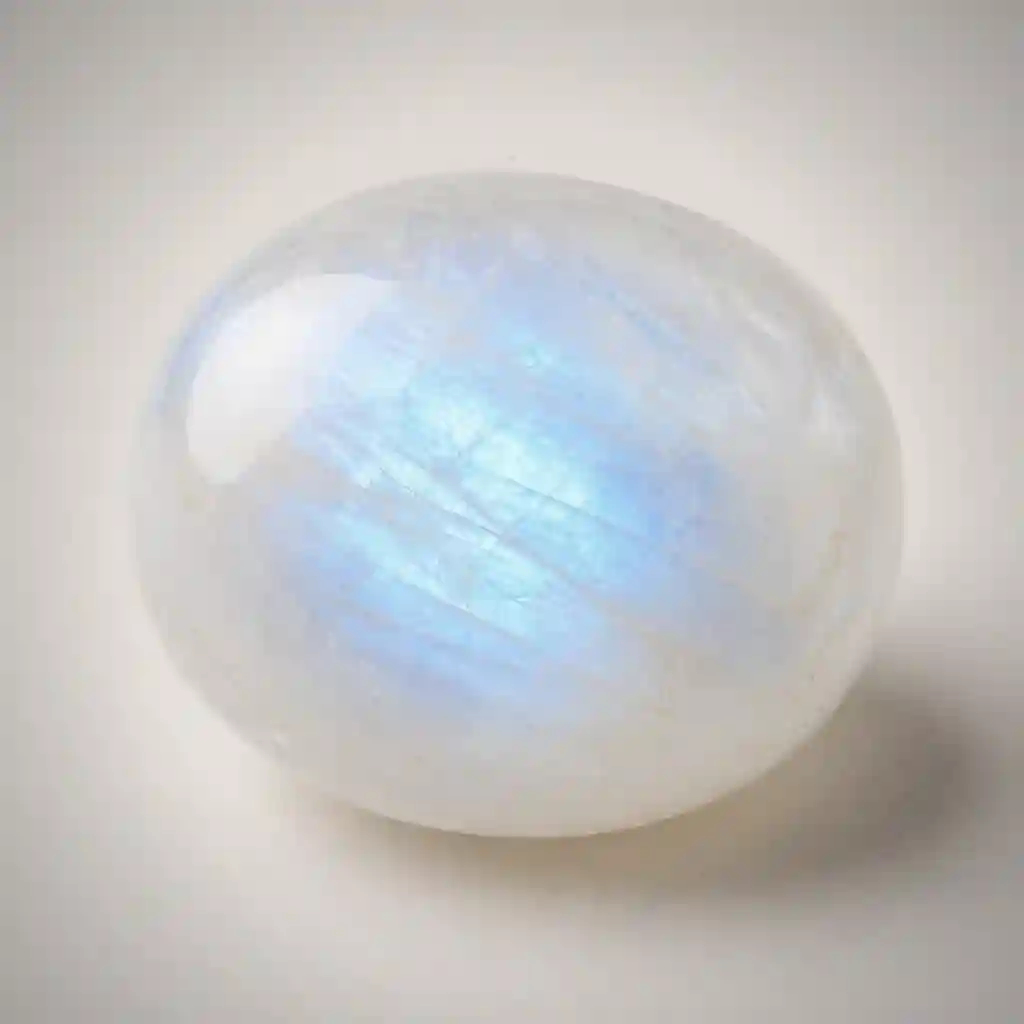
Moonstone enhances Stilbite's dreamwork and intuitive properties, creating a powerful combination for lucid dreaming, creative visualization, and accessing the wisdom of the subconscious mind
If You Like Stilbite, Also Try
How Can You Tell if Stilbite is Real or Fake?
Common Imitations
Identification Tests
1.Visual Inspection
Examine the specimen under good lighting with a 10x loupe, looking for crystal form, luster, and texture.
Genuine Stilbite displays characteristic sheaf-like or bow-tie crystal aggregates with a distinctive pearly luster on cleavage surfaces. Crystals are thin and tabular, often forming radiating sprays. The color ranges from white to peach/pink with natural variation. Dyed material shows unnaturally uniform color.
2.Hardness Test
Gently attempt to scratch the specimen with a fingernail (Mohs ~2.5) and a copper coin (Mohs ~3).
Stilbite (Mohs 3.5-4) cannot be scratched by a fingernail but may be scratched with difficulty by a copper coin. Calcite (Mohs 3) is softer and can be scratched by a copper coin easily. Glass imitations (Mohs 5-5.5) resist both. This test should be performed on an inconspicuous area.
3.Cleavage Observation
Examine the crystal's surface and edges under magnification, looking for cleavage planes.
Stilbite has perfect cleavage in one direction, which produces the characteristic pearly luster on cleavage surfaces. This pearly sheen on flat, reflective surfaces is a distinctive feature of genuine Stilbite and is difficult to replicate in imitations.
4.Specific Gravity Test
Heft the specimen and compare its weight to a similarly sized piece of quartz.
Stilbite (SG 2.15) is noticeably lighter than quartz (SG 2.65). It should feel distinctly light for its size. Glass imitations have a specific gravity around 2.5-2.6 and will feel heavier than genuine Stilbite.
Price Reference
Small
$5-15
Medium
$20-60
Large
$70-200+
Stilbite is generally affordable due to abundant supply from Indian deposits. Large, aesthetic crystal sprays with attractive peach coloring and associated apophyllite command higher prices. Cabinet-sized specimens from India are widely available at reasonable prices, making Stilbite one of the more accessible zeolite minerals for collectors and practitioners.
Is Stilbite Safe? Care & Precautions
Toxicity Warning
Stilbite is generally considered non-toxic for handling purposes. It is a hydrated sodium calcium aluminum silicate that does not contain toxic heavy metals. As with all crystals, do not ingest and wash hands after handling. Do not use in direct elixir preparation due to potential surface contamination and the mineral's water sensitivity.
Storage
Store Stilbite in a dry location away from humidity and moisture. Its zeolite structure can absorb water from the air, which may affect the specimen over time in very humid environments. Keep away from direct sunlight, which can fade pink and peach color varieties. Store separately from harder minerals (Mohs 3.5-4 makes it easily scratched) in a soft pouch or lined box.
Special Warnings
- ⚠Do not expose to water or high humidity — the zeolite structure can absorb moisture and the specimen may deteriorate
- ⚠Relatively soft and fragile — handle with care and avoid dropping or impact
- ⚠Pink and peach varieties may fade with prolonged sun exposure — store in a cool, dark place
- ⚠Do not use in direct gemstone elixirs; always use the indirect method (stone outside the water vessel)
- ⚠Avoid heat — high temperatures can cause dehydration of the zeolite structure
What is Stilbite Best For?
Stilbite FAQ — Common Questions Answered
What is Stilbite good for?+
Stilbite is excellent for promoting deep inner peace, emotional tranquility, and restful sleep. It calms anxiety and racing thoughts, enhances creative visualization, and supports lucid dreaming. Its gentle energy makes it ideal for those who find stronger stones overwhelming and for anyone seeking to establish a peaceful, meditative atmosphere. It is also valued for heart-centered healing and for connecting with spiritual guidance through gentle, receptive states of awareness.
How do I cleanse Stilbite?+
Stilbite is a soft zeolite mineral and must be cleansed very gently. Moonlight bathing is the ideal method — place it in direct moonlight overnight during the full moon. Smudging with sage or palo santo and sound healing with singing bowls are also safe and effective. Avoid all water exposure (Stilbite can be damaged by moisture), salt, chemical cleaners, ultrasonic cleaners, and any abrasive treatment. Handle with care as it is relatively fragile.
Can Stilbite help with sleep?+
Yes, Stilbite is one of the best crystals for promoting restful sleep. Its calming energy helps quiet racing thoughts and ease anxiety that can interfere with falling and staying asleep. Many people find that placing Stilbite near their bed or under their pillow supports deeper, more restorative sleep cycles and can enhance dream recall and facilitate lucid dreaming. Its gentle vibration is particularly suitable for those who find that more stimulating stones (like some Third Eye crystals) can actually disrupt sleep.
What makes Stilbite different from other zeolites?+
While all zeolites share a porous crystal structure and generally calming energy, Stilbite is distinguished by its characteristic sheaf-like crystal formations (resembling bundled wheat), its soft pearlescent luster, and its particularly gentle, heart-centered energy. Other common zeolites like Apophyllite tend to have more activating, clarifying energy, while Stilbite's specialty is deep peace and emotional soothing. Its peach and pink color varieties give it a warmth and heart-resonance that is unique among the zeolites.
Is Stilbite safe to use in elixirs?+
No, direct elixir preparation is not recommended for Stilbite. It is a soft, hydrated zeolite mineral that can deteriorate in water and release undesirable compounds. If you wish to make a gemstone elixir with Stilbite's energy, use the indirect method — place the stone in a separate container outside the water vessel rather than submerging it directly. Always research a mineral's safety before making gemstone elixirs, and never ingest water that has had a potentially toxic or water-soluble mineral submerged in it.
Was this helpful?