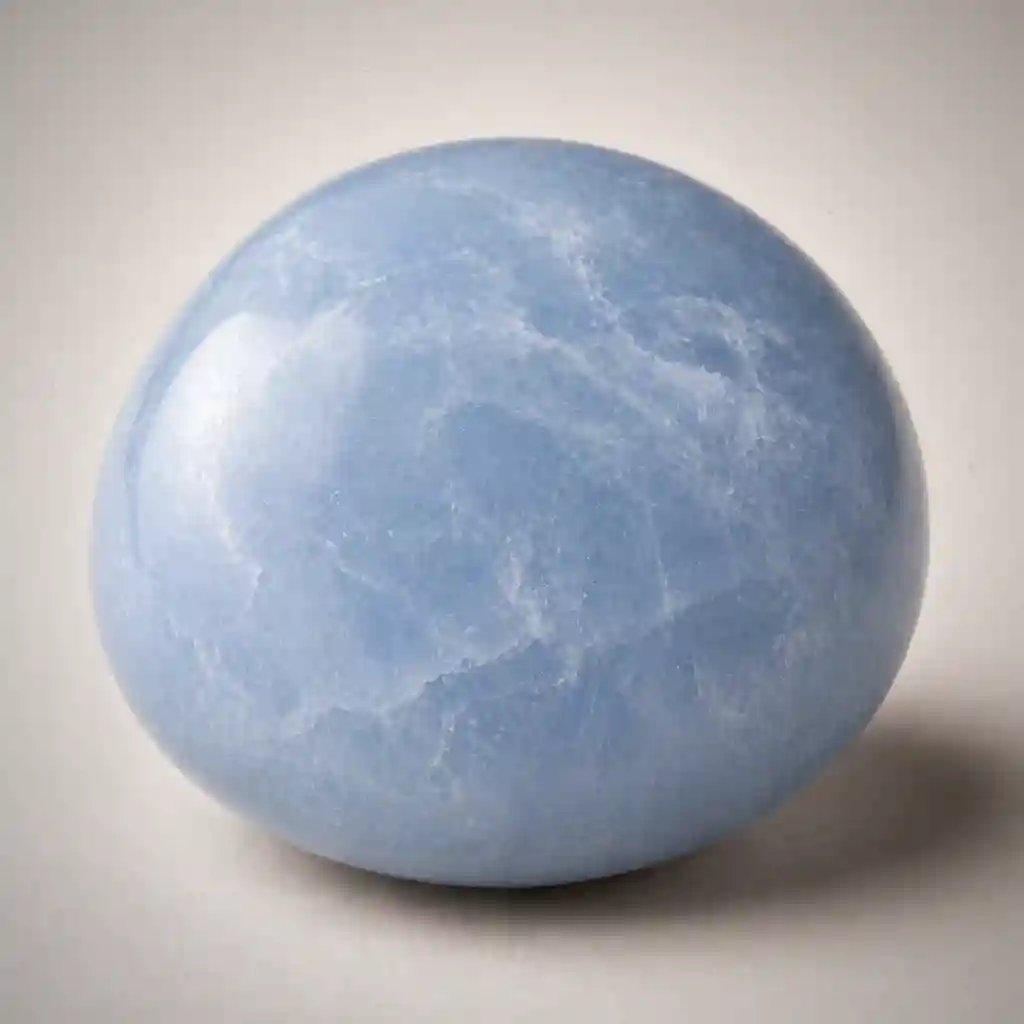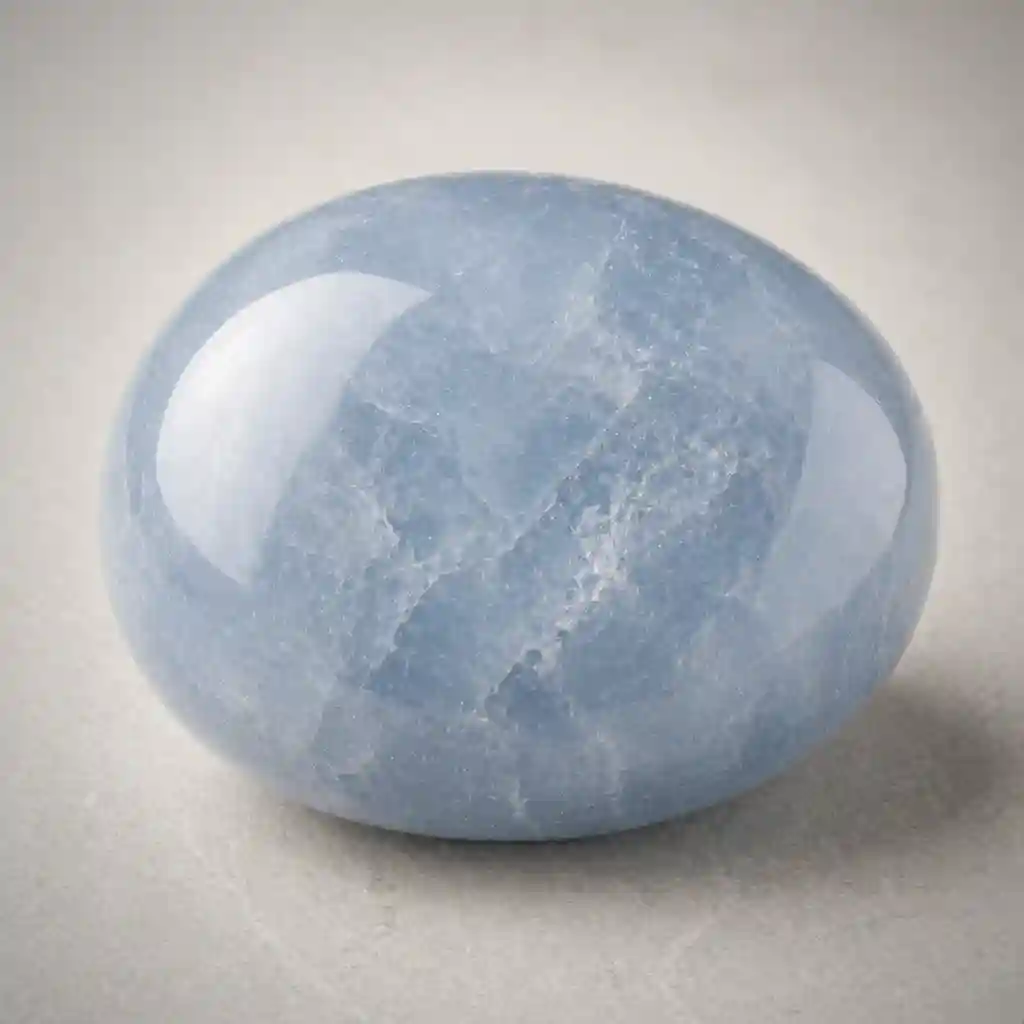
Celestite at a Glance
Celestite is a delicate sky-blue mineral used for angelic connection, anxiety relief, and peaceful sleep.
People working with spirit guides, anyone dealing with anxiety or poor sleep, and meditation practitioners
“I am open to guidance. Peace moves through me and settles where I need it most.”
Cleanse with moonlight or sound only — never water; store away from sunlight to prevent fading; handle gently due to fragility
Celestite Quick Answers
Can Celestite go in water?
No. Celestite is a soft mineral (3-3.5 Mohs) and moisture damages it. Prolonged water exposure makes the crystals dull, cloudy, or worse. Cleanse it with moonlight, sound, or smudging instead. Keep it somewhere dry.
Is Celestite the same as Angelite?
No, though they look similar and share the angelic association. Celestite (SrSO4) is strontium sulfate that forms transparent to translucent blue crystals. Angelite (CaSO4) is a form of anhydrite, a calcium sulfate that forms dense, opaque masses. Celestite has a lighter, more ethereal feel; Angelite is denser and more grounding. Celestite is the natural mineral. Angelite is actually a trade name.
What is the Meaning & History of Celestite?
Core Meaning
The Stone of Heavenly Communication and Peace — Celestite gets its name from the Latin word for "heavenly," and that is the simplest way to understand it. This is a stone people reach for when they want to feel calm, connected, and quietly supported by something larger than themselves. Practitioners use it to open communication with spirit guides, though whether you think of that as literal contact or as accessing your own deeper knowing is up to you. The effect is real either way: Celestite has a noticeably settling quality. It slows racing thoughts, eases worry, and makes meditation feel less like effort and more like arrival. It resonates with both the Throat and Crown Chakras, which is unusual. That dual resonance is why it gets used for both communication work and spiritual practice. The stone also has a reputation for dream work. People place it by the bed to encourage peaceful sleep and better dream recall, and some practitioners use it for astral travel.
Historical & Cultural Significance
The German mineralogist Abraham Gottlob Werner named Celestite in 1791, choosing "celestine" (from Latin "caelestis," heavenly) for its pale blue color. The mineral had already been used ornamentally before that. In the 18th and 19th centuries, it had industrial uses too: sugar refining and manufacturing strontium compounds for fireworks and flares (strontium burns a brilliant red). The famous Madagascar geodes started reaching mineral collectors in large numbers in the late 20th century, and they quickly became popular in metaphysical circles.
Symbolism
- ✦Heavenly connection: a link between everyday life and whatever you consider the higher realms
- ✦Angelic guidance: the idea that help is available if you listen for it
- ✦Inner peace: the specific kind of quiet that comes from feeling supported
- ✦Clear communication: honesty paired with compassion
- ✦Dream access: using sleep as a way to receive insight
Folklore & Legends
Some practitioners believe Celestite geodes form where angelic energy touched the earth, crystallizing that contact into something physical. Whether or not you take that literally, it is a useful image. Certain Native American traditions used pale blue stones in vision quests as portals to the sky realm. European folk traditions held that keeping Celestite in the home attracted guardian spirits and warded off nightmares. These are old stories, not verified facts, but they have persisted for a reason: people who work with this stone tend to report similar experiences of calm, clarity, and feeling looked after.
Geological Profile
Formation Process
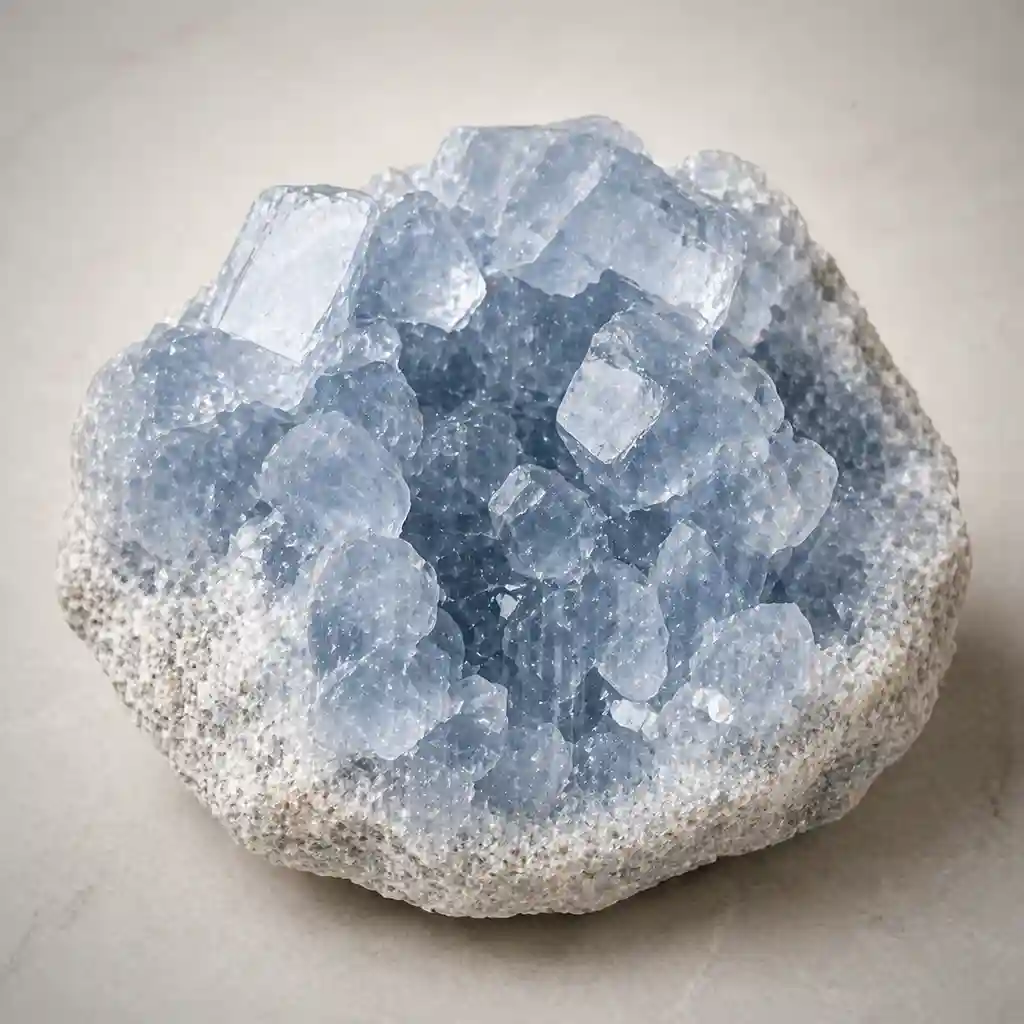
Celestite (strontium sulfate, SrSO4) forms mostly in sedimentary environments, especially limestone and dolomite. Strontium-bearing solutions percolate through the rock and precipitate in cavities, fractures, and geodes. The pale blue color comes from trace amounts of irradiated fluorine or natural color centers in the crystal structure. Celestite geodes form when mineral-rich fluids slowly fill rounded voids in limestone over geological time. The slow crystallization is what produces those large, delicate tabular crystals.
Varieties
Classic Pale Blue Celestite
The most common form: sky-blue to pale blue tabular crystals with good transparency. Madagascar geodes set the standard.
White/Colorless Celestite
Colorless to white specimens without the blue tint. Less popular for metaphysical use but mineral collectors seek them for crystallographic study.
Yellow to Orange Celestite
Rare specimens colored by trace sulfur compounds. Found in some Ohio deposits. The unusual color makes them collector pieces more than typical metaphysical stones.
Notable Origins
Madagascar (Sakoany)
Produces the world's best Celestite geodes. Large, well-formed sky-blue tabular crystals line spherical geodes up to 30cm across. Color is consistently good.
United States (Ohio, Michigan)
Ohio is a major Celestite source with large deposits in limestone near Clay Center. Some Ohio material is colorless to white rather than blue. Celestite is Ohio's state gem.
Italy (Sicily)
Italian Celestite occurs in sulfur deposits, sometimes alongside sulfur crystals. Known since the mineral's original classification in the 18th century.
Mineral data verified via Mindat.org
Physical Properties
| Hardness | 3.5 on the Mohs scale |
| Chemical Formula | SrSO₄ |
| Crystal System | Orthorhombic |
| Primary Color | Pale Blue |
| Origin | Madagascar, United States, Italy, Britain, Egypt |
| Transparency | Transparent to translucent |
| Luster | Vitreous to pearly on cleavage surfaces |
| Specific Gravity | 3.90-3.97 (notably heavy for its appearance) |
What Are the Healing Properties of Celestite?
Emotional & Mental Well-being
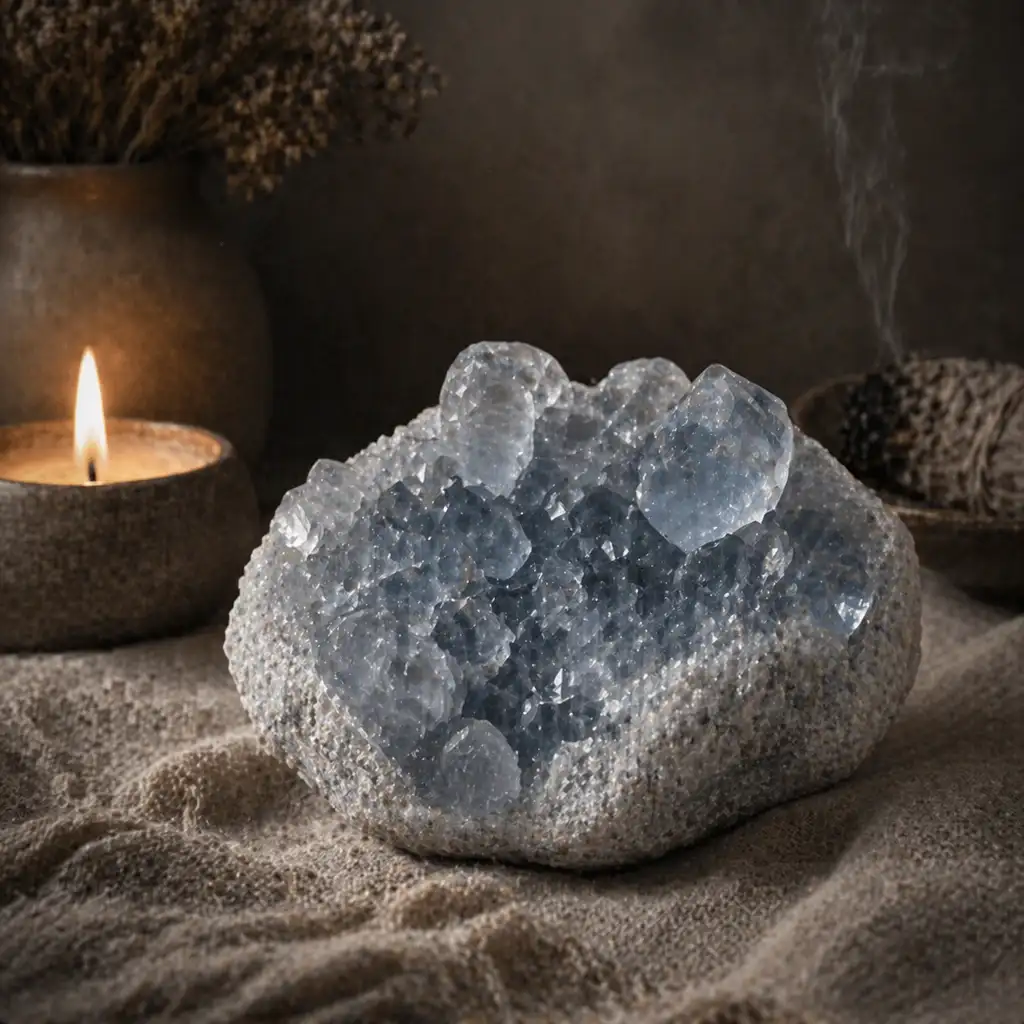
Celestite is one of the better stones for anxiety.
- ◆Its effect is hard to describe precisely but easy to recognize: the mental chatter quiets down, and everyday worries feel less urgent.
- ◆The closest comparison might be the feeling of lying on your back looking up at a wide, clear sky.
- ◆Practitioners recommend it for generalized anxiety, worry-driven insomnia, and the emotional aftermath of difficult experiences.
- ◆It also seems to help people who feel spiritually disconnected, not by pushing them toward any particular belief but by restoring a general sense that they are not alone.
- ◆Some crystal workers report that clients holding Celestite shift from anxious overthinking to something quieter within minutes.
- ◆Your mileage may vary, of course, but the anecdotal track record is consistent enough to be worth noting.
- ◆Celestite is also used for easing fear of death and the unknown.
Spiritual Properties
Celestite is a common choice for angelic communication work and spiritual development.
- ◆It activates both the Throat and Crown Chakras, which practitioners say creates a channel for receiving guidance and expressing spiritual truth.
- ◆The stone gets used for mediumship, channeling, and automatic writing because it seems to open the higher centers without pulling you completely out of your body.
- ◆As a dream stone, it gets placed by the bedside to promote peaceful sleep, enhance dream recall, and support lucid dreaming.
- ◆In meditation, practitioners use it to connect with spirit guides or simply to access quieter states of mind.
- ◆It is gentle and non-forceful, which makes it a reasonable starting point for beginners.
- ◆Experienced practitioners still use it too.
Physical Healing Traditions
In traditional crystal healing, Celestite is associated with the throat, thyroid, and vocal apparatus.
- ◆Healers recommend it for laryngitis, thyroid imbalances, and vocal strain.
- ◆It is also used for tension headaches caused by mental stress and for supporting restful sleep.
- ◆Folk medicine sometimes placed it on the forehead to reduce fever.
- ◆None of this is medically verified, but the throat connection tracks with its Throat Chakra association.
Note: These properties are based on metaphysical traditions and are not a substitute for medical advice.
What Science Says
Mineralogically, Celestite is strontium sulfate (SrSO4), a soft (3-3.
- ◆5 Mohs), brittle mineral with perfect cleavage in two directions.
- ◆The pale blue color comes from natural color centers in the crystal structure, possibly related to trace potassium or irradiation effects.
- ◆Celestite is the primary ore of strontium, used in fireworks (red colorant), ceramic magnets, and some medical imaging.
- ◆It is sensitive to moisture and should not be exposed to water.
- ◆Its specific gravity (3.
- ◆9-4.
- ◆0) makes it noticeably heavy for its size, which is a useful identification trait.
Which Chakras Does Celestite Connect To?
Which Zodiac Signs Match Celestite?
How Do You Use Celestite?
Meditation
Hold a Celestite crystal in your hands or place a geode nearby. Close your eyes and either visualize pale blue light extending upward from the crystal, or simply focus on your breathing. Set an intention to connect with your guides, then stay open to whatever comes through: impressions, images, words, feelings. Even 5-10 minutes can shift the mental state noticeably.
Daily Wear
Celestite is soft (3-3.5 Mohs) and fragile, so it is not ideal for rings or bracelets. A pendant in a bezel setting works if you are careful. Remove it before physical activity, water exposure, or sleep.
Home Placement
A Celestite geode on the nightstand is the classic placement, and for good reason: it tends to improve sleep quality and dream recall. In a meditation space, a Celestite specimen helps maintain a calm atmosphere. In Feng Shui, the northeast sector (knowledge and spirituality) is the traditional spot. Keep it out of bathrooms and kitchens due to humidity.
Crystal Grids
Use Celestite as the center stone in a grid for peace or spiritual connection. Pair it with Selenite and Angelite for angelic contact work, or with Amethyst and Labradorite for dream exploration. It broadcasts a calm, clear energy that holds a grid together well.
How Do You Cleanse & Charge Celestite?
Moonlight Bathing
RecommendedSound Healing
RecommendedSmudging
RecommendedRunning Water
Avoid water — Celestite is fragile and can be damaged by moisture
Use CautionMoon Phase Charging: Place Celestite in direct moonlight overnight during the full moon to cleanse and recharge it. The full moon is the traditional choice for this stone. For dream work, some practitioners prefer the waning moon to release unwanted energy before sleep. Sound healing with singing bowls is also effective and avoids any risk of moisture damage.
Avoid the following:
- ✗All water contact — Celestite is water-sensitive and can degrade or become cloudy
- ✗Direct sunlight for extended periods — UV exposure fades the blue color
- ✗Salt water or salt beds — salt is abrasive and moisture damages the crystal
- ✗Ultrasonic cleaners — the vibrations can crack Celestite's delicate crystal structure
- ✗Smudging with heavy smoke — residue can deposit on and dull the crystal surfaces over time
What Crystals Pair Well with Celestite?
Best Combinations
Selenite
Selenite purifies and amplifies Celestite's calm energy. Together they create a noticeably peaceful atmosphere, especially in meditation spaces.
Amethyst
Amethyst adds intuitive depth to Celestite's angelic connection. The pairing works well for dream work and meditation.
Angelite
Angelite shares Celestite's angelic association. Together they create a focused channel for guidance work. The combination is straightforward and effective.
If You Like Celestite, Also Try
How Can You Tell if Celestite is Real or Fake?
Common Imitations
Identification Tests
1.Weight Test
Hold the specimen in your hand and assess its weight relative to its size. Celestite has a notably high specific gravity (3.9-4.0).
Genuine Celestite feels surprisingly heavy for its size — noticeably heavier than quartz (2.65) or calcite (2.71). Glass and plastic imitations feel lighter by comparison. This is one of the most reliable non-destructive tests.
2.Hardness Test
Try to scratch the specimen with your fingernail (hardness ~2.5) and a copper coin (hardness ~3).
Genuine Celestite (hardness 3-3.5) cannot be scratched by a fingernail but can be scratched by a copper coin. If the specimen is harder than a coin, it is likely quartz or another harder mineral. If a fingernail scratches it, it may be a softer imitation.
3.Crystal Structure Examination
Examine the crystal shapes under magnification. Celestite crystallizes in the orthorhombic system.
Genuine Celestite forms tabular to prismatic crystals with a distinctive rectangular or diamond-shaped cross-section. Crystal terminations are typically flat or slightly pointed. Glass and plastic fakes show conchoidal fracture (curved breaks) rather than natural crystal faces.
Price Reference
Small
$5-15
Medium
$15-50
Large
$40-150
Small tumbled pieces and single crystals are affordable. Madagascar geodes command the highest prices — large, deep-blue geodes with large crystal formations can range from $50 to several hundred dollars depending on size, color quality, and crystal condition.
Is Celestite Safe? Care & Precautions
Toxicity Warning
Celestite (strontium sulfate) is generally considered non-toxic under normal handling conditions. However, it is a strontium compound and should not be ingested. Do not use in direct-consumption gem elixirs. Wash hands after handling.
Storage
Store Celestite away from moisture and humidity — it is sensitive to water and can degrade with prolonged exposure. Keep out of direct sunlight, which can fade the pale blue color over time. Wrap individual crystals in soft cloth or tissue to protect their delicate terminations. Store away from harder stones that could scratch or chip the soft crystals.
Special Warnings
- ⚠Celestite is fragile (3-3.5 Mohs) with perfect cleavage — handle gently to avoid chipping or breaking crystals
- ⚠Never place Celestite in water — it is water-sensitive and can become dull or degrade
- ⚠Prolonged direct sunlight can fade the blue color — store in a cool, dry, shaded location
- ⚠Keep away from children who may handle it roughly due to its delicate crystal structure
What is Celestite Best For?
Celestite FAQ — Common Questions Answered
Can Celestite go in water?+
No. Celestite is a soft mineral (3-3.5 Mohs) and moisture damages it. Prolonged water exposure makes the crystals dull, cloudy, or worse. Cleanse it with moonlight, sound, or smudging instead. Keep it somewhere dry.
Is Celestite the same as Angelite?+
No, though they look similar and share the angelic association. Celestite (SrSO4) is strontium sulfate that forms transparent to translucent blue crystals. Angelite (CaSO4) is a form of anhydrite, a calcium sulfate that forms dense, opaque masses. Celestite has a lighter, more ethereal feel; Angelite is denser and more grounding. Celestite is the natural mineral. Angelite is actually a trade name.
How do I use Celestite for angelic communication?+
Find a quiet space and hold the stone or sit near a geode during meditation. Breathe, and either visualize pale blue light extending upward from the crystal or simply set an intention to connect with your guides. Then wait. Pay attention to impressions, images, words, or feelings that come through. Some people report warmth or flashes of blue light. There is no single right way to do this. The practice is about being receptive.
How does Celestite support Gemini through the Throat and Crown Chakras?+
Celestite hits both the Throat and Crown Chakras, which is why it pairs well with Gemini. Geminis are already good at exchanging ideas. What Celestite adds is a bridge between that communicative skill and something deeper. It helps Gemini move from clever wordplay toward expression that actually means something.
Where is Celestite found and why is it so fragile?+
The best Celestite geodes come from Madagascar, with additional deposits in the United States (Ohio especially), Italy, Britain, and Egypt. At 3-3.5 Mohs, strontium sulfate is simply a soft mineral. The crystals scratch and break easily. Handle with care, but do not let that scare you off. Small to medium specimens are affordable and widely available.
Related Guides for Celestite
Was this helpful?