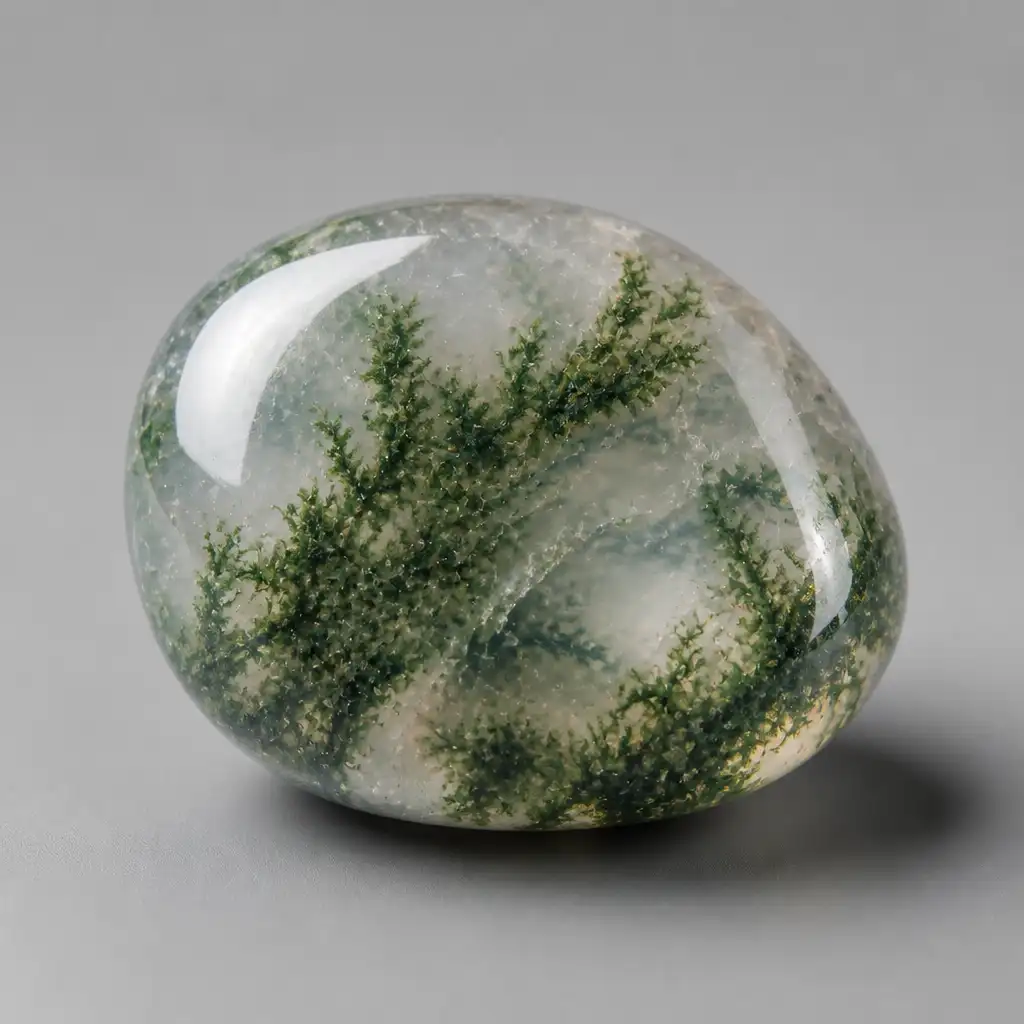
Moss Agate at a Glance
Moss Agate is the stone of new beginnings — a green, earth-connected crystal that encourages growth, abundance, and a deep bond with the natural world.
Gardeners, anyone starting a new chapter in life, those seeking abundance, and people who want to strengthen their connection to the natural world
“I am growing, thriving, and open to the abundant gifts of new beginnings.”
Cleanse under running water or moonlight; charge by burying in soil; avoid prolonged direct sunlight
Moss Agate Quick Answers
What is Moss Agate good for?
Moss Agate is primarily used for encouraging new beginnings, abundance, and personal growth. Its energy supports those starting fresh chapters in life — career, relationships, creative endeavors, you name it. It is also valued as a gardening and agricultural crystal, traditionally used to strengthen the health of plants and deepen your connection to the nurturing energy of the natural world.
Is Moss Agate a real agate?
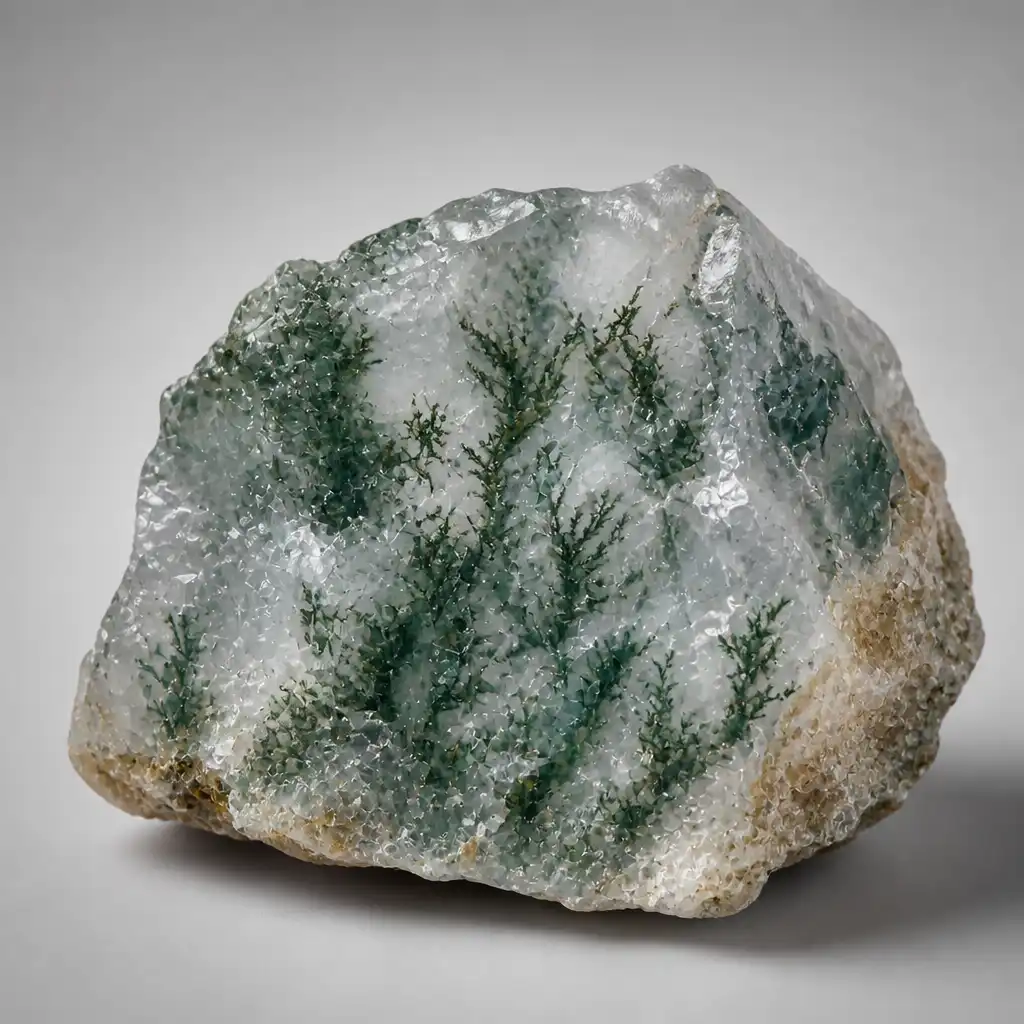
Moss Agate is technically a variety of chalcedony rather than a true banded agate. It lacks the concentric banding patterns that define typical agates. Instead, it contains green mineral inclusions — primarily hornblende or chlorite — that form dendritic, moss-like patterns within a translucent to opaque white or colorless chalcedony matrix. Despite this geological distinction, it has been called "Moss Agate" for centuries and the name persists in both gemology and crystal practice.
What is the Meaning & History of Moss Agate?
Core Meaning
The Stone of New Beginnings — Moss Agate carries the steady, patient energy of the natural world. Its green inclusions — formed by hornblende, chlorite, or other iron-rich minerals — mirror the patterns of moss and foliage, and this visual quality has long been tied to themes of growth, resilience, and renewal. As a Heart Chakra stone rooted in the Earth element, Moss Agate bridges the emotional and physical realms, helping you ground aspirations in practical action while staying open to the organic unfolding of your life. This is not a stone of dramatic transformation. It is about steady, incremental development — the kind of growth that happens one cell at a time, like a plant reaching toward light. That quality makes it especially useful when you feel stuck, stagnant, or disconnected from your sense of purpose and vitality.
Historical & Cultural Significance
Moss Agate has been valued since antiquity for its connection to agriculture and the earth's abundance. In ancient Rome, it was known as the "agricultural stone" and worn by farmers who trusted it to ensure healthy crops and protect against plant disease. The Greek naturalist Pliny the Elder wrote about agates with moss-like inclusions, describing their use as talismans for prosperity. In medieval Europe, Moss Agate was associated with earth spirits and placed in fields during planting season. Across India and the Middle East, it was used in healing rituals, valued for harmonizing opposing energies and restoring balance to body and spirit. Native American traditions also honored green stones as symbols of the plant nation, using them in ceremonies that paid tribute to the earth.
Symbolism
- ✦New beginnings — the energy of spring, fresh starts, and the first green shoot breaking through soil
- ✦Abundance and prosperity — attracts wealth in all its forms, particularly through steady growth
- ✦Connection to nature — deepens the bond between the individual and the natural world
- ✦Emotional balance — stabilizes mood and encourages calm equilibrium
- ✦Fertility and creation — supports both physical fertility and the birth of creative projects
- ✦Resilience — the patient persistence of living things growing through adversity
Folklore & Legends
European folklore holds that Moss Agate can predict the weather — if the green inclusions appear more vivid and prominent, rain is on the way, while faded inclusions suggest dry weather ahead. In ancient India, the stone was known as the "stone of cloud patterns" and carried by merchants who believed it could attract wealth through trade and diplomatic skill. Some Celtic traditions linked Moss Agate with the green world of the fae, using it as a gateway stone to communicate with nature spirits during Beltane and Midsummer celebrations.
Geological Profile
Formation Process
Moss Agate forms as a variety of chalcedony (microcrystalline quartz) when silica-rich fluids deposit microscopic quartz crystals in cavities within volcanic or sedimentary host rocks. The characteristic green "moss" patterns are created by inclusions of iron-rich minerals — primarily hornblende, chlorite, or other amphibole group minerals — that crystallize simultaneously with or slightly after the chalcedony matrix. These inclusions form dendritic (branching) or cloud-like patterns rather than the concentric bands seen in other agates. The green coloration results from the presence of ferrous iron (Fe2+) within the inclusion minerals. Formation typically occurs at relatively low temperatures in vesicles, fractures, or replacement zones within basalt, rhyolite, or limestone host rocks over thousands to millions of years.
Varieties
Indian Moss Agate
Highly prized material from India featuring vivid green moss-like inclusions in a clear to milky white chalcedony base. Indian specimens often display the most intricate and visually striking dendritic patterns.
Montana Moss Agate
Found in the alluvial deposits of the Yellowstone River in Montana, USA. Known for its clear base with sharp, reddish-brown to black dendritic inclusions that create detailed landscape scenes within the stone.
Dendritic Agate
A closely related variety featuring black or brown manganese oxide dendrites that form tree-like or fern-like branching patterns. While not green, it shares the same visual phenomenon and is often grouped with Moss Agate in metaphysical practice.
Notable Origins
India (Deccan Plateau)
The most commercially significant source of Moss Agate, producing material with vivid green inclusions in translucent chalcedony. Indian Moss Agate is widely available and shows some of the most attractive moss-like patterns in the world.
Brazil (Rio Grande do Sul)
Brazilian Moss Agate often features more subtle, diffuse green inclusions with a slightly different mineral composition. The material is frequently found alongside other agate varieties in volcanic geode deposits.
USA (Montana, Yellowstone River)
Montana Moss Agate is renowned for its clarity and detailed dendritic inclusions. Specimens often contain scenic landscape patterns — trees, mountains, and skies rendered in manganese and iron oxides against a clear quartz backdrop.
Madagascar
Malagasy Moss Agate displays rich, varied green tones with well-defined dendritic formations. Material from this region is valued for its high translucency and the artistic quality of its natural inclusions.
Mineral data verified via Mindat.org
Physical Properties
| Hardness | 6.75 on the Mohs scale |
| Chemical Formula | SiO₂ |
| Crystal System | Hexagonal (Trigonal) |
| Primary Color | Green (with white/clear) |
| Origin | India, Brazil, Uruguay, USA, Madagascar |
| Transparency | Translucent to semi-transparent |
| Luster | Vitreous to waxy |
| Specific Gravity | 2.58-2.64 |
What Are the Healing Properties of Moss Agate?
Emotional & Mental Well-being
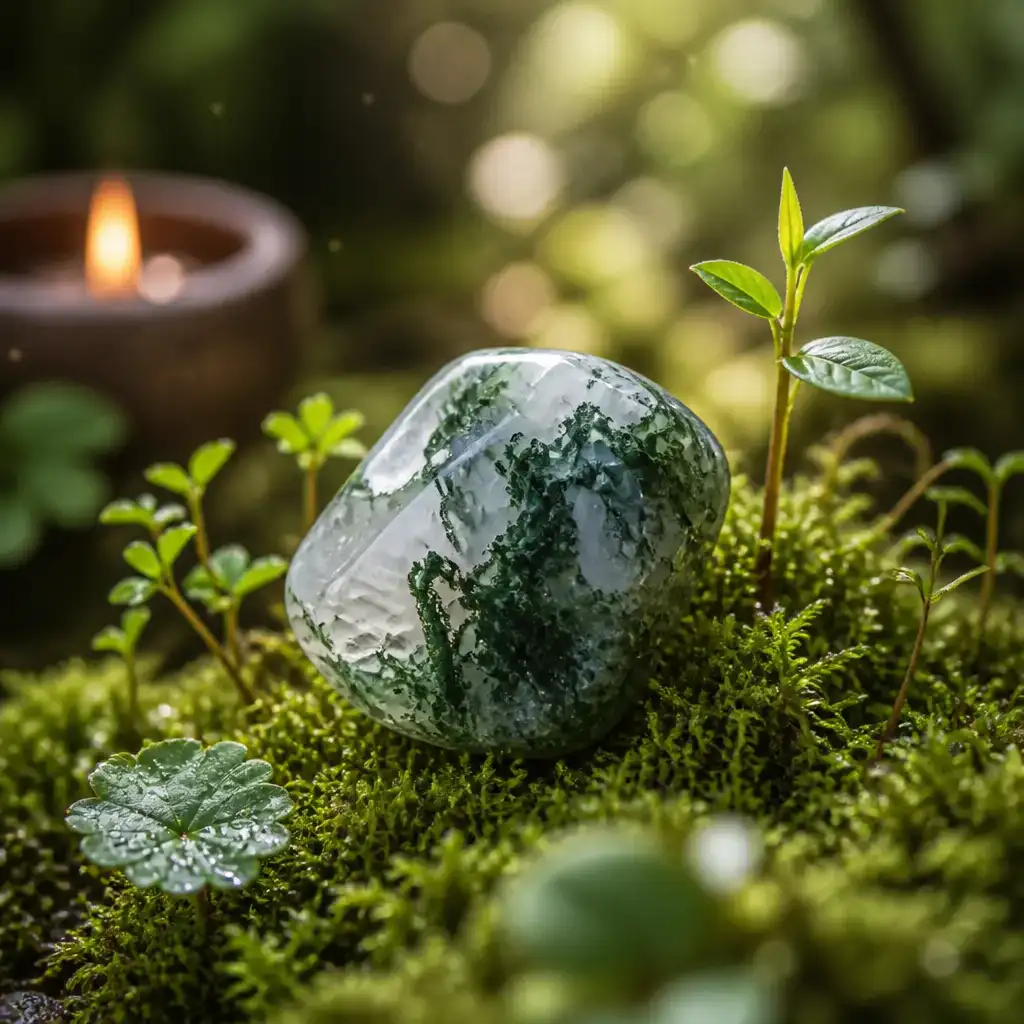
Moss Agate has a reputation as an emotionally stabilizing stone that gently dissolves blockages and encourages a balanced, optimistic outlook.
- ◆Its steady earth energy helps calm mood swings, ease irritability, and build emotional resilience during periods of transition or uncertainty.
- ◆It is a go-to stone for those recovering from emotional trauma or grief, because it supports the gradual, organic process of healing rather than pushing for dramatic breakthroughs.
- ◆The stone encourages self-acceptance and trust in your own timing, helping you release the need to control outcomes and instead let your emotional landscape unfold at its own pace.
- ◆It also has a long association with harmony in relationships — particularly family dynamics and close friendships — by fostering understanding, patience, and mutual respect.
Spiritual Properties
As a Heart Chakra stone connected to the Earth element, Moss Agate helps align spiritual aspirations with grounded, embodied experience.
- ◆It encourages a direct, felt connection to the natural world and the rhythms of the earth — the cycles of day and night, the seasons, the growth and decay that govern all living things.
- ◆Many people use Moss Agate to deepen meditation, particularly nature-based meditations and earth-healing rituals.
- ◆In crystal traditions, it facilitates communication with plant spirits, nature devas, and the consciousness of the green world.
- ◆For shadow work or ancestral healing, Moss Agate provides a stabilizing anchor that keeps you connected to the present moment and your physical body while exploring deep inner territory.
Physical Healing Traditions
In traditional crystal healing, Moss Agate is linked with supporting the immune system, reducing inflammation, and promoting general physical vitality.
- ◆Healers sometimes place it on the body near areas of swelling or infection to support the body's natural healing processes.
- ◆It has also been traditionally associated with the digestive system, lymphatic drainage, and skin conditions.
- ◆Some crystal workers recommend Moss Agate for those recovering from illness or surgery, as its gentle energy is thought to promote steady, sustained recovery.
- ◆These uses come from folk healing traditions and metaphysical practice — they are not a substitute for professional medical care.
Note: These properties are based on metaphysical traditions and are not a substitute for medical advice.
What Science Says
Mineralogically, Moss Agate is a well-characterized variety of chalcedony whose distinctive green inclusions have been identified as iron-bearing silicate minerals, primarily hornblende and chlorite.
- ◆The dendritic patterns form through crystallographic branching processes that are well understood in materials science.
- ◆The stone's metaphysical properties have not been tested in peer-reviewed clinical research.
- ◆That said, studies on nature exposure, gardening, and biophilia — the innate human affinity for the natural world — have demonstrated measurable benefits for stress reduction, mood improvement, and immune function.
- ◆The psychological benefits of staying connected to nature, which Moss Agate symbolizes, are well-documented in environmental psychology.
Which Chakras Does Moss Agate Connect To?
Which Zodiac Signs Match Moss Agate?
How Do You Use Moss Agate?
Meditation
Hold a piece of Moss Agate at your Heart Chakra while sitting comfortably, preferably outdoors or near plants. Close your eyes and breathe deeply, visualizing roots growing from your body into the earth while green light from the crystal expands through your chest. When working with new beginnings, meditate with Moss Agate during the new moon or at dawn, setting clear intentions for what you wish to grow in your life. Let the stone's steady energy remind you that growth happens in its own time and cannot be rushed.
Daily Wear
Wear Moss Agate as a pendant near the heart or as a bracelet on the left wrist (receiving hand) to keep its growth-oriented energy close throughout the day. A small tumbled stone carried in a pocket or pouch works just as well. Those who work with plants — farmers, gardeners, florists, landscape designers — may benefit from wearing Moss Agate during work hours to stay consciously connected to the green world. Starting a new venture? Carry Moss Agate during interviews, pitches, or first meetings to project grounded confidence.
Home Placement
Place Moss Agate near houseplants or in your garden to create a supportive energetic environment for plant growth. In the home, position it in the southeast corner (the traditional feng shui wealth and abundance area) to attract prosperity. Keep Moss Agate on your desk or in your workspace to encourage steady progress on creative projects and professional goals. In the kitchen, a piece of Moss Agate near fresh herbs or a windowsill garden reinforces the connection between nourishment and nature.
Crystal Grids
Use Moss Agate as the center stone of an abundance or new-beginnings grid. Surround it with Clear Quartz points to amplify its energy, and add Citrine and Aventurine to create a three-fold prosperity pattern. For a healing garden grid, arrange Moss Agate with other green stones — Malachite, Green Aventurine, and Jade — in a circular pattern and place the grid among your plants or near a window overlooking a garden. Activate the grid during the new moon and recharge it monthly under the full moon.
How Do You Cleanse & Charge Moss Agate?
Moonlight Bathing
RecommendedSmudging
RecommendedRunning Water
RecommendedSound Healing
RecommendedMoon Phase Charging: Moss Agate responds beautifully to moonlight charging, particularly during the waxing moon phases when energy is building toward fullness. Place your Moss Agate on a windowsill or outdoors where it can absorb moonlight overnight during the waxing crescent to full moon for growth and abundance work. For release and letting go, charge during the waning moon. The new moon is especially potent for setting new-beginnings intentions with Moss Agate. An earth burial — placing the stone in healthy garden soil for 24 hours — is also an ideal charging method for this deeply earth-connected crystal.
Avoid the following:
- ✗Harsh chemical cleaners — ammonia, bleach, and abrasive cleansers can damage the surface
- ✗Prolonged boiling water — thermal shock can cause fractures in the chalcedony
- ✗Salt water for extended periods — salt can eventually etch the quartz surface
What Crystals Pair Well with Moss Agate?
Best Combinations
Aventurine
Green Aventurine and Moss Agate share the Heart Chakra and Earth element, creating a powerful combination for abundance work and emotional healing — together they amplify each other's growth energy
Citrine
Citrine's Solar Plexus activation pairs beautifully with Moss Agate's Heart-centered growth energy, combining confidence and optimism with patient, grounded development
Clear Quartz
Clear Quartz amplifies Moss Agate's growth and abundance vibration, making it an ideal addition to crystal grids and intention-setting rituals focused on new beginnings
Moonstone
Moonstone's connection to new cycles and feminine energy complements Moss Agate's new-beginnings theme, creating a supportive pairing for fertility work and creative endeavors
If You Like Moss Agate, Also Try
How Can You Tell if Moss Agate is Real or Fake?
Common Imitations
Identification Tests
1.Magnification Inspection
Examine the stone under a 10x jeweler's loupe or magnifying glass, focusing on the green inclusions and their relationship to the surrounding chalcedony.
Natural Moss Agate shows green mineral inclusions that are integrated into the chalcedony matrix — they appear to be growing within the stone, not painted on the surface. The inclusions will show natural branching patterns, varying opacity, and three-dimensional depth when the stone is tilted. Dyed stones often show color concentrated in surface cracks with an unnatural, uniform green hue.
2.Scratch Test
Attempt to scratch the specimen with a steel knife blade, and try to scratch a piece of glass with the specimen.
Genuine Moss Agate (Mohs 6.5-7) will scratch glass and cannot be scratched by a steel knife (Mohs 5.5). Glass imitations (Mohs 5-5.5) will not scratch glass and can be scratched by steel. Plastic and resin fakes are easily scratched by steel and will not scratch glass at all.
3.Temperature Test
Hold the stone in your closed palm for 30 seconds, noting how quickly it warms and whether it initially feels cold.
Natural chalcedony has relatively high thermal conductivity and will feel distinctly cold when first picked up, warming slowly in the hand. Glass warms moderately quickly, while plastic and resin warm almost immediately and never have that initial cold, dense feel of genuine stone.
4.UV Light Examination
Examine the stone under short-wave and long-wave ultraviolet light in a darkened room.
Natural Moss Agate typically shows weak to no fluorescence, though some specimens may display a faint greenish or whitish glow under long-wave UV due to trace uranium content in the green inclusions. Dyed material often shows strong, unnatural fluorescence in the colored areas. Glass imitations may show characteristic glass fluorescence patterns.
Price Reference
Small
$3-12
Medium
$15-40
Large
$45-200
Moss Agate is generally affordable and widely available. Pricing depends primarily on the visual quality and artistic appeal of the moss inclusions — specimens with vivid green, well-defined landscape or dendritic patterns command higher prices. Indian material with particularly scenic inclusions can be significantly more expensive than standard specimens.
Is Moss Agate Safe? Care & Precautions
Toxicity Warning
Moss Agate is non-toxic and considered safe for direct skin contact, elixir preparation, and use around children and pets. As a quartz variety (chalcedony), it is chemically inert and stable.
Storage
Store Moss Agate in a soft pouch or lined box, separated from harder minerals that could scratch it. While it is relatively hard (Mohs 6.5-7), it can be scratched by harder stones like topaz, corundum, and diamond. Avoid prolonged exposure to harsh chemicals.
Special Warnings
- ⚠Avoid ultrasonic cleaners if the stone contains fractures, as vibrations can worsen internal cracks
- ⚠Keep away from hydrofluoric acid, which dissolves silica minerals
What is Moss Agate Best For?
Moss Agate FAQ — Common Questions Answered
What is Moss Agate good for?+
Moss Agate is primarily used for encouraging new beginnings, abundance, and personal growth. Its energy supports those starting fresh chapters in life — career, relationships, creative endeavors, you name it. It is also valued as a gardening and agricultural crystal, traditionally used to strengthen the health of plants and deepen your connection to the nurturing energy of the natural world.
Is Moss Agate a real agate?+
Moss Agate is technically a variety of chalcedony rather than a true banded agate. It lacks the concentric banding patterns that define typical agates. Instead, it contains green mineral inclusions — primarily hornblende or chlorite — that form dendritic, moss-like patterns within a translucent to opaque white or colorless chalcedony matrix. Despite this geological distinction, it has been called "Moss Agate" for centuries and the name persists in both gemology and crystal practice.
How do I cleanse and charge Moss Agate?+
Moss Agate can be cleansed under cool running water, by moonlight bathing, or through smudging with sage or palo santo. Sound healing with singing bowls also works well. Because of its earthy nature, burying it in healthy soil for 24 hours is a popular charging method that reconnects the stone with its source energy. Avoid prolonged direct sunlight, which can fade the green inclusions over time.
Can Moss Agate help plants grow?+
Moss Agate has a long tradition as a gardener's talisman. Ancient Romans and medieval European farmers placed it in fields and gardens to protect crops and encourage growth. Crystal enthusiasts today keep Moss Agate near potted plants, bury small pieces in garden beds, or place them in watering cans. There is no scientific evidence that crystals directly affect plant growth, but the mindful attention and ritual of caring for a garden with intention can certainly foster a positive growing environment.
What is the difference between Moss Agate and Tree Agate?+
Both are chalcedony varieties with dendritic green inclusions, but they look different. Moss Agate has a translucent to semi-transparent base with green inclusions that look like moss or seaweed floating in water. Tree Agate has an opaque white base with more defined, branching dendritic patterns resembling tree branches or ferns. Both carry earthy, growth-oriented energy, but Moss Agate tends to feel more activating while Tree Agate is more stabilizing.
Was this helpful?