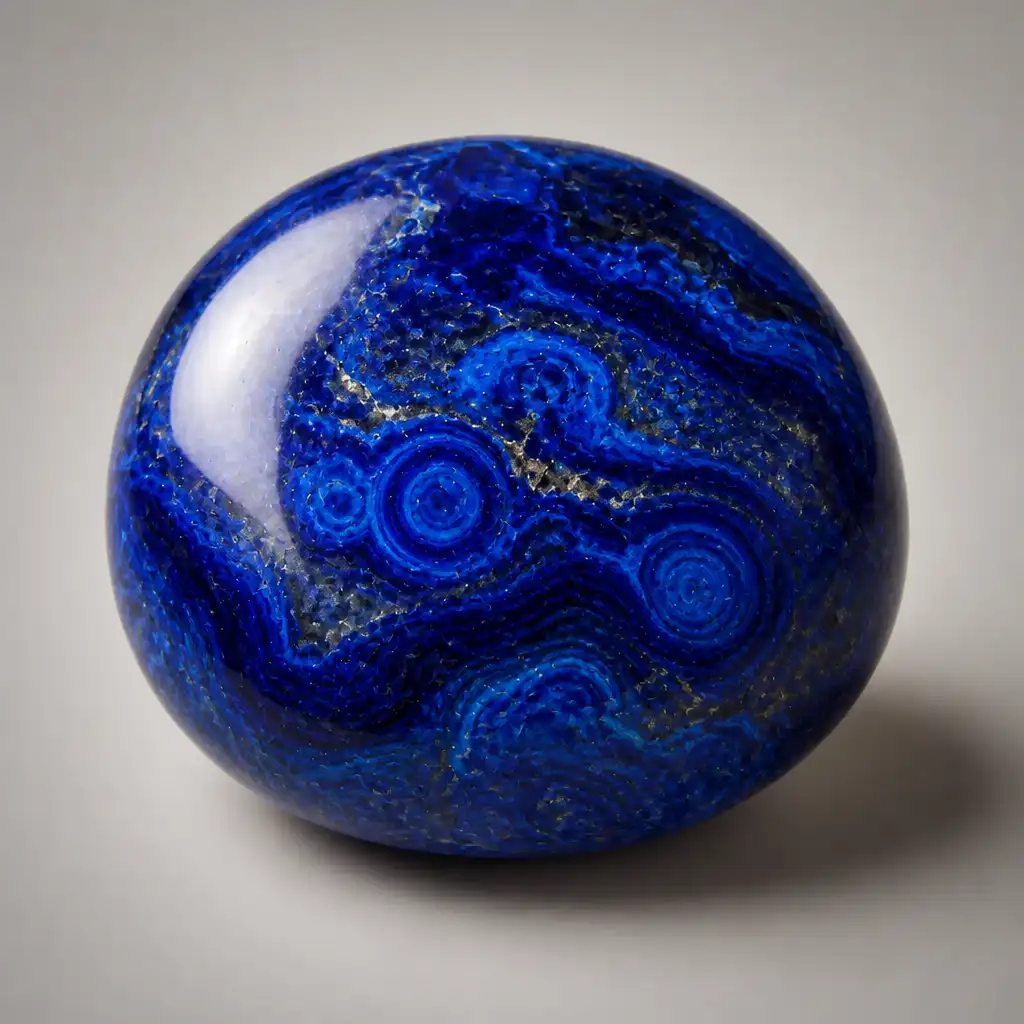
Azurite at a Glance
Azurite is the Stone of Heaven — a deep blue copper carbonate that activates the Third Eye, unlocks psychic perception, and elevates the mind to its highest visionary potential.
Psychic practitioners, meditators, students, creative professionals, and anyone seeking to develop their intuition and access higher states of awareness
“I trust the visions that rise from within me. My inner sight is clear, my intuition is strong, and I am connected to the infinite wisdom of the universe.”
Charge under moonlight; cleanse with sage or sound; keep completely dry and avoid sunlight — this is a delicate stone requiring careful handling
Azurite Quick Answers
What is Azurite good for?
Azurite is renowned for activating the Third Eye Chakra and enhancing psychic abilities, intuition, and inner vision. It clears mental confusion, stimulates intellectual curiosity, and supports deep meditation. It is excellent for developing clairvoyance, improving dream recall, overcoming indecision, and accessing spiritual guidance. Its deep blue energy promotes mental clarity and the courage to trust your inner knowing.
How do I cleanse Azurite?
Azurite is a soft, copper-based mineral that requires gentle care. Moonlight bathing is the safest method — place it in direct moonlight overnight. Smudging with sage or palo santo and sound healing with singing bowls are also excellent. Avoid all water exposure (Azurite can be damaged by moisture), salt, chemical cleaners, ultrasonic cleaners, and prolonged sunlight which can alter its color.
What is the Meaning & History of Azurite?
Core Meaning
The Stone of Heaven — Azurite carries one of the highest and most focused Third Eye vibrations in the mineral kingdom. Its energy is penetrating and precise — it does not gently suggest intuitive impressions but delivers them with startling clarity and vividness. This makes Azurite a stone for those who are ready to see truth, not merely glimpse it. The stone's deep blue frequency resonates with the deepest layers of consciousness, accessing the subconscious mind, the collective unconscious, and the akashic records with equal facility. Azurite teaches that true vision requires both seeing and understanding — it activates not just the ability to receive psychic impressions but the mental clarity to interpret them accurately. Its copper content provides conductive energy that bridges the physical and etheric bodies, making it an efficient transmitter of non-physical information into conscious awareness.
Historical & Cultural Significance
Azurite has been used since ancient times across multiple civilizations. The ancient Egyptians ground it into pigment for ceremonial painting and used it in amulets dedicated to the sky gods. Pliny the Elder described its use in Roman times, noting its deep blue color and its occurrence alongside malachite in copper mines. In medieval and Renaissance Europe, Azurite was the primary source of blue pigment before the availability of ultramarine (lapis lazuli) — it was used extensively in illuminated manuscripts, panel paintings, and frescoes, often in depictions of the Virgin Mary's robes. Chinese artisans carved Azurite into ceremonial objects and used it in traditional medicine. The stone was valued not only for its color but for its perceived ability to enhance spiritual vision and connect the practitioner with divine wisdom. In the 19th century, the discovery of large Azurite deposits in Chessy-les-Mines near Lyon, France, made French Azurite specimens among the most prized in European mineral collections.
Symbolism
- ✦Divine vision — opens the Third Eye to perceive spiritual realities beyond the physical
- ✦Inner sky — connects the individual mind to the infinite expanse of cosmic consciousness
- ✦Psychic clarity — delivers intuitive impressions with vivid precision and accuracy
- ✦Mental mastery — dissolves confusion and indecision, replacing them with clear insight
- ✦Creative inspiration — stimulates the imagination to reach beyond conventional boundaries
- ✦Ancient wisdom — connects the practitioner to the accumulated knowledge of past civilizations
Folklore & Legends
In the occult traditions of medieval Europe, Azurite was known as the "Philosopher's Blue" and was used by alchemists in their spiritual work. The belief was that gazing into the stone's deep blue depths could reveal the hidden nature of reality and the secrets of spiritual transformation. Some traditions held that Azurite was solidified drops of the primordial sky, fallen to earth during the creation of the world. Australian Aboriginal traditions associate blue stones with the Dreamtime and the great sky spirits who shaped the land, using them in initiation ceremonies to facilitate visionary experiences.
Geological Profile
Formation Process
Azurite forms as a secondary mineral in the oxidized zones of copper ore deposits, where copper-rich solutions react with carbonate minerals (usually limestone or dolomite) in the surrounding rock. It occurs in arid to semi-arid environments where the specific geochemical conditions — alkaline pH and limited water — favor the formation of copper carbonates rather than copper silicates or oxides. Azurite frequently occurs in association with malachite (a related copper carbonate), native copper, cuprite, and chrysocolla. Over geological time, Azurite tends to alter to malachite as it absorbs additional water and carbon dioxide, which is why specimens showing both minerals together are common. Well-formed Azurite crystals develop in cavities within the oxidized zone where free growth space allows the development of characteristic tabular to prismatic monoclinic crystals.
Varieties
Crystallized Azurite
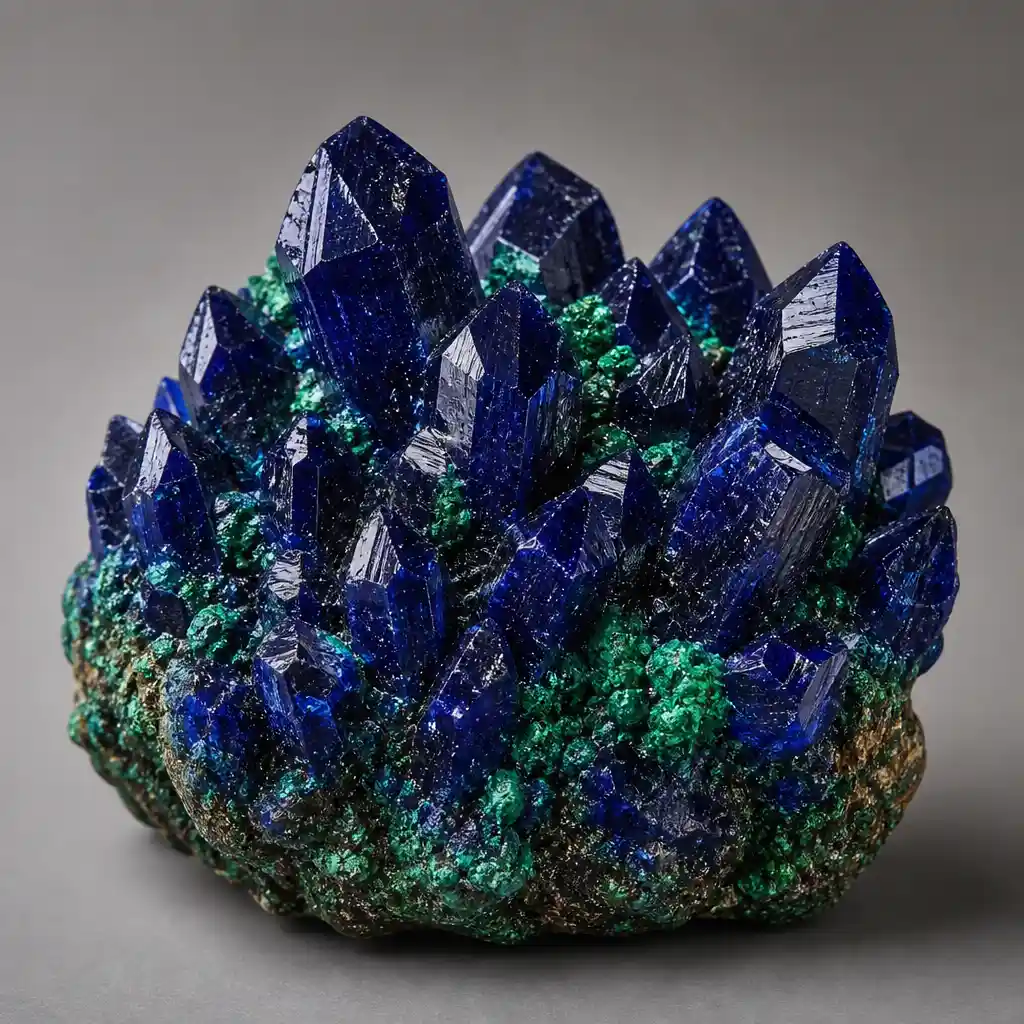
The most prized form, displaying well-formed deep blue tabular or prismatic crystals with a brilliant vitreous luster. Exceptional crystals from Tsumeb (Namibia) and Chessy (France) are among the most sought-after mineral specimens in the world.
Azurite Sun
A distinctive variety from the Malbunka mine in Australia's Northern Territory, occurring as flat, disc-shaped circular aggregates that resemble brilliant blue suns. These unique formations are highly prized by collectors and are unlike Azurite from any other locality.
Azurite-Malachite
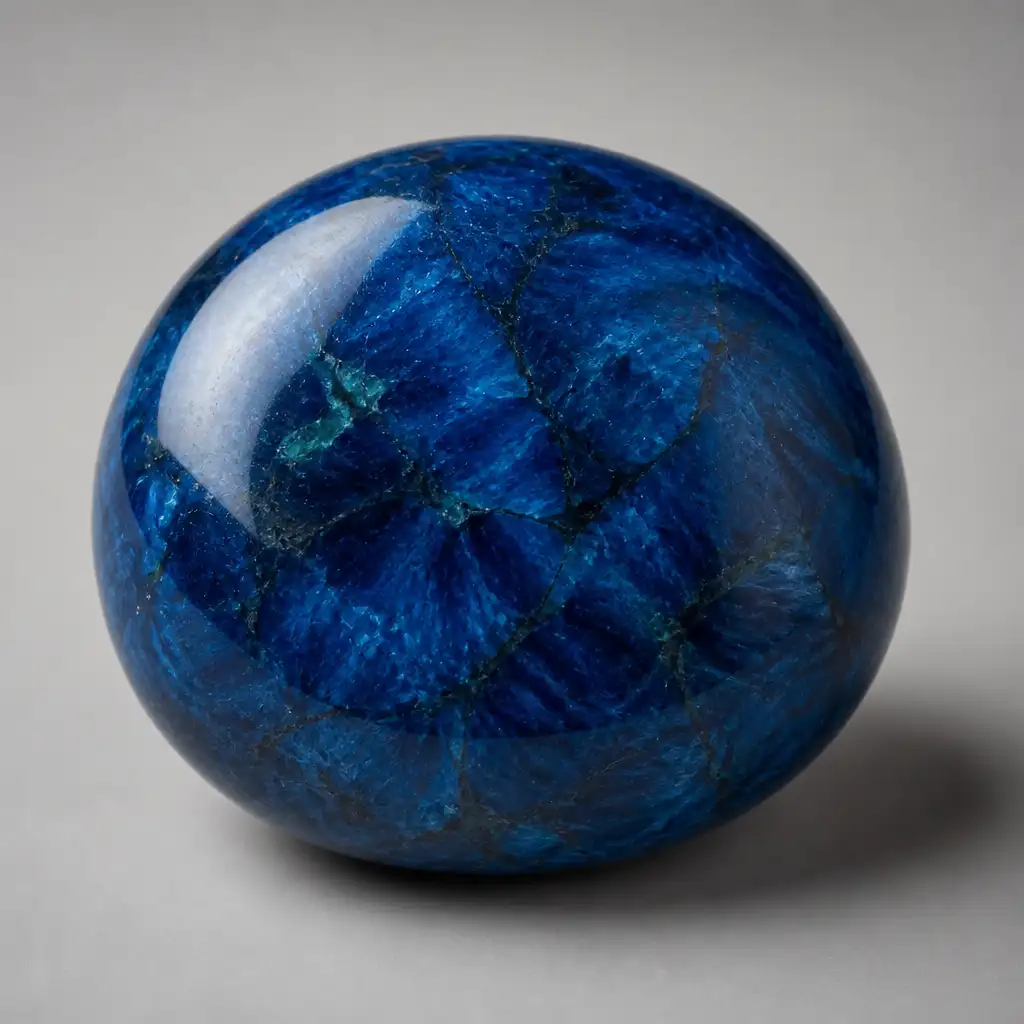
Natural intergrowths of blue Azurite and green Malachite, often forming striking banded or mixed specimens. This combination represents the natural alteration of Azurite to Malachite and is popular in both collector and lapidary markets.
Notable Origins
Morocco (Kerrouchen, Touissit)
Morocco produces large quantities of attractive Azurite specimens, ranging from drusy blue crusts to well-formed crystal groups. Moroccan material is widely available and offers good quality at accessible prices for both collectors and metaphysical users.
Democratic Republic of Congo (Katanga)
The DRC copper belt yields excellent Azurite, often in association with vibrant green malachite. Specimens range from compact blue nodules to impressive crystal clusters of deep azure color.
Australia (Northern Territory — Malbunka)
Famous for producing the unique "Azurite Sun" formations — flat, circular disc-like aggregates of radiating Azurite crystals. These are found nowhere else in the world and are among the most distinctive and collectible mineral specimens from any locality.
France (Chessy-les-Mines)
The type locality for Azurite, Chessy produced historically important specimens of deep blue monoclinic crystals in the 19th century. While largely exhausted, Chessy Azurite remains a benchmark for quality in mineralogical collections worldwide.
Mineral data verified via Mindat.org
Physical Properties
| Hardness | 3.75 on the Mohs scale |
| Chemical Formula | Cu₃(CO₃)₂(OH)₂ |
| Crystal System | Monoclinic |
| Primary Color | Blue |
| Origin | Morocco, Democratic Republic of Congo, Australia, France, USA, China |
| Transparency | Transparent to translucent (crystals), opaque (massive) |
| Luster | Vitreous |
| Specific Gravity | 3.77 |
What Are the Healing Properties of Azurite?
Emotional & Mental Well-being
Azurite approaches emotional healing through clarity and truth.
- ◆It has a real talent for cutting through the mental fog, confusion, and indecision that so often sit beneath emotional distress.
- ◆By activating the Third Eye, Azurite helps you see your emotional patterns with stark objectivity — why you feel what you feel, which thought patterns generate which emotional states.
- ◆That clear seeing is itself therapeutic, since many emotional difficulties persist precisely because they haven't been fully understood.
- ◆The stone really shines for people who feel overwhelmed by too many options or paralyzed by the fear of choosing wrong.
- ◆Its energy slices through circular thinking and returns you to a state of calm, focused clarity where confident decisions become possible.
- ◆It also supports grief processing by providing the mental clarity to understand and integrate painful experiences instead of drowning in them.
Spiritual Properties
Azurite ranks among the premier Third Eye stones, prized for producing clear, vivid, and immediately usable psychic impressions.
- ◆Where some third eye stones create vague or dreamy states, Azurite's energy is sharp, focused, and lucid — people often report receiving specific images, words, or insights rather than hazy general feelings.
- ◆It's highly effective for past-life regression, akashic record work, and any practice involving non-ordinary states of consciousness where you need to stay sharply aware.
- ◆Azurite also activates the Crown Chakra, building a bridge between the intuitive knowing of the Third Eye and the transcendent awareness above.
- ◆Together, these create a state of "illuminated knowing" — intuitive insight grounded in genuine spiritual understanding, not ego or wishful thinking.
Physical Healing Traditions
Traditional crystal healing connects Azurite to brain function, the nervous system, and the pineal gland — often considered the physical counterpart of the Third Eye.
- ◆Healers sometimes place it on the forehead during sessions for headaches, migraines, and mental fatigue.
- ◆Its copper content gives it a folk-healing link to healthy blood, reduced inflammation, and better circulation.
- ◆Some practitioners also use it for vertigo, dizziness, and inner ear imbalance.
- ◆A critical safety note: Azurite contains copper and must never be used in direct elixir preparation.
- ◆These are traditional folk-healing applications.
- ◆Crystal work can support conventional medical treatment, but it should never replace professional healthcare.
Note: These properties are based on metaphysical traditions and are not a substitute for medical advice.
What Science Says
Azurite is a basic copper carbonate (Cu3(CO3)2(OH)2) whose intense blue comes from d-d electronic transitions in copper ions within the crystal structure.
- ◆It's been used as a blue pigment since antiquity, and art conservation science has thoroughly documented its color properties and stability.
- ◆Over time, Azurite converts to the more stable green malachite by absorbing water and carbon dioxide — a natural process that has altered many historical paintings.
- ◆Clinical studies haven't examined Azurite's metaphysical claims directly, but research on meditation and contemplative practice shows measurable improvements in attention, cognitive flexibility, and creative problem-solving.
- ◆These happen to be the same cognitive functions Azurite has traditionally been associated with.
Which Chakras Does Azurite Connect To?
Which Zodiac Signs Match Azurite?
How Do You Use Azurite?
Meditation
Place Azurite directly on your Third Eye (between the eyebrows) while lying down in a comfortable position. Close your eyes and visualize a deep blue light emanating from the stone, penetrating your forehead and illuminating the inner space of your mind. Allow images, impressions, and insights to arise naturally without forcing or analyzing them. For past-life or akashic record meditation, hold Azurite in your receiving hand while setting a clear intention to access specific information. Azurite is most effective when meditated with in a quiet, dimly lit environment — many practitioners find that meditating with Azurite at twilight or in the early morning hours produces the clearest results.
Daily Wear
Wear Azurite as a pendant near the throat or as a headband/headpiece for direct Third Eye contact during spiritual practice. For daily use, a small tumbled stone carried in a pocket provides a subtle but consistent boost to mental clarity and intuitive awareness. Because Azurite is relatively soft and sensitive to moisture, choose protective jewelry settings and avoid wearing it during exercise, bathing, or in humid environments. Students and creative professionals benefit from keeping Azurite on their desk during focused work sessions.
Home Placement
Place Azurite in your meditation space or sacred area to enhance the environment's vibrational clarity and facilitate deep spiritual practice. On a desk or study area, it supports focused intellectual work and creative problem-solving. Avoid placing Azurite in bathrooms, kitchens, or any area with high humidity or moisture exposure. Keep it away from direct sunlight, which can gradually alter its deep blue color. A dedicated altar space with Azurite alongside Amethyst and Clear Quartz creates a powerful configuration for spiritual development.
Crystal Grids
Use Azurite as the center stone of a Third Eye activation grid. Surround it with Lapis Lazuli (wisdom and truth), Amethyst (spiritual protection), and Labradorite (mystery and magic) in a circular pattern. For a study and learning grid, combine Azurite with Clear Quartz (amplification), Fluorite (focus), and Sodalite (logic). For psychic development, arrange Azurite with Moldavite (transformation), Shattuckite (truth channeling), and Moonstone (intuition) in a triangular formation.
How Do You Cleanse & Charge Azurite?
Moonlight Bathing
RecommendedSmudging
RecommendedSound Healing
RecommendedSelenite Charging
RecommendedMoon Phase Charging: Azurite resonates powerfully with lunar energy, especially the full moon when intuitive abilities are naturally heightened. Place your Azurite in direct moonlight overnight during the full moon for a thorough energetic cleanse and recharge. The waxing moon phase supports using Azurite for developing psychic abilities and creative vision. The dark moon (new moon) is ideal for deep inner work — place Azurite on your Third Eye during meditation in complete darkness to access the deepest layers of the subconscious.
Avoid the following:
- ✗All water immersion — Azurite can be damaged by moisture; even brief soaking risks surface alteration
- ✗Salt and salt water — highly damaging to copper carbonate minerals
- ✗Chemical cleansers — ammonia, bleach, and acidic cleaners will damage the stone surface
- ✗Ultrasonic cleaners — vibration and liquid combination is destructive to soft Azurite
- ✗Prolonged direct sunlight — UV exposure can alter the copper compounds and change the blue color
- ✗High heat — can cause color change and structural damage
What Crystals Pair Well with Azurite?
Best Combinations
Lapis Lazuli
Lapis Lazuli and Azurite share a deep blue affinity for the Third Eye and Crown Chakras, and together they create a powerful synergy for accessing ancient wisdom, enhancing intuition, and deepening spiritual understanding
Malachite
Malachite and Azurite are natural geological companions (Azurite often alters to Malachite over time), and metaphysically they complement each other — Azurite opens the vision while Malachite empowers the transformation that vision demands
Amethyst
Amethyst provides spiritual protection and grounding while Azurite opens the Third Eye, together creating a safe and powerful combination for deep meditation and psychic exploration
If You Like Azurite, Also Try
How Can You Tell if Azurite is Real or Fake?
Common Imitations
Identification Tests
1.Visual Inspection
Examine the specimen under good lighting with a 10x loupe, looking for crystal form, color variation, and natural texture.
Genuine Azurite shows deep azure to dark blue color with natural variation, often occurring alongside green malachite. Crystallized specimens display monoclinic crystal forms. Dyed material shows unnaturally uniform color with dye pooling in cracks and surface irregularities.
2.Hardness Test
Gently attempt to scratch the specimen with a copper coin (Mohs ~3) and a steel knife (Mohs ~5.5).
Azurite (Mohs 3.5-4) can be scratched by a steel knife but resists scratching by a copper coin. Glass imitations (Mohs 5-5.5) cannot be scratched by steel. This test should be performed on an inconspicuous area as Azurite is relatively soft.
3.Acid Test (Effervescence)
Place a tiny drop of dilute hydrochloric acid or white vinegar on an inconspicuous area of the specimen.
Genuine Azurite is a carbonate mineral and will effervesce (fizz) weakly in dilute acid as carbon dioxide is released. Glass and most non-carbonate imitations will not react. This is a mildly destructive test — use on an area that won't be visible.
4.Specific Gravity Test
Heft the specimen and compare its weight to a similarly sized piece of quartz.
Azurite (SG 3.77) is noticeably heavier than quartz (SG 2.65) due to its copper content. Glass imitations typically have a specific gravity around 2.5-2.6. Reconstituted material mixed with resin will feel lighter than genuine Azurite.
Price Reference
Small
$8-25
Medium
$30-90
Large
$100-400+
Azurite pricing depends heavily on form and quality. Tumbled stones and cabochons are moderately priced. Well-crystallized specimens from classic localities (Tsumeb, Chessy, Malbunka) command significant collector premiums. Azurite-Malachite combinations are popular and generally affordable in cabochon form.
Is Azurite Safe? Care & Precautions
Toxicity Warning
Azurite contains copper and should be handled with care. It is not acutely toxic through skin contact but should never be ingested or used in direct elixir preparation (use the indirect method only). Wash hands after handling raw or unpolished specimens. Keep away from children and pets who might put stones in their mouths.
Storage
Store Azurite away from direct sunlight and high humidity. Its deep blue color can fade with prolonged UV exposure, and moisture can accelerate its conversion to green malachite. Store separately from harder minerals in a soft pouch or lined box, as it is relatively soft (Mohs 3.5-4) and easily scratched. A cool, dry, dark storage location is ideal.
Special Warnings
- ⚠Contains copper — do not use in direct gemstone elixirs; always use the indirect method (stone outside the water vessel)
- ⚠Wash hands after handling raw or rough specimens to avoid copper residue transfer
- ⚠Keep dry — moisture can damage the stone surface and accelerate conversion to malachite
- ⚠Avoid prolonged sunlight exposure which can fade the deep blue color
- ⚠Keep out of reach of children and pets due to copper content
What is Azurite Best For?
Azurite FAQ — Common Questions Answered
What is Azurite good for?+
Azurite is renowned for activating the Third Eye Chakra and enhancing psychic abilities, intuition, and inner vision. It clears mental confusion, stimulates intellectual curiosity, and supports deep meditation. It is excellent for developing clairvoyance, improving dream recall, overcoming indecision, and accessing spiritual guidance. Its deep blue energy promotes mental clarity and the courage to trust your inner knowing.
How do I cleanse Azurite?+
Azurite is a soft, copper-based mineral that requires gentle care. Moonlight bathing is the safest method — place it in direct moonlight overnight. Smudging with sage or palo santo and sound healing with singing bowls are also excellent. Avoid all water exposure (Azurite can be damaged by moisture), salt, chemical cleaners, ultrasonic cleaners, and prolonged sunlight which can alter its color.
Can Azurite help me develop my psychic abilities?+
Yes, Azurite is considered one of the most powerful stones for Third Eye activation and psychic development. Its energy tends to produce vivid, clear inner experiences rather than vague impressions. Many practitioners report enhanced clairvoyance, stronger intuitive hits, and more meaningful dreams when working with Azurite. It is best used in a dedicated meditation practice rather than casually, as its energy is intense and focused.
What is the difference between Azurite and Lapis Lazuli?+
While both are deep blue stones associated with the Third Eye and spiritual insight, they are completely different minerals. Azurite is a copper carbonate mineral (Cu3(CO3)2(OH)2) that is relatively soft (Mohs 3.5-4) and occurs as crystalline or massive formations. Lapis Lazuli is a metamorphic rock composed primarily of lazurite with pyrite and calcite inclusions, and is harder (Mohs 5-6). Metaphysically, Azurite is more focused on psychic activation and inner vision, while Lapis Lazuli encompasses wisdom, truth, and royal authority alongside intuitive development.
Why is Azurite called the Stone of Heaven?+
The title "Stone of Heaven" reflects Azurite's extraordinary deep blue color — reminiscent of the vast, infinite sky — and its ability to elevate consciousness toward heavenly or transcendent states. Ancient cultures associated its celestial blue with divine realms and used it to connect with the gods. The name also references its capacity to open the Crown and Third Eye Chakras, effectively linking the human mind to the "heavenly" dimensions of spiritual awareness and cosmic consciousness.
Was this helpful?