Chiastolite at a Glance
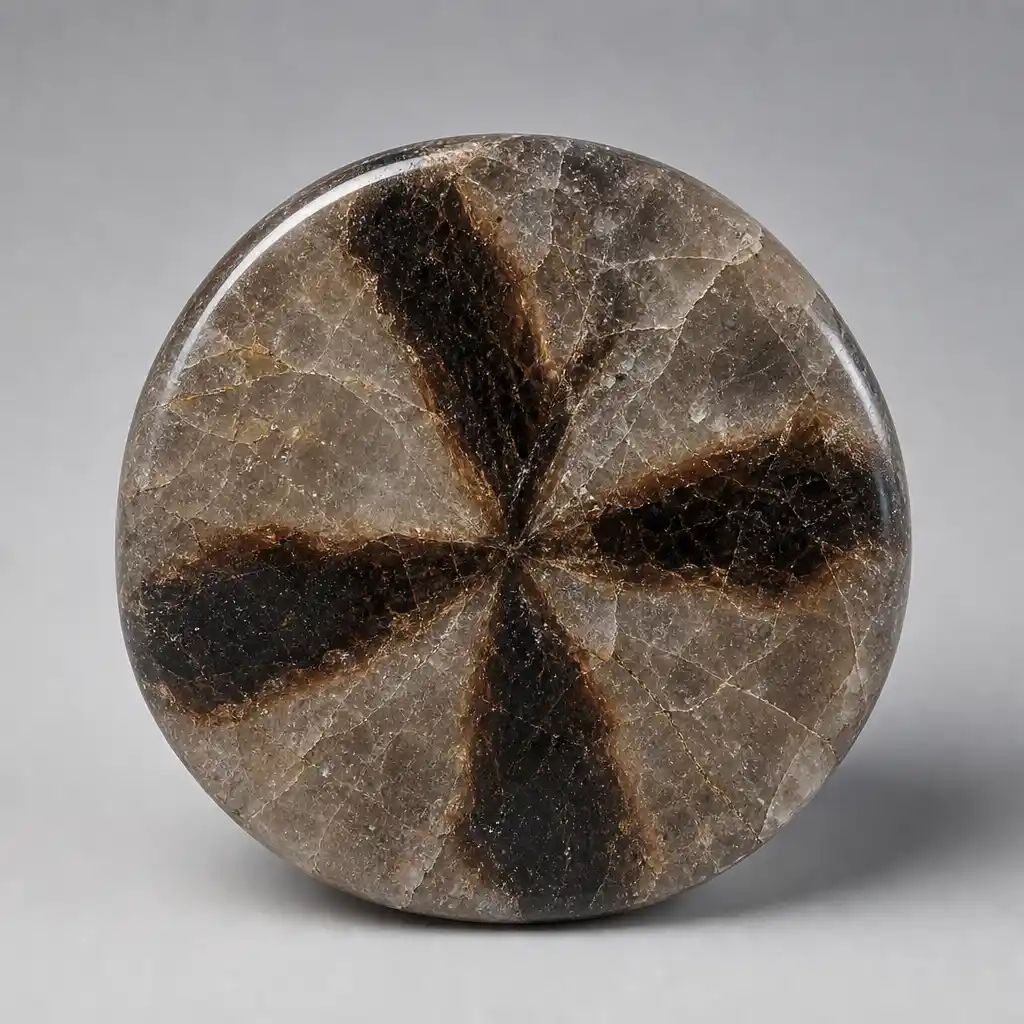
Chiastolite is the Stone of the Cross — a natural andalusite variety with a genuine black cross pattern formed by carbon inclusions, valued for millennia as a protective talisman and bridge between physical and spiritual realms.
Those navigating life transitions, spiritual seekers needing grounding, anyone requiring strong protection that does not close the heart, and people drawn to the symbolism of the cross
“I am protected, grounded, and guided through all transitions. I stand at the crossroads with courage and clarity.”
Cleanse with moonlight, earth burial, or sage smoke; durable stone that tolerates most cleansing methods; store normally
Chiastolite Quick Answers
What is Chiastolite?
Chiastolite is a variety of the mineral andalusite (aluminum silicate) that displays a natural black cross pattern when sliced across its cross-section. The cross pattern is formed by carbonaceous inclusions that arrange themselves along the crystal's crystallographic axes during growth. It is not carved, painted, or artificial in any way — the cross is a genuine geological feature. Chiastolite has been used as a protective amulet across multiple cultures for thousands of years.
Is the cross pattern in Chiastolite natural?
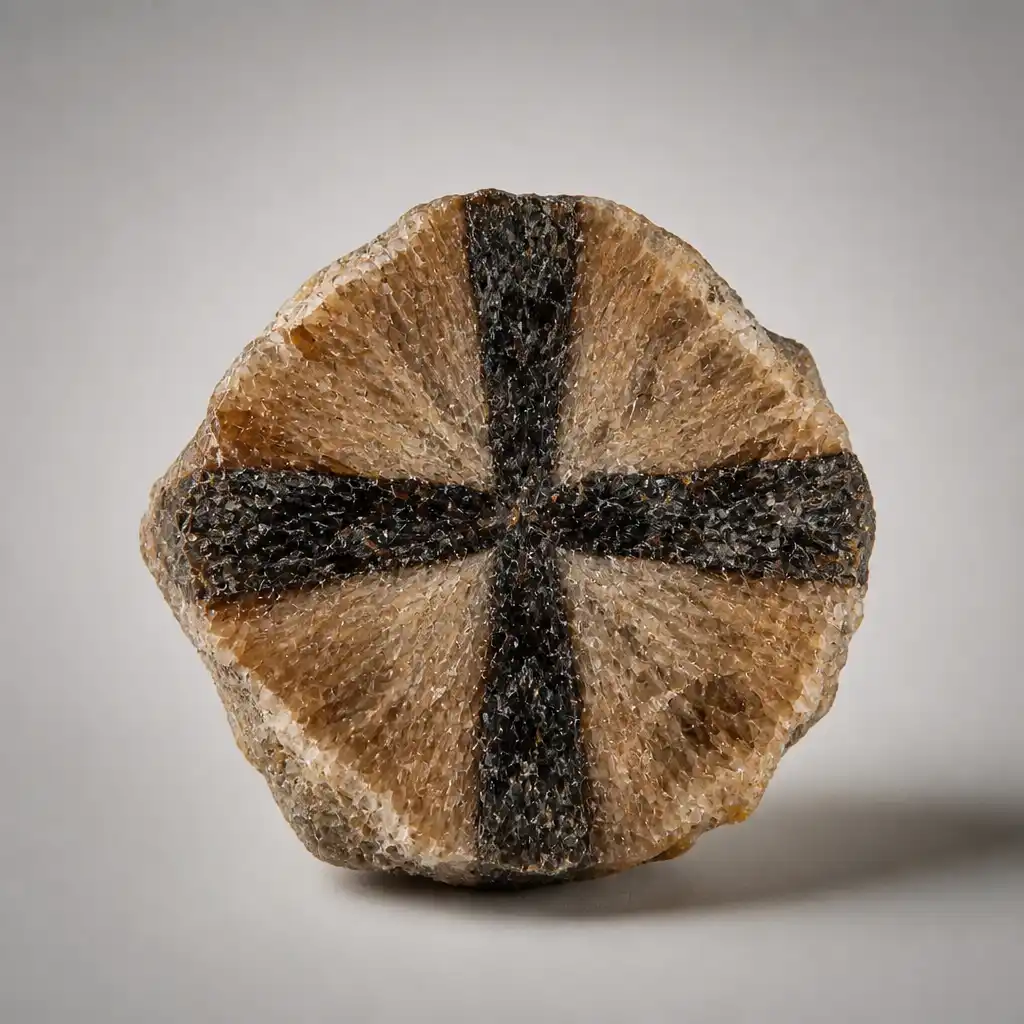
Yes, the cross pattern is entirely natural and forms through a well-understood geological process. As the andalusite crystal grows under metamorphic conditions, carbonaceous material from the surrounding rock is incorporated into the crystal structure. Due to the orthorhombic symmetry of andalusite, the carbon inclusions are preferentially arranged along specific crystallographic directions, forming a cross or X-shaped pattern visible in cross-section. The regularity and clarity of the cross varies between specimens, with the best examples showing a sharp, well-defined cross.
What is the Meaning & History of Chiastolite?
Core Meaning
The Stone of the Cross — Chiastolite's core meaning centers on protection through grounded spiritual awareness. The natural cross pattern that defines the stone is not merely decorative — it represents the intersection of the physical and spiritual, the human and the divine, the known and the unknown. This symbolism of the crossroads or meeting point is central to how Chiastolite works energetically: it does not push you toward the spiritual or anchor you exclusively in the physical but stands at the intersection of both, allowing free movement between realms while maintaining a secure connection to solid ground.
Historical & Cultural Significance
Chiastolite has been valued as a protective talisman for thousands of years, long before mineralogy could explain the origin of its cross pattern. Ancient Romans carried it as an amulet, and it was widely used in medieval Europe as a protective charm against evil spirits and misfortune. The stone was particularly popular among Christian pilgrims who saw the natural cross pattern as a divine sign. Significant deposits in Spain, particularly in the Asturias region, have been worked since antiquity. The mineral was formally described by the French naturalist Joseph Dombey in 1801, and the species name "andalusite" honors Andalusia in Spain, reflecting the importance of Spanish deposits in the mineral's early study.
Symbolism
- ✦The cross — intersection of physical and spiritual, human and divine, matter and spirit
- ✦Protection — one of the oldest protective talismans, shielding without closing off
- ✦Transition and the crossroads — standing at the meeting point of what was and what will be
- ✦Grounded spirituality — connects Root to Crown through Heart, integrating earth and heaven
- ✦Natural sacred geometry — the cross pattern is formed by nature, not human hands
- ✦Courage at the threshold — supports stepping into the unknown with faith and stability
Folklore & Legends
Chiastolite carries some of the richest folklore of any crystal, largely because its natural cross pattern has invited spiritual interpretation across cultures and centuries. In medieval European tradition, Chiastolite was considered one of the most powerful protective stones, often set in silver and worn as an amulet to ward off the evil eye, curses, and malevolent spirits. The natural cross was seen as evidence of divine blessing — a sacred symbol produced by nature itself rather than carved by human hands. Christian pilgrims traveling to sacred sites carried Chiastolite as a talisman of faith and protection on the journey. In some traditions, the four arms of the cross were associated with the four cardinal directions, the four elements, or the four archangels, making the stone a comprehensive symbol of cosmic order and protection. The ancient Chinese also valued Chiastolite, associating the cross pattern with the concept of the center — the still point around which all movement revolves.
Geological Profile
Formation Process
Chiastolite forms under low-pressure, moderate-temperature metamorphic conditions when aluminum-rich, carbon-bearing sedimentary rocks (such as shale or slate) are subjected to regional or contact metamorphism. As the rock is heated and stressed, andalusite crystals grow from the available aluminum and silica, incorporating carbonaceous material from the original sediment. The carbon inclusions are preferentially concentrated along specific crystallographic planes determined by the orthorhombic symmetry of andalusite, creating the characteristic cross pattern. The regularity of the cross depends on the growth rate, the availability of carbonaceous material, and the specific metamorphic conditions. Well-formed crosses require relatively slow, steady growth with consistent access to carbon-bearing material.
Varieties
Classic Brown Chiastolite
The most common variety, displaying a warm brown body color with a darker brown to black cross pattern. This material is found in many worldwide deposits and is the form most commonly encountered in both mineral collections and crystal healing practice.
Black Chiastolite
A darker variety where the body color is deep brown to nearly black, making the cross pattern subtler and requiring careful observation to see. This material tends to come from higher-grade metamorphic environments where temperatures were sufficient to darken both the andalusite and its carbon inclusions.
Gray-White Chiastolite
A lighter variety with a grayish to pale body color and a sharp black cross, producing the most visually striking contrast between the cross pattern and the surrounding material. This form is less common and particularly valued for the clarity of its cross pattern.
Notable Origins
Spain (Asturias and Galicia)
Spanish deposits produce some of the finest Chiastolite specimens, known for their well-formed prismatic crystals with sharp, regular cross patterns. The Asturias region has been a historic source since antiquity, and Spanish Chiastolite remains the benchmark for quality. Specimens from these deposits are widely available and moderately priced.
USA (California and Maine)
California deposits, particularly in the Sierra Nevada foothills, produce attractive Chiastolite crystals that are sometimes referred to locally as "Cross Stones." Maine deposits have also produced notable specimens. American material ranges from brown to gray and can show well-defined cross patterns when sectioned.
Chile (Atacama Region)
Chilean deposits produce distinctive Chiastolite specimens, often in well-formed elongated prismatic crystals with good cross pattern definition. The material tends toward darker brown colors and is valued by collectors for its crystal form as much as for its cross pattern.
Mineral data verified via Mindat.org
Physical Properties
| Hardness | 7 on the Mohs scale |
| Chemical Formula | Al₂SiO₅ |
| Crystal System | Orthorhombic |
| Primary Color | Brown/Black (with natural cross pattern) |
| Origin | Spain, Chile, Russia, USA, Australia, Brazil |
| Transparency | Opaque to translucent at thin edges |
| Luster | Vitreous to sub-resinous on crystal faces, dull on cross-sections |
| Specific Gravity | 3.13-3.17 |
What Are the Healing Properties of Chiastolite?
Emotional & Mental Well-being
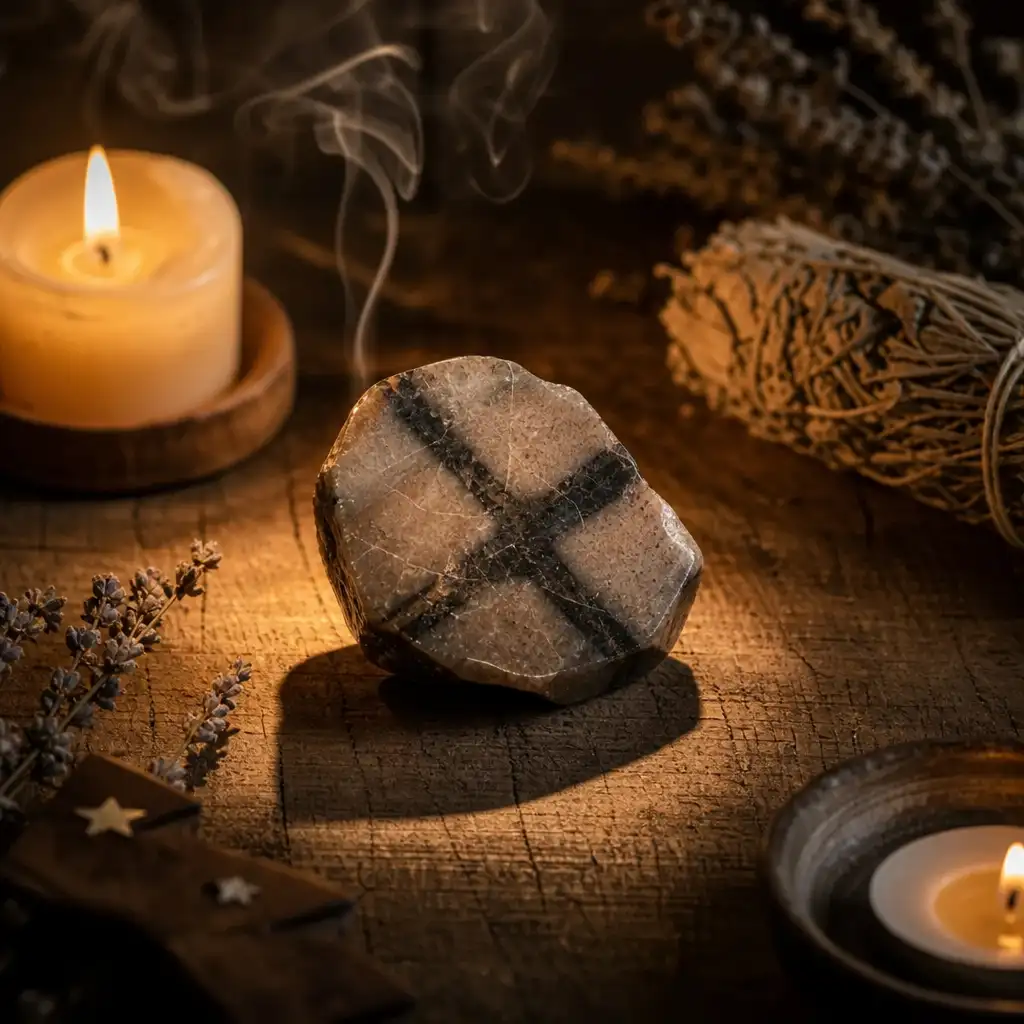
Chiastolite is valued for its ability to provide emotional stability during periods of change, uncertainty, and transition.
- ◆Its grounding energy creates a sense of solid ground beneath your feet even when everything around you feels like it is shifting.
- ◆Crystal practitioners often suggest it for anxiety related to life changes — career transitions, relocations, relationship shifts, and the general uncertainty that accompanies stepping into new chapters of life.
- ◆Rather than eliminating the natural apprehension that comes with change, it provides the grounded confidence to move through it without being overwhelmed.
- ◆Chiastolite also dispels fearful thoughts and replacing them with calm, clear awareness of the present moment.
Spiritual Properties
Chiastolite serves as a bridge stone between the physical and spiritual realms.
- ◆Its unique chakra alignment — Root, Heart, and Crown — creates a pathway from grounded physical awareness through the heart's wisdom to higher spiritual consciousness.
- ◆This three-chakra bridge makes Chiastolite valuable for meditation practices that seek to integrate spiritual insights into daily life rather than experiencing them as separate, disconnected states.
- ◆It also supports spiritual journeying, past-life exploration, and any practice that involves moving between different states of consciousness while maintaining a grounded connection to the physical body.
Physical Healing Traditions
In traditional crystal healing, Chiastolite is associated with supporting the skeletal system, particularly the spine and joints, which aligns with its Root Chakra connection to the body's structural foundation.
- ◆Some practitioners also recommend it for supporting the body during periods of physical recovery and rehabilitation, reflecting its broader theme of supporting transitions and healing processes.
- ◆The stone is linked to healthy bone formation and the body's ability to repair structural tissues.
- ◆These are traditional associations rooted in folk practice, not clinical claims.
- ◆Always consult a qualified healthcare provider for medical concerns.
Note: These properties are based on metaphysical traditions and are not a substitute for medical advice.
What Science Says
Chiastolite is a well-characterized variety of andalusite, an aluminum silicate mineral with orthorhombic crystal structure.
- ◆The cross pattern is fully explained by the preferential distribution of carbonaceous inclusions along specific crystallographic planes during metamorphic crystal growth.
- ◆This mechanism has been confirmed through optical microscopy, electron microprobe analysis, and X-ray diffraction studies.
- ◆The carbon inclusions are primarily graphite, derived from organic material in the original sedimentary rock.
- ◆The andalusite mineral itself is polymorphous with kyanite and sillimanite, all having the same chemical composition (Al2SiO5) but different crystal structures that form under different pressure-temperature conditions.
- ◆As with all crystals, the metaphysical properties attributed to Chiastolite come from crystal healing tradition and lack controlled scientific validation.
Which Chakras Does Chiastolite Connect To?
Which Zodiac Signs Match Chiastolite?
Libra
recommended
Supports Libra's quest for balance and harmony with grounded protection and the ability to navigate transitions without losing center
Capricorn
recommended
Enhances Capricorn's natural grounding and discipline with spiritual depth, helping them navigate transitions between life phases with earthy wisdom
How Do You Use Chiastolite?
Meditation
Hold Chiastolite in your receiving hand or place it at your Root Chakra (base of spine) to establish a firm grounding foundation before beginning deeper meditation. Visualize the natural cross pattern expanding from the stone into your energy field, creating a protective framework through which higher energies can flow safely. For transition-focused meditation, hold the stone while reflecting on what you are leaving behind and what you are moving toward, allowing the cross symbolism to represent the meeting point of past and future.
Daily Wear
Carry Chiastolite as a pocket stone during times of transition or when you need grounding and protection in challenging environments. It can be worn as a pendant — the natural cross pattern makes it an attractive and symbolically meaningful piece of jewelry. For those in helping professions (therapists, social workers, healthcare workers), wearing Chiastolite provides protective energy that prevents the absorption of others' negative emotions while maintaining an open, compassionate heart.
Home Placement
Place Chiastolite at the four corners of your meditation space or bedroom to create a protective energy grid. At the entrance to your home, it serves as a guardian stone that filters negative energy before it enters your living space. For Feng Shui, place it in the north area (career and life path) or the center (health and balance) to support smooth transitions and grounded stability.
Crystal Grids
Use Chiastolite as an anchor stone in protection grids, placed at the four cardinal directions with a center stone of Clear Quartz or Black Tourmaline. For transition support grids, combine it with Smoky Quartz for grounding, Moonstone for intuitive guidance, and Amethyst for spiritual clarity. The stone's natural cross pattern makes it symbolically appropriate for grids that involve crossing thresholds or navigating liminal spaces.
How Do You Cleanse & Charge Chiastolite?
Moonlight Bathing
RecommendedSmudging
RecommendedEarth Burial
RecommendedSound Healing
RecommendedMoon Phase Charging: Chiastolite responds well to moonlight charging, which aligns with its spiritual bridge nature. Place it in direct moonlight during the full moon for a complete overnight cleanse and recharge. Earth burial is particularly appropriate for Chiastolite due to its strong earth element connection — briefly bury the stone in healthy soil overnight to ground and recharge its energy. This method resonates deeply with the stone's Root Chakra affinity.
Avoid the following:
- ✗Harsh chemical cleaners — unnecessary and potentially damaging to polished surfaces
- ✗Prolonged salt water immersion — while Chiastolite is durable, salt can be abrasive to polished cross-sections over time
What Crystals Pair Well with Chiastolite?
Best Combinations
Black Tourmaline
Black Tourmaline amplifies Chiastolite's protective properties, creating one of the most comprehensive protection combinations available. Together they establish a grounded, impenetrable energy field that shields without closing off spiritual receptivity.
Smoky Quartz
Smoky Quartz complements Chiastolite's grounding energy with its own earthy, stabilizing vibration, creating a deeply rooted foundation that supports both protection and spiritual exploration.
Moonstone
Moonstone adds intuitive and feminine wisdom to Chiastolite's grounded protection, supporting smooth transitions with grace and inner knowing. The combination is excellent for navigating life changes with both practical stability and spiritual sensitivity.
Amethyst
Amethyst extends Chiastolite's bridge from Root to Crown with its own powerful Crown Chakra connection, creating a complete pathway for spiritual exploration that remains safely grounded in the physical body.
If You Like Chiastolite, Also Try
How Can You Tell if Chiastolite is Real or Fake?
Common Imitations
Identification Tests
1.Cross Pattern Examination
Examine the cross pattern under magnification (10x loupe or jeweler's loop), paying close attention to the edges, color distribution, and integration with the surrounding material.
In genuine Chiastolite, the cross pattern is formed by carbonaceous inclusions that are integral to the crystal structure. The boundaries between the cross and surrounding material will show gradual transitions, natural irregularities, and three-dimensional depth. Artificial crosses painted or etched onto stones will show surface-level application, sharp artificial edges, and lack of three-dimensional structure.
2.Hardness Test
Test the specimen against reference materials of known hardness.
Chiastolite (andalusite) has a hardness of 6.5-7.5 on the Mohs scale, meaning it can scratch glass. Dyed quartz imitations will have similar hardness but will lack the natural cross pattern. Softer imitations like resin or composites will be noticeably softer and may be scratched by a copper coin.
3.Specific Gravity and Heft Test
Compare the weight of the specimen to a similar-sized piece of known mineral.
Chiastolite has a specific gravity of 3.13-3.17, which is noticeably heavier than quartz (2.65) but lighter than many metallic minerals. Resin replicas will feel significantly lighter. This test is most useful for ruling out lightweight imitations.
Price Reference
Small
$5-15
Medium
$15-45
Large
$45-150
Chiastolite is generally affordable and widely available from multiple deposits worldwide. Specimens with particularly sharp, well-defined cross patterns command higher prices. Polished cross-section slices that clearly display the cross pattern are the most popular form and are moderately priced. Raw prismatic crystals are less expensive but require cutting to reveal the cross pattern.
Is Chiastolite Safe? Care & Precautions
Toxicity Warning
Chiastolite is a form of andalusite (aluminum silicate) and is considered non-toxic for normal handling and display. The carbon inclusions are inert graphite and pose no health risk through skin contact.
Storage
Chiastolite is a relatively durable stone with good hardness (6.5-7.5) and no cleavage, making it resistant to both scratching and splitting. It can be stored with other minerals without special precautions, though a soft pouch will help maintain its polish.
What is Chiastolite Best For?
Chiastolite FAQ — Common Questions Answered
What is Chiastolite?+
Chiastolite is a variety of the mineral andalusite (aluminum silicate) that displays a natural black cross pattern when sliced across its cross-section. The cross pattern is formed by carbonaceous inclusions that arrange themselves along the crystal's crystallographic axes during growth. It is not carved, painted, or artificial in any way — the cross is a genuine geological feature. Chiastolite has been used as a protective amulet across multiple cultures for thousands of years.
Is the cross pattern in Chiastolite natural?+
Yes, the cross pattern is entirely natural and forms through a well-understood geological process. As the andalusite crystal grows under metamorphic conditions, carbonaceous material from the surrounding rock is incorporated into the crystal structure. Due to the orthorhombic symmetry of andalusite, the carbon inclusions are preferentially arranged along specific crystallographic directions, forming a cross or X-shaped pattern visible in cross-section. The regularity and clarity of the cross varies between specimens, with the best examples showing a sharp, well-defined cross.
What is Chiastolite good for?+
Chiastolite's primary strengths lie in protection, grounding, and supporting transitions. Its energy creates a protective field that shields against negative influences without closing you off from positive experiences. It shines during significant life changes — career shifts, relocations, relationship transitions, and spiritual passages. It also supports meditation by providing a grounded foundation from which to explore higher consciousness, and it encourages clarity and courage when facing difficult decisions.
Where does the name Chiastolite come from?+
The name Chiastolite comes from the Greek word "chiastos," meaning "marked with a cross" or "arranged diagonally," referring to the X-shaped or cross-shaped pattern visible in the mineral when cut perpendicular to its long axis. The Greek letter chi (X) is the visual reference for both the name and the pattern. The mineral was formally named chiastolite in 1801 by Joseph Dombey, though the stone itself had been recognized and valued for its cross pattern since ancient times.
Can Chiastolite help with meditation?+
Yes, Chiastolite works beautifully as a meditation stone, particularly for practitioners who struggle with feeling ungrounded or scattered during deep meditation. Its Root Chakra connection provides a stable, secure foundation, while its natural cross pattern symbolizes the bridge between physical and spiritual awareness. Crystal practitioners recommend starting a meditation session by holding Chiastolite to establish grounding, then setting it aside (or keeping it nearby) as you move into deeper states. It also shines for transition-focused meditation — reflecting on where you are and where you are going.
Was this helpful?