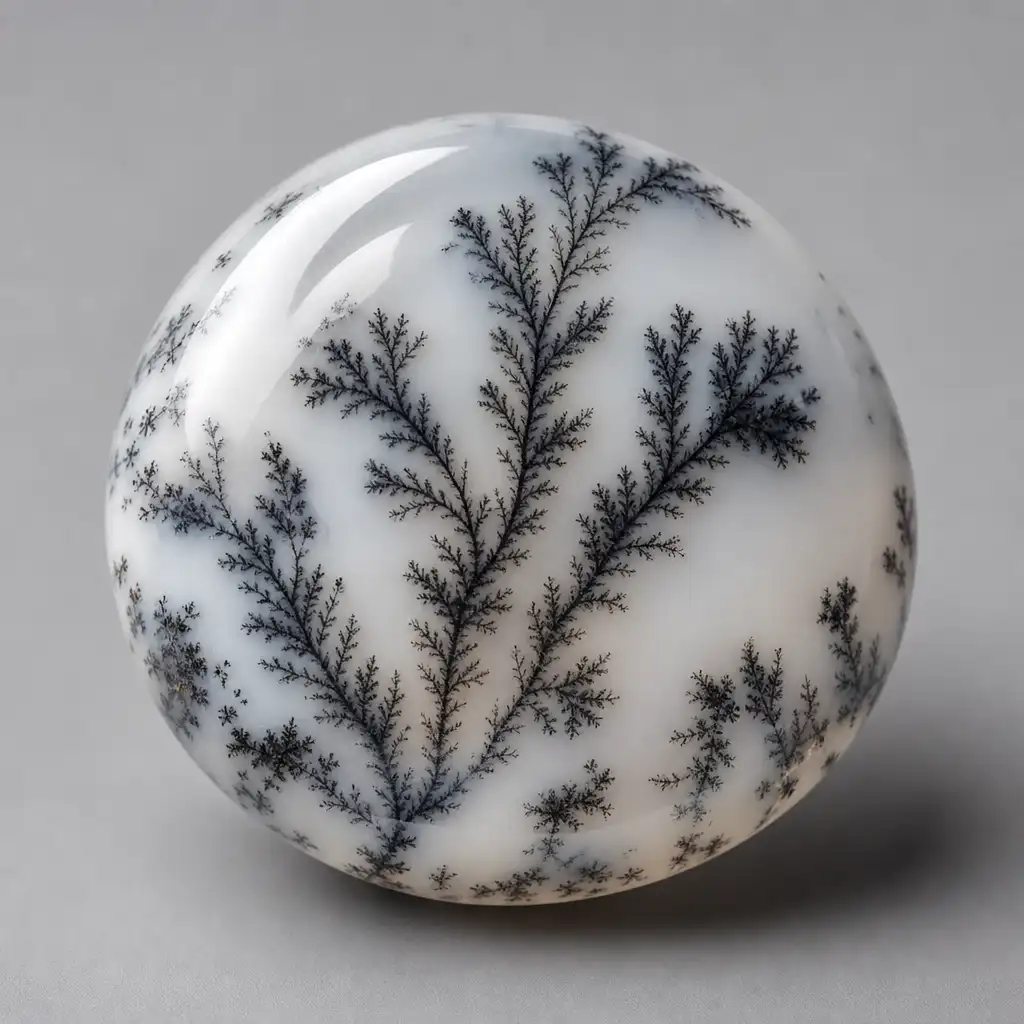
Dendritic Opal at a Glance
Dendritic Opal is the Stone of Inner Growth — a common opal with black manganese oxide dendrites that bridge the physical and spiritual worlds, supporting shamanic work, intuition, and the courage to explore the unknown.
Shamanic practitioners, spiritual seekers exploring inner landscapes, artists and creatives drawn to nature imagery, and anyone working with duality or shadow integration
“I trust the branching pathways of my growth. Every fork in the road leads me deeper into wisdom.”
Cleanse with moonlight, smudging, or selenite; avoid prolonged water exposure and harsh chemicals; handle with reasonable care due to moderate hardness
Dendritic Opal Quick Answers
What is Dendritic Opal good for?
Spiritual growth, shamanic journeying, and tapping into inner wisdom are its main strengths. The Third Eye activation sharpens intuition and psychic perception, and the Root Chakra link keeps you grounded while you explore. Creatively, the stone is a natural ally — those one-of-a-kind patterns spark the imagination and encourage unconventional thinking. Healers and practitioners also use it for past-life recall and for connecting with nature spirits or animal guides.
Is Dendritic Opal the same as Merlinite?
In the metaphysical community, "Merlinite" is commonly used as a trade name for Dendritic Opal, though this can cause some confusion. Strictly speaking, "Merlinite" is sometimes also applied to a different stone — a black and white psilomelane/chalcedony mixture from New Mexico. When purchasing, confirm with the seller that the material is Dendritic Opal (common opal with manganese oxide dendrites) if the specific mineral matters to you. The metaphysical properties attributed to both are very similar, centering on spiritual growth, duality, and magical work.
What is the Meaning & History of Dendritic Opal?
Core Meaning
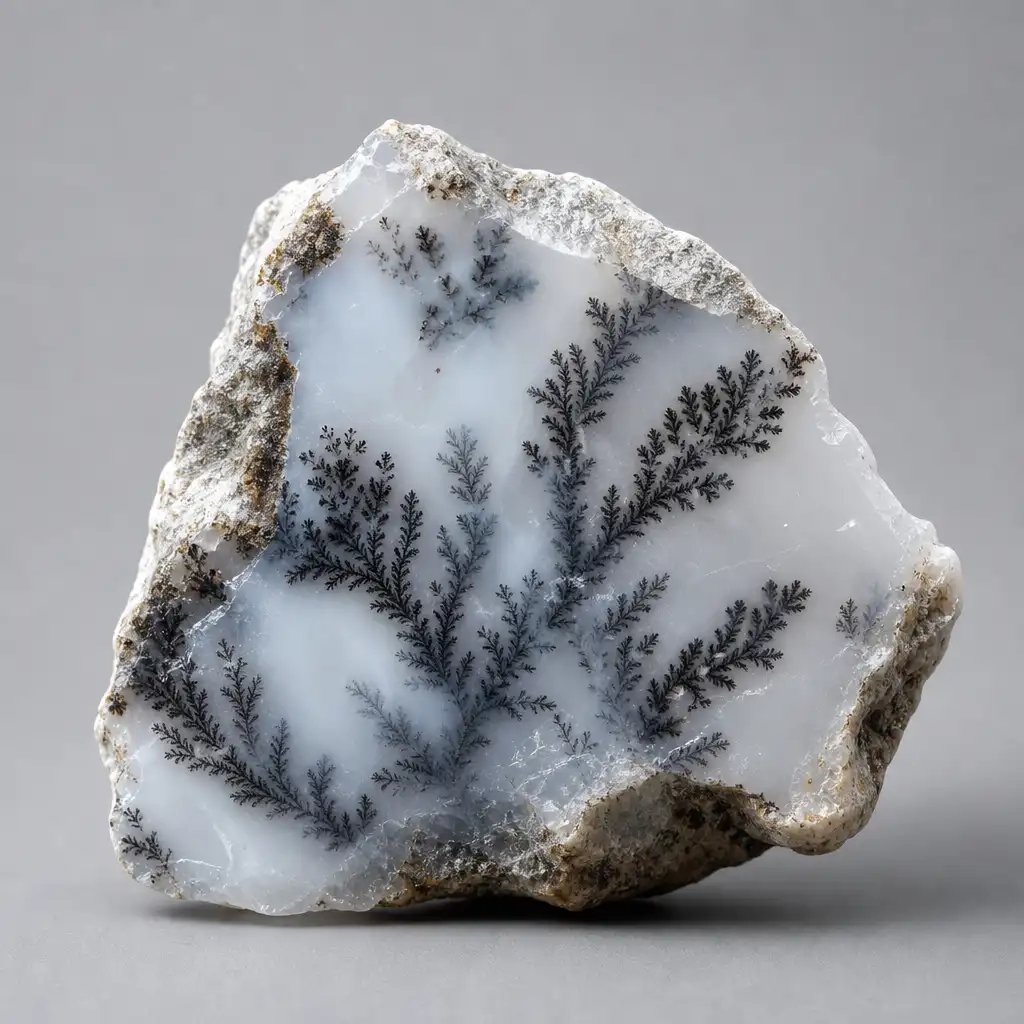
The Stone of Inner Growth — The core lesson of Dendritic Opal is that real growth does not travel in a straight line. It branches. It doubles back. It follows an organic logic that only makes sense in retrospect. Those fern-like inclusions — dark manganese oxide against pale opal — are a constant visual reminder: the most meaningful growth often takes the most unexpected route, and the path that looks like a detour may be exactly where you needed to go. Energetically, the stone sits at a rare intersection. Through the Third Eye and Crown, it opens the door to spiritual insight and higher guidance. Through the Root, it keeps you tethered to physical reality so the experience does not float off into ungrounded fantasy. Expansion and anchoring happen at the same time, and that is what makes Dendritic Opal so effective for serious spiritual work. Duality runs through everything about this stone. Light background, dark inclusions. Known and unknown. Physical and spiritual. Rather than asking you to pick one over the other, it invites you to hold both at once — which is exactly what effective shadow work demands. You do not banish the dark. You learn where it fits in the larger pattern.
Historical & Cultural Significance
Dendritic Opal has been appreciated for its striking visual appearance across multiple cultures throughout history. The name "dendrite" comes from the Greek word "dendron," meaning tree, a direct reference to the branching inclusions that resemble foliage. In ancient Rome, dendritic stones were sometimes called "landscape agates" or "mocha stones" (from Mocha in Yemen, where similar dendritic material was traded) and were valued as curiosities and ornamental objects. The trade name "Merlinite" emerged in the late twentieth century metaphysical community, drawing an association with the legendary wizard Merlin of Arthurian legend. The black and white patterning was seen as representing the mastery of both light and dark magic, and the stone became popular among practitioners of natural magic, Wicca, and shamanic traditions. The name persists in the metaphysical market today, though mineralogists prefer the more precise "dendritic opal" or "dendritic common opal." In India, where significant deposits of Dendritic Opal occur, the stone has been carved into cabochons and ornamental objects for centuries. Indian lapidaries particularly value specimens with well-defined, aesthetically pleasing dendritic patterns.
Symbolism
- ✦The Tree of Life: branching patterns representing interconnected growth and the unity of all living things
- ✦Duality mastery: light and dark coexisting, each enriching the other
- ✦Inner pathways: the courage to follow non-linear spiritual paths
- ✦Nature's artistry: each stone a unique landscape reminding us of the creativity inherent in natural processes
- ✦Shamanic gateway: the dendritic branches serve as visual portals to altered states of consciousness
- ✦Mycelial connection: hidden networks of communication and interdependence beneath the visible surface
Folklore & Legends
Crystal folklore links Dendritic Opal to the spirit of the forest and the intelligence woven through the natural world. There is a belief that the dendritic patterns encode messages from nature spirits or devas, and that meditating on the branching lines can surface guidance about your spiritual path. The Merlin association — from the "Merlinite" trade name — ties the stone to the legendary magician who moved freely between human and magical realms. Dendritic Opal is said to play a similar bridging role for those who work with it. One folk practice suggests setting the stone at the base of a living plant to create an energetic bridge between crystal and roots, boosting the growth of both.
Geological Profile
Formation Process
Dendritic Opal is a variety of common opal (hydrated silica, SiO2-nH2O) that forms in low-temperature sedimentary and volcanic environments. The opal itself precipitates from silica-rich groundwater, filling cavities and replacing organic material in sedimentary rocks. The distinctive dendritic (branching) inclusions are composed of manganese oxide minerals, primarily psilomelane, that crystallized along fractures and surfaces within the opal during or after its formation. The dendritic growth pattern is a result of diffusion-limited aggregation — the manganese oxide crystals grow at their tips where the concentration of dissolved minerals is highest, splitting and branching as they encounter variations in the host material. This is the same physical process that creates lightning bolts, river deltas, and the branching patterns of real trees and ferns.
Varieties
White Dendritic Opal
The most common variety, featuring a white to cream-colored opal background with black or dark brown manganese oxide dendrites. Produces the highest contrast between dendrites and background, making the branching patterns most visible.
Grey Dendritic Opal
Features a grey background with darker dendritic inclusions. The subtler contrast creates a more muted, atmospheric appearance. Sometimes shows dendrites in multiple shades of grey and brown.
Dendritic Agate
Technically a chalcedony (microcrystalline quartz) rather than opal, but visually similar with dendritic inclusions. Harder and more durable than dendritic opal. The trade name "Merlinite" is sometimes applied to both materials.
Notable Origins
India
One of the most prolific sources of Dendritic Opal, producing material in a range of qualities. Indian specimens often feature well-defined dendritic patterns on white to cream backgrounds. Widely available in the lapidary trade.
USA
Dendritic Opal occurs in several western states, with some specimens from Oregon and Montana displaying particularly fine dendritic patterns. American material is less commonly seen in the commercial market but is valued by collectors.
Mexico
Mexican deposits produce Dendritic Opal with distinctive warm-toned backgrounds ranging from cream to light brown. The dendrites tend to be dark brown to black, creating strong visual contrast.
Australia
Australian Dendritic Opal sometimes occurs in association with precious opal deposits. The material can display dendritic patterns against a slightly translucent background with warm body tones.
Mineral data verified via Mindat.org
Physical Properties
| Hardness | 6 on the Mohs scale |
| Chemical Formula | SiO₂·nH₂O (with manganese oxide dendrites) |
| Crystal System | Amorphous |
| Primary Color | White/Grey (with black dendrite inclusions) |
| Origin | India, USA, Mexico, Australia, Brazil |
| Transparency | Opaque to translucent |
| Luster | Vitreous to waxy |
| Specific Gravity | 1.98-2.20 |
What Are the Healing Properties of Dendritic Opal?
Emotional & Mental Well-being
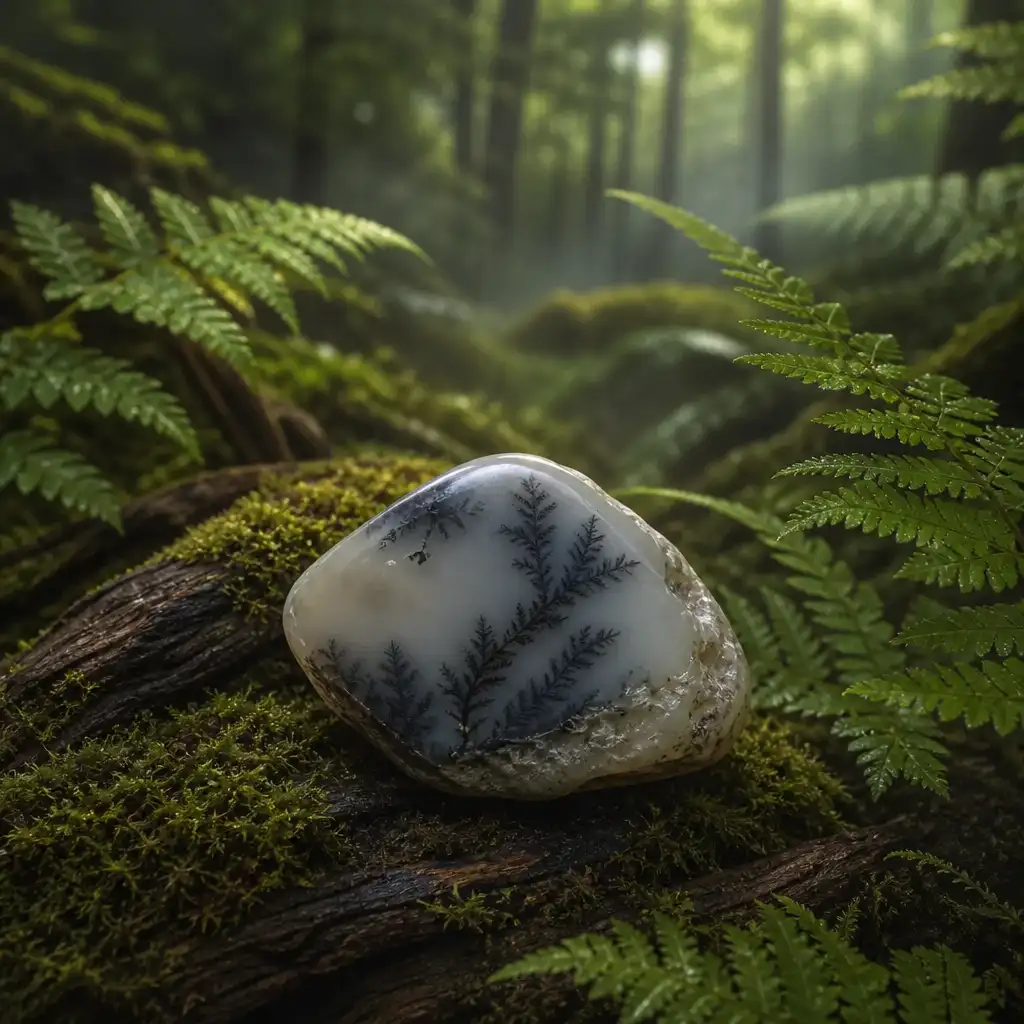
Dendritic Opal helps you accept that emotional growth does not follow a neat trajectory.
- ◆If you have ever felt stuck or frustrated in therapy or personal development — convinced you are making no progress — this stone offers a counter-argument in visual form.
- ◆Those branching inclusions say: growth happens in directions you did not plan, and what looks like a setback might actually be a new shoot.
- ◆It encourages emotional honesty without bullying you into it.
- ◆The energy feels more like water finding its way through stone than like a crowbar prying feelings loose.
- ◆Breakthroughs happen, but they happen organically, at a pace the psyche can absorb.
- ◆That makes it a strong companion for long-term emotional work where patience and self-compassion matter more than speed.
- ◆If you wrestle with the duality of your emotional life — strength alongside vulnerability, joy tangled with grief, confidence shadowed by doubt — Dendritic Opal offers a framework for accepting the whole tangle rather than trying to prune away the hard parts.
Spiritual Properties
Among shamanic and spiritual practitioners, Dendritic Opal has a serious reputation.
- ◆The Third Eye activation sharpens perception of non-ordinary reality and helps you navigate spiritual landscapes with more confidence.
- ◆A common trance technique involves following the dendritic patterns with your gaze — tracing the branching lines until the physical image dissolves and the inner journey takes over.
- ◆Having both Crown and Root engaged creates an energetic axis that lets you travel deep while staying connected to the physical body.
- ◆That matters in shamanic work: you need to go far, but you also need to come back fully.
- ◆The branching patterns connect to past-life recall and ancestral work too, since the visual echo of a family tree — roots, forks, interconnections — is hard to miss.
Physical Healing Traditions
Traditional crystal healing connects Dendritic Opal to the nervous system, the skeletal system, and the body's general healing processes.
- ◆Healers sometimes place it on injuries to support cellular regeneration — a logical extension of its growth-oriented reputation.
- ◆Certain traditions also link it to the spleen and immune function.
- ◆These associations come from folk practice and metaphysical tradition rather than medical science, and they work best as a complement to, not a substitute for, professional healthcare.
Note: These properties are based on metaphysical traditions and are not a substitute for medical advice.
What Science Says
Geologically, Dendritic Opal is common opal (hydrated amorphous silica) with manganese oxide inclusions.
- ◆The branching patterns form through diffusion-limited aggregation — the same physical process behind snowflakes, lightning bolts, and mineral dendrites in many rock types.
- ◆Unlike precious opal, it lacks the regular silica sphere structure that produces play-of-color.
- ◆The manganese oxide inclusions (primarily psilomelane) are stable and pose no handling risk.
- ◆At 5.
- ◆5-6.
- ◆5 on the Mohs scale, the stone is relatively soft and somewhat porous, so treat it with reasonable care.
- ◆The metaphysical properties have not been scientifically validated, though the psychological benefits of meditative practice using visual focal points are well-supported in mindfulness research.
Which Chakras Does Dendritic Opal Connect To?
Which Zodiac Signs Match Dendritic Opal?
How Do You Use Dendritic Opal?
Meditation
For Third Eye meditation, hold Dendritic Opal at your brow or place it between your eyebrows while lying down. Before closing your eyes, spend a few moments gazing into the dendritic patterns, letting your eyes follow the branches without trying to control where they go. When you close your eyes, the afterimage of the branches may transform into inner visions or intuitive insights. For shamanic journeying, hold the stone in your dominant hand and allow the dendritic patterns to serve as the entry point into non-ordinary reality.
Daily Wear
Wear Dendritic Opal as a pendant to keep its growth-promoting energy close to your heart and third eye throughout the day. The stone is moderately hard (5.5-6.5) and should be set in protective bezels rather than prong settings for daily wear. A cabochon cut that showcases the dendritic patterns is ideal. For those who work with nature — gardeners, environmentalists, outdoor educators — wearing Dendritic Opal can enhance the sense of connection to the natural world.
Home Placement
Place Dendritic Opal on your meditation altar or spiritual workspace to enhance the energy of spiritual growth and exploration. In the creative workspace, it stimulates imagination and unconventional thinking. Near houseplants, some practitioners believe Dendritic Opal creates an energetic bridge that benefits both the crystals and the plants. Avoid placing it in areas of high humidity or direct, prolonged sunlight, which can affect common opal over time.
Crystal Grids
Use Dendritic Opal as the center stone in spiritual growth or shamanic journeying grids. Surround it with Moldavite for accelerated transformation, Labradorite for Third Eye enhancement, and Black Tourmaline for grounding and protection. For creative grids, combine Dendritic Opal with Citrine for inspiration and Clear Quartz for amplification. The stone's branching energy works well as the hub from which other crystal energies radiate outward.
How Do You Cleanse & Charge Dendritic Opal?
Moonlight Bathing
RecommendedSmudging
RecommendedSound Healing
RecommendedSelenite Charging
RecommendedMoon Phase Charging: Dendritic Opal responds beautifully to moonlight cleansing, particularly under the full moon. Place it where it can absorb moonlight overnight for a gentle, thorough cleanse. The new moon phase is ideal for setting intentions around spiritual growth and new beginnings. Smudging with sage, palo santo, or cedar is also highly effective and resonates with the stone's earthy nature. Selenite charging plates work well for maintenance cleansing between uses.
Avoid the following:
- ✗Prolonged water soaking — common opal is porous and can absorb moisture
- ✗Salt water — can damage the stone's surface and affect the dendritic inclusions
- ✗Harsh chemical cleaners — ammonia, bleach, and strong solvents
- ✗Ultrasonic cleaners — the vibrations can potentially damage the stone's internal structure
- ✗Extreme heat or rapid temperature changes
What Crystals Pair Well with Dendritic Opal?
Best Combinations
Labradorite
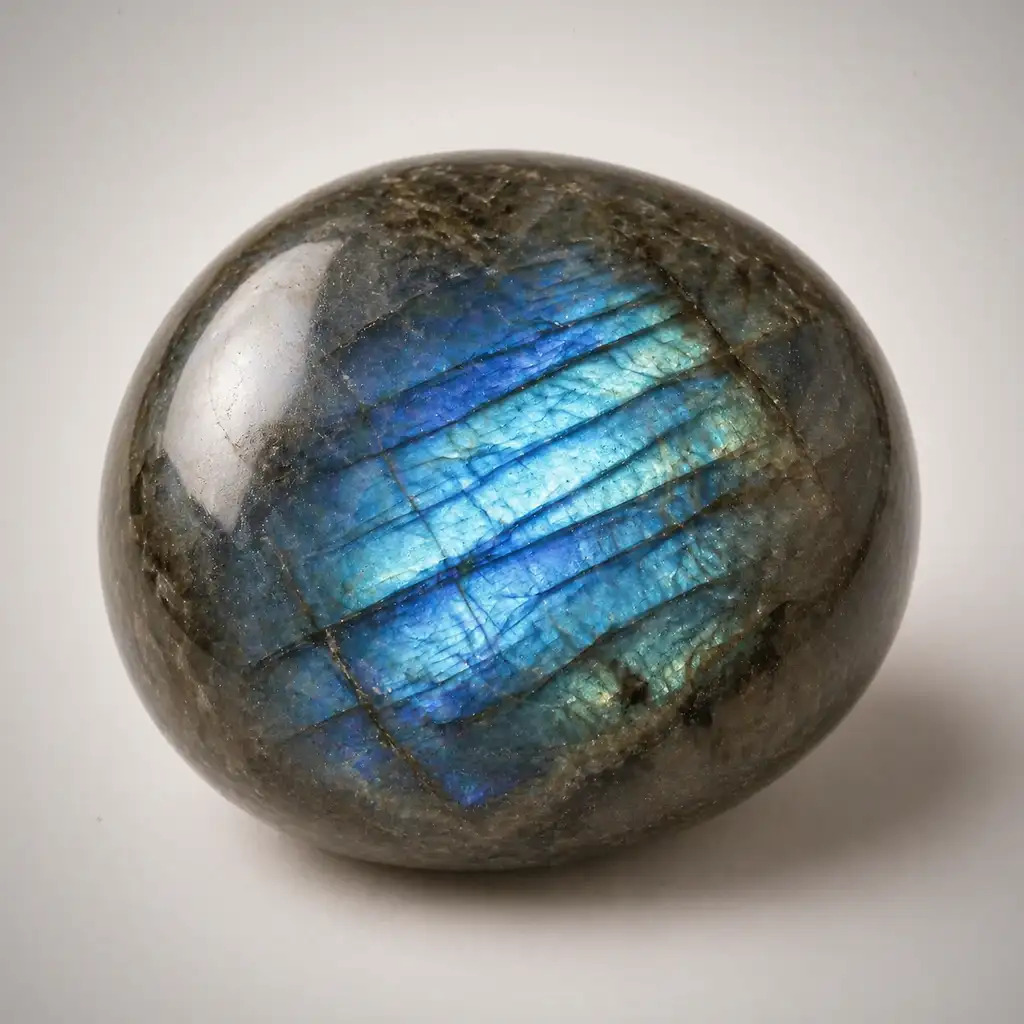
Labradorite and Dendritic Opal are both Third Eye stones, but Labradorite adds flash and mystery while Dendritic Opal adds grounding and organic growth — together they create a powerful yet balanced spiritual awareness combination
Moss Agate
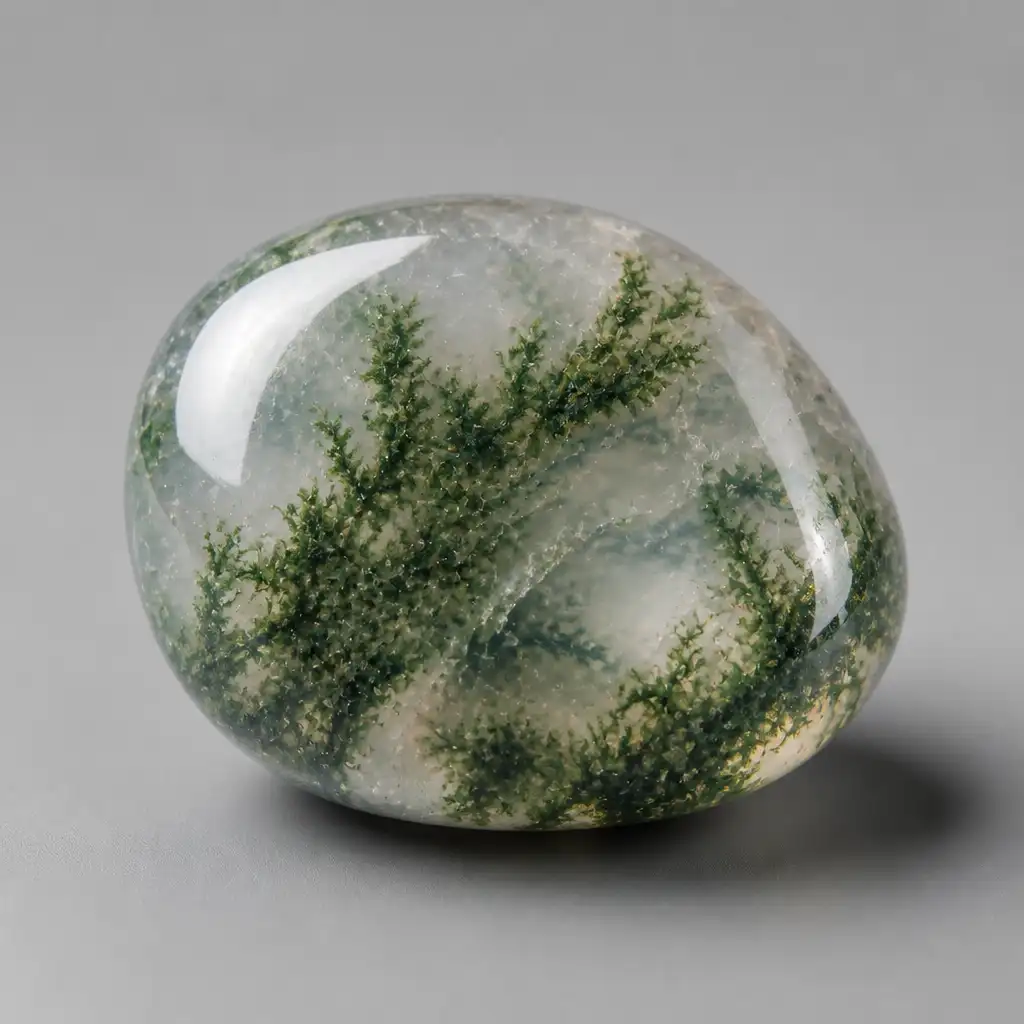
Moss Agate shares the dendritic/plant-like visual quality and earthy energy, making this a natural pairing for nature-based spiritual work, garden magic, and connecting with the green world
Moldavite
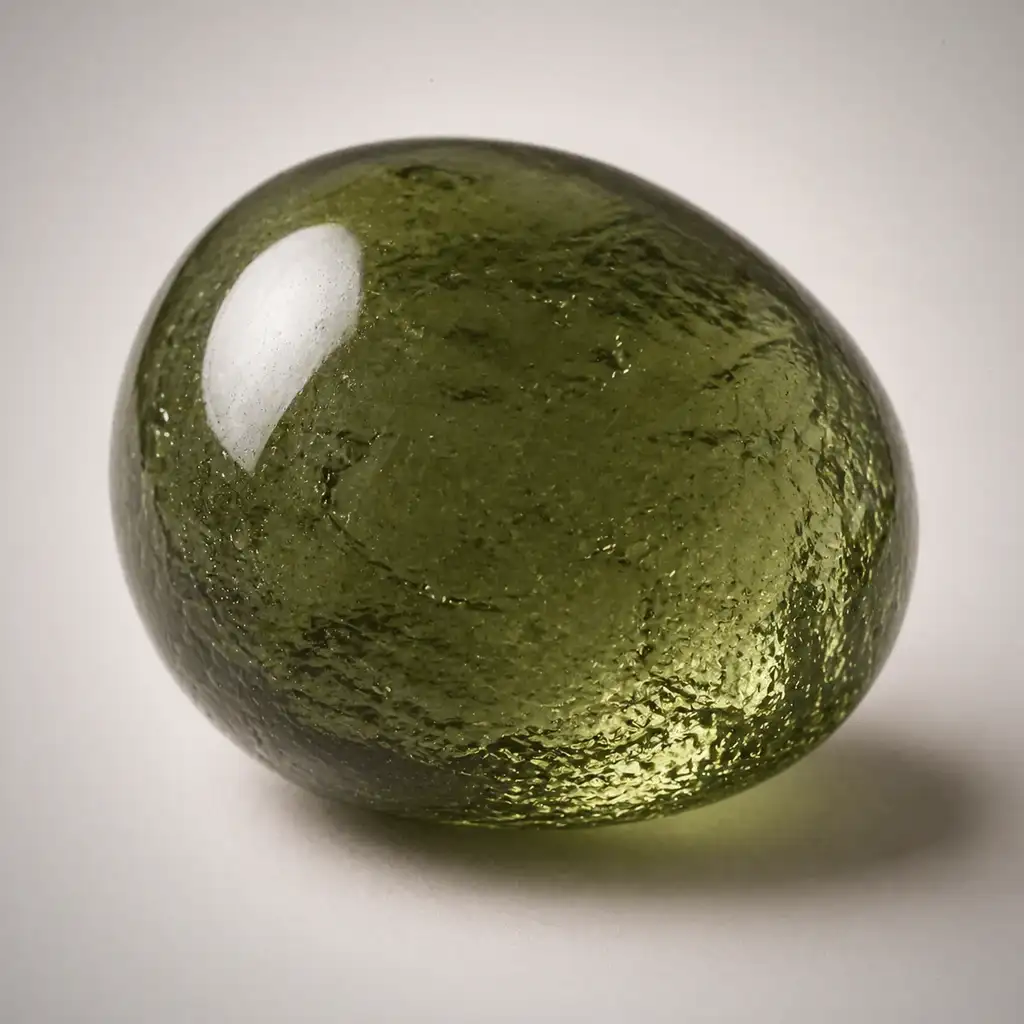
Moldavite accelerates spiritual transformation while Dendritic Opal provides the grounding stability to handle that acceleration safely — an excellent combination for intensive spiritual growth work
If You Like Dendritic Opal, Also Try
How Can You Tell if Dendritic Opal is Real or Fake?
Common Imitations
Identification Tests
1.Magnification of Dendritic Patterns
Examine the dendritic inclusions under 10x magnification, looking at the edges and structure of the branching patterns.
Natural dendritic inclusions show three-dimensional branching that extends into the stone, with edges that vary in thickness and show natural mineral texture. Manufactured or printed patterns appear flat, two-dimensional, and too uniform. Real dendrites have the organic irregularity of actual plant growth.
2.Hardness Test
Test the hardness by trying to scratch the stone with a steel nail and a copper coin.
Genuine Dendritic Opal (5.5-6.5 Mohs) can be scratched by a steel nail with moderate effort and can scratch a copper coin. Resin imitations are much softer and show a waxy or sticky texture when scratched. Glass imitations are harder and more uniform in texture.
3.Weight and Temperature Test
Hold the stone and assess its weight relative to its size, and note how quickly it warms in your hand.
Natural opal has a moderate specific gravity and feels like stone in the hand — cool to the touch initially, warming slowly. Resin is noticeably lighter and warms quickly. Common opal should feel distinctly heavier than plastic of the same size.
Price Reference
Small
$5-20
Medium
$20-60
Large
$50-150
Dendritic Opal is moderately priced and generally accessible. Specimens with particularly well-defined, aesthetically pleasing dendritic patterns command higher prices. Cabochons with landscape-like dendritic scenes are the most sought after. The price is primarily determined by the visual quality of the dendritic patterns rather than size alone.
Is Dendritic Opal Safe? Care & Precautions
Toxicity Warning
Dendritic Opal is composed of hydrated silica with manganese oxide inclusions. Both components are stable and non-toxic under normal handling conditions. The manganese is locked within the crystal structure and does not leach out. Safe for direct skin contact and display. Standard hygiene practices (hand washing after handling raw specimens) are sufficient.
Storage
Store Dendritic Opal away from harder minerals that could scratch it, in a soft pouch or lined container. Common opal is more porous than crystalline quartz, so avoid storing in extremely dry conditions that could potentially cause microscopic cracking over very long periods. Normal indoor humidity is fine.
Special Warnings
- ⚠Avoid prolonged soaking in water — common opal is more porous than precious opal and can absorb moisture
- ⚠Do not expose to extreme heat or rapid temperature changes, which can cause cracking
- ⚠Handle with reasonable care — at 5.5-6.5 Mohs, it is more susceptible to scratching than quartz varieties
What is Dendritic Opal Best For?
Dendritic Opal FAQ — Common Questions Answered
What is Dendritic Opal good for?+
Spiritual growth, shamanic journeying, and tapping into inner wisdom are its main strengths. The Third Eye activation sharpens intuition and psychic perception, and the Root Chakra link keeps you grounded while you explore. Creatively, the stone is a natural ally — those one-of-a-kind patterns spark the imagination and encourage unconventional thinking. Healers and practitioners also use it for past-life recall and for connecting with nature spirits or animal guides.
Is Dendritic Opal the same as Merlinite?+
In the metaphysical community, "Merlinite" is commonly used as a trade name for Dendritic Opal, though this can cause some confusion. Strictly speaking, "Merlinite" is sometimes also applied to a different stone — a black and white psilomelane/chalcedony mixture from New Mexico. When purchasing, confirm with the seller that the material is Dendritic Opal (common opal with manganese oxide dendrites) if the specific mineral matters to you. The metaphysical properties attributed to both are very similar, centering on spiritual growth, duality, and magical work.
Can Dendritic Opal go in water?+
Dendritic Opal is a common opal variety containing water in its structure, and while brief rinsing under cool water for cleansing is generally safe, prolonged soaking should be avoided. Common opal is more porous and less durable than precious opal, and extended water exposure can potentially affect the stone over time. Never use hot water, salt water, or chemical solutions. Dry the stone promptly after any water cleansing. The safest cleansing methods are moonlight, smudging, and selenite charging.
How do the dendritic patterns form?+
The distinctive tree-like or branching patterns in Dendritic Opal are formed by manganese oxide minerals (primarily psilomelane) that crystallized within fractures and along surfaces in the opal during its formation. The dendrites grow in a branching pattern because the manganese oxide crystals follow the path of least resistance through the host rock, splitting and branching much like a river delta or a living plant. This process occurs at the microscopic level, and each dendritic pattern is entirely unique, making every stone a one-of-a-kind natural artwork.
What is the spiritual significance of the dendritic patterns?+
The branching patterns carry a lot of symbolic weight. They evoke the Tree of Life, the interconnectedness of all living things, and the forked paths of spiritual development. Dark branches against a pale background mirror the interplay of shadow and light, conscious and unconscious, known and unknown. Shamans and meditators use the patterns as visual gateways, letting the eye trace the branches until ordinary awareness shifts into something deeper. The patterns also bring to mind mycelial networks — those hidden fungal highways connecting forest root systems underground — a reminder that the most important connections are often the ones you cannot see.
Was this helpful?