Aquamarine at a Glance
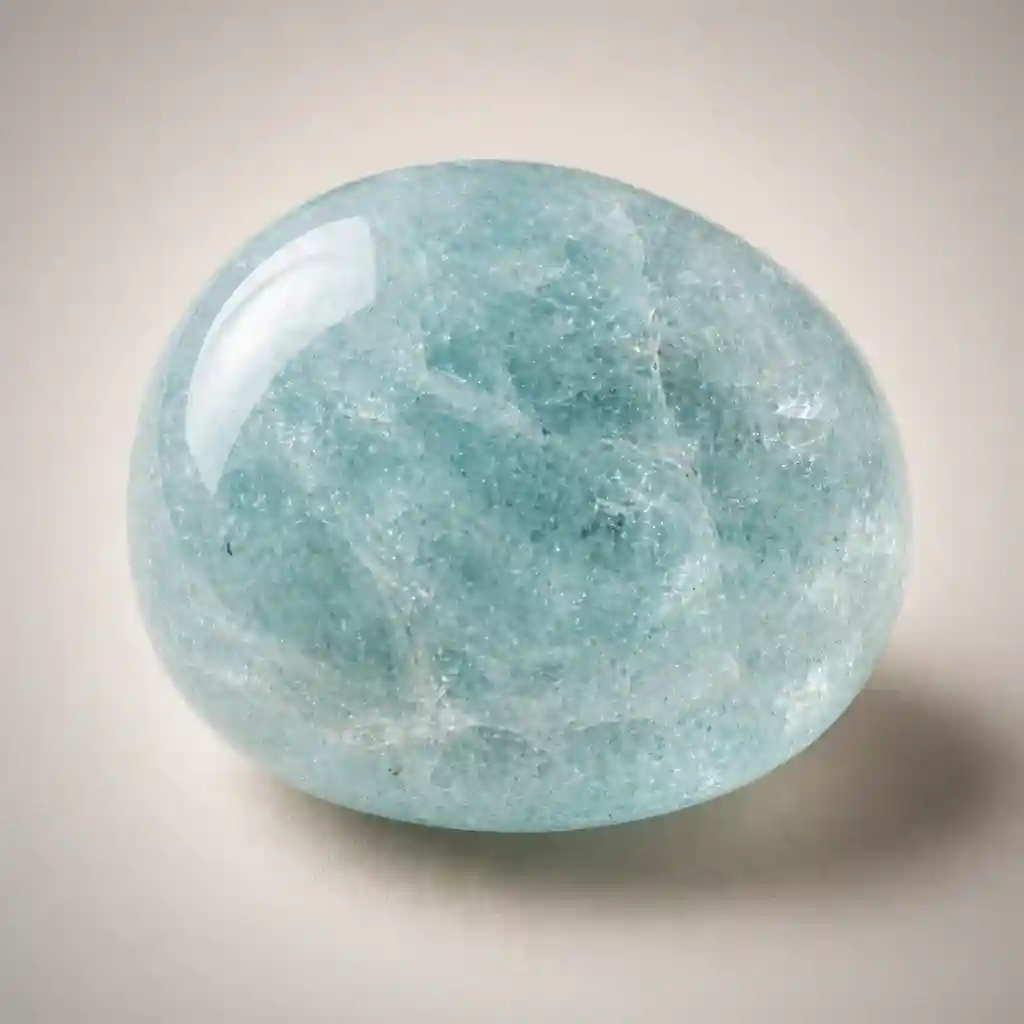
Aquamarine is the stone of courage and the calm sea — a serene blue beryl that washes away fear, clarifies the mind, and empowers truthful, compassionate communication.
Sensitive people needing courage to speak their truth, Pisces and Aquarians, travelers on water, and those seeking calm mental clarity during turbulent times
“I flow with the calm courage of the sea — my mind is clear, my words are true, and my spirit is serene.”
Rinse under running water; charge in moonlight (avoid prolonged sunlight); smudge with sage
Aquamarine Quick Answers
What is Aquamarine good for?
Aquamarine is best known as a stone of courage, calm communication, and protection. It reduces stress, quiets the mind, promotes clear thinking, and helps sensitive people express themselves with confidence. Aquamarine activates the Throat Chakra for honest, compassionate communication, protects travelers (especially on water), enhances intuition and spiritual awareness, and supports the health of the throat, thyroid, and eyes. Its calming energy makes it excellent for meditation and emotional balance.
Does Aquamarine fade in sunlight?
Yes, Aquamarine's delicate blue color can fade with prolonged exposure to strong sunlight or heat. This is because the color comes from iron impurities within the beryl structure, and extended UV exposure can alter these trace elements. Store Aquamarine away from direct sunlight when not wearing it, and avoid leaving it on sunny windowsills. Brief wear in sunlight is fine, but for charging, use moonlight or running water instead of direct sun exposure.
What is the Meaning & History of Aquamarine?
Core Meaning
The Stone of Courage and the Calm Sea — Aquamarine is a stone of courage and calm whose soothing energy reduces stress, quiets the mind, and promotes clear, rational thinking. It has an affinity with sensitive people, providing them with the courage and clarity needed to express their innermost thoughts and feelings. Aquamarine activates the Throat and Heart Chakras, promoting compassionate communication, emotional balance, and the ability to speak one's truth without anger or blame. Its gentle, flowing energy is like the ocean itself — powerful yet peaceful, deep yet transparent.
Historical & Cultural Significance
Aquamarine has been treasured since antiquity for its oceanic beauty and protective properties. Roman fishermen called it the "sailor's gem" and carried it for protection on the water, believing it was the treasure of mermaids. Ancient Romans also believed that Aquamarine could reconcile warring friends, cure laziness, and make the wearer more intelligent. In the Middle Ages, it was believed to be an effective antidote against poison — courtiers wore Aquamarine amulets to protect against assassins. Sumerians, Egyptians, and Hebrews all valued Aquamarine, and it appears in the Bible as one of the gems in the high priest's breastplate. The stone was traditionally used as a prescription for eyeglasses in Germany and Poland — Pope Julius II is recorded as having an Aquamarine lens for this purpose.
Symbolism
- ✦Courage through calm — provides the serenity needed to face fears with grace and composure
- ✦Oceanic wisdom — carries the deep, ancient knowing of the sea and its tides
- ✦Truthful expression — activates the Throat Chakra for honest, compassionate communication
- ✦Purification — like water, Aquamarine cleanses and refreshes the mind and spirit
- ✦Safe passage — traditionally protects travelers, especially those journeying over water
- ✦Eternal youth — ancient Romans believed Aquamarine could preserve youthful vitality
Folklore & Legends
Ancient sailors believed that Aquamarine was the treasure of mermaids, fallen from their underwater kingdoms and washed ashore. The stone was said to ensure safe passage across stormy seas and protect sailors from drowning. In one medieval legend, a fisherman who found an Aquamarine crystal in the belly of a fish was thereafter able to calm any storm simply by holding the stone aloft. In Germanic folklore, Aquamarine was the favorite stone of the Rhine Maidens — water spirits who guarded treasure beneath the river. Ancient Hebrew tradition associated Aquamarine with the tribe of Asher and the month of March, linking it to the spring thaw and the renewal of water flows.
Geological Profile
Formation Process
Aquamarine is a pale blue to blue-green variety of the mineral beryl, the same mineral family that includes Emerald, Morganite, and Goshenite. It forms primarily in granitic pegmatites — coarse-grained igneous rocks that crystallize from the last remnants of magma, rich in rare elements. The blue color of Aquamarine results from trace amounts of iron (Fe2+) within the beryl crystal structure, which substitutes for aluminum in the crystal lattice. The intensity of the blue color depends on the iron concentration — deeper blue specimens are rarer and more valuable. Aquamarine crystals can grow to enormous sizes in pegmatites; the largest known Aquamarine crystal, found in Brazil, weighed over 110 kilograms (243 pounds). Heat treatment is commonly used in the gem trade to remove greenish tones and enhance the pure blue color.
Varieties
Santa Maria Aquamarine
The most prized color variety, displaying an intense, deeply saturated blue named after the Santa Maria de Itabira mine in Brazil. True Santa Maria color is rare and commands premium gemstone pricing.
Maxixe Aquamarine
An extremely deep blue variety discovered in the Maxixe mine of Brazil. Its intense color is due to radiation-induced color centers, but it is notoriously light-sensitive and can fade with prolonged sun exposure.
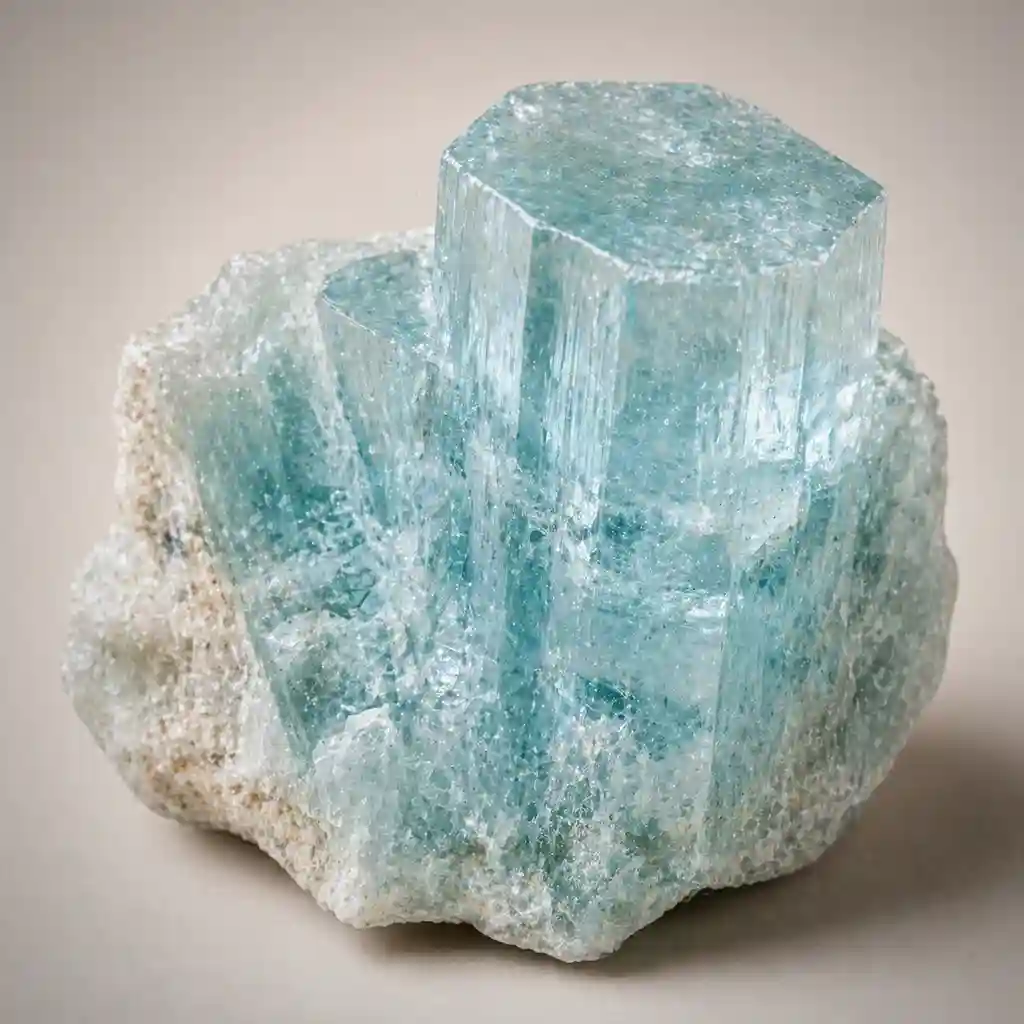
Rough Hexagonal Aquamarine
Uncut crystals displaying the characteristic hexagonal prism form of beryl. Prized by mineral collectors for their natural geometric beauty and by crystal healers for their unprocessed energy.
Notable Origins
Brazil (Minas Gerais)
The world's largest and most prolific producer of Aquamarine, including the famous Santa Maria material. Pegmatite deposits yield enormous crystals, some weighing hundreds of kilograms. Brazilian Aquamarine ranges from pale sky blue to deep teal.
Pakistan (Karakoram Range)
Produces exceptional Aquamarine crystals at high altitudes (over 4,000 meters). Known for superb clarity and sharp hexagonal crystal form. The extreme mining conditions make this material particularly valued by collectors.
Madagascar
Produces Aquamarine in a distinctive blue-green to teal color range. Often found alongside tourmaline and other beryl varieties in pegmatite deposits. Madagascar material is appreciated for its unique color character.
Mineral data verified via Mindat.org
Physical Properties
| Hardness | 8 on the Mohs scale |
| Chemical Formula | Be₃Al₂Si₆O₁₈ |
| Crystal System | Hexagonal |
| Primary Color | Pale Blue |
| Origin | Brazil, Pakistan, Madagascar, Nigeria, Mozambique |
| Transparency | Transparent to translucent |
| Luster | Vitreous |
| Specific Gravity | 2.68-2.71 |
What Are the Healing Properties of Aquamarine?
Emotional & Mental Well-being
Aquamarine is one of the most effective crystals for emotional calming and the development of inner courage.
- ◆Its gentle, flowing energy acts like cool, clear water washing over heated emotions — reducing anger, calming anxiety, and bringing the mind to a state of serene clarity.
- ◆Practitioners frequently recommend Aquamarine for those who struggle with overthinking, as it helps quiet the mental chatter that feeds anxiety and fear.
- ◆The stone is particularly valuable for sensitive people and empaths who absorb the emotions of others, providing an energetic boundary that allows compassion without overwhelm.
- ◆Aquamarine supports the resolution of emotional conflicts by promoting clear, rational thinking balanced with genuine feeling.
- ◆It helps release old emotional patterns that no longer serve, particularly those related to fear of self-expression and the suppression of personal truth.
- ◆Many crystal workers report that wearing Aquamarine during therapy or deep emotional work provides a sense of being held and supported by a calm, loving presence.
Spiritual Properties
Spiritually, Aquamarine is a powerful activator of the Throat Chakra for spiritual communication and the Heart Chakra for compassionate connection.
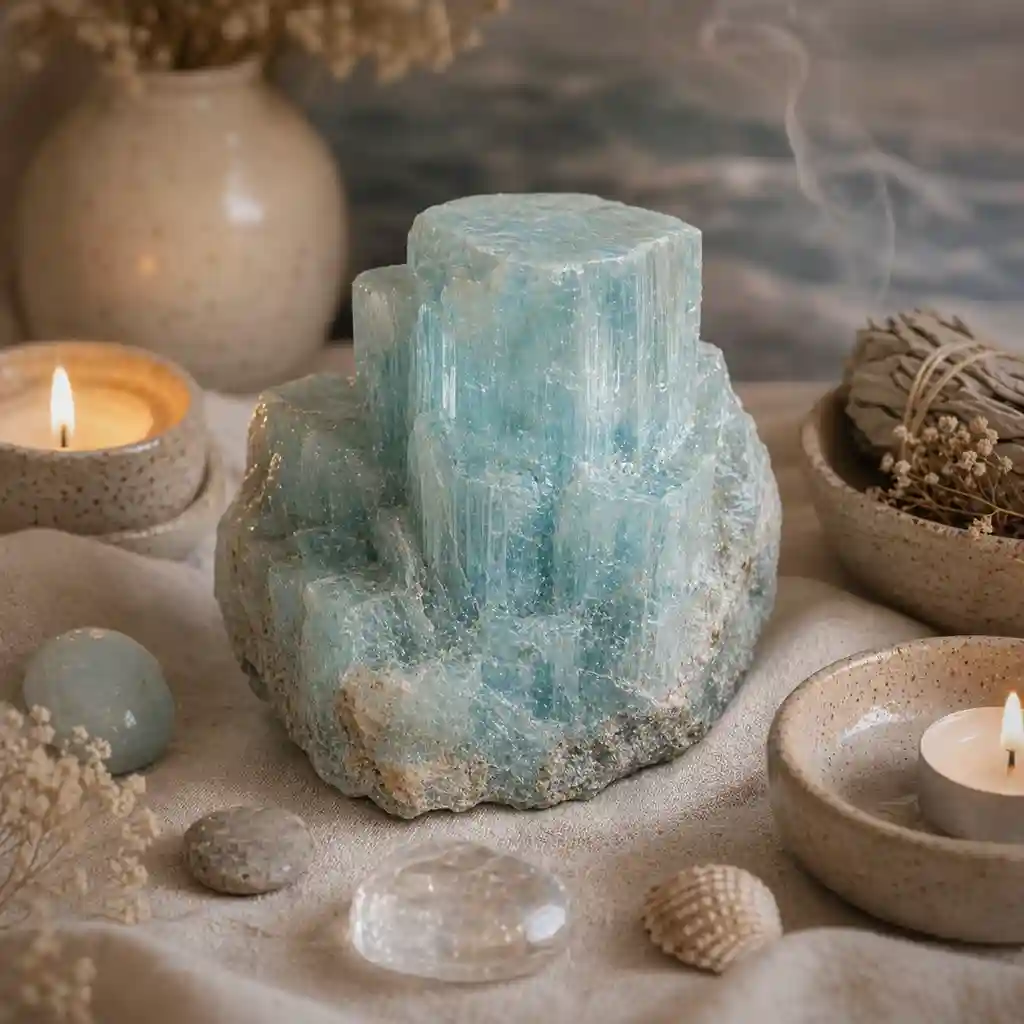
- ◆It is used in meditation to access states of deep tranquility while remaining alert and aware — a rare combination that makes it ideal for contemplative practices.
- ◆Aquamarine sharpens intuition and opens clairvoyant abilities, particularly those related to receiving clear visual imagery during meditation.
- ◆The stone is valued for past-life regression work, as its connection to the element of Water makes it a natural tool for accessing the Akashic records and the oceanic depths of collective consciousness.
- ◆Aquamarine also supports the development of mediumship and spiritual channeling by creating a clear, calm channel between the physical and spiritual bodies.
Physical Healing Traditions
In crystal healing traditions, Aquamarine is most closely associated with the throat, thyroid, and parathyroid glands.
- ◆Crystal practitioners recommend it for vocal cord health, particularly for singers, teachers, and public speakers.
- ◆It is also used for thyroid conditions and is believed to help regulate the body's metabolic processes.
- ◆Aquamarine is traditionally associated with eye health — historically, it was used to improve vision and soothe eye inflammation.
- ◆Some practitioners recommend Aquamarine for conditions related to fluid retention, swollen glands, and jaw tension.
- ◆Its cooling energy is also applied to reduce fever and inflammation.
Note: These properties are based on metaphysical traditions and are not a substitute for medical advice.
What Science Says
From a mineralogical perspective, Aquamarine is a variety of beryl (beryllium aluminum cyclosilicate) whose blue color results from divalent iron ions (Fe2+) replacing aluminum in the crystal lattice.
- ◆It has a Mohs hardness of 7.
- ◆5-8, making it one of the harder gemstones suitable for daily wear.
- ◆Most commercial Aquamarine has been heat-treated (typically at 400-450 degrees Celsius) to remove greenish tones and enhance the pure blue color — this treatment is permanent and widely accepted in the gem trade.
- ◆Aquamarine can fade with prolonged exposure to intense sunlight, as UV radiation can alter the iron oxidation state.
- ◆The geological conditions required for beryl formation (beryllium-rich pegmatites) are well-understood, and Aquamarine deposits are found on every continent except Antarctica.
Which Chakras Does Aquamarine Connect To?
Which Zodiac Signs Match Aquamarine?
How Do You Use Aquamarine?
Meditation
Hold Aquamarine at the Throat Chakra or place it between the eyebrows at the Third Eye during meditation. Visualize cool, clear ocean water flowing through your mind, washing away stress, confusion, and fear. For courage-building meditations, silently repeat: "I flow with calm courage" while feeling the Aquamarine's serene energy merging with your breath. Aquamarine meditation is particularly powerful near natural bodies of water — the ocean, a lake, or a flowing stream. If you cannot be near water, play ocean sounds to enhance the stone's aquatic resonance. Practice for 10-15 minutes when you need to restore mental clarity.
Daily Wear
Wear Aquamarine as a pendant near the throat to enhance communication and the courage to speak your truth throughout the day. As a ring, Aquamarine is durable enough (Mohs 7.5-8) for daily wear, though remove it before activities that could expose it to harsh blows. Aquamarine earrings keep the stone's calming energy near the Third Eye for intuitive clarity. For maximum benefit, wear Aquamarine jewelry on days when you need calm courage — presentations, difficult conversations, or travel. Store Aquamarine jewelry away from direct sunlight when not wearing it to preserve the delicate blue color.
Home Placement
Place Aquamarine in your bathroom or near water features to amplify its oceanic energy (ensure it is not in direct sunlight). A piece on your desk promotes calm, clear thinking during stressful work periods. In the bedroom, Aquamarine on the nightstand encourages restful sleep and intuitive dreams. For Feng Shui applications, place Aquamarine in the north sector (career and life path) or the east (health and family). Near the entrance of your home, Aquamarine creates a welcoming, calm energy for visitors. Avoid placing it on sunny windowsills where the color could fade over time.
Crystal Grids
Use Aquamarine as the center stone in grids for courage, communication, or emotional healing. For a peace grid, combine Aquamarine with Rose Quartz (unconditional love) and Amethyst (spiritual calm) in a triangular pattern. For a truth-speaking grid, place Aquamarine at the throat position with Amazonite and Blue Lace Agate (if available, use Chalcedony Blue). For travel protection, create a simple grid with Aquamarine and Black Tourmaline placed near your travel documents or in your luggage.
How Do You Cleanse & Charge Aquamarine?
Running Water
RecommendedMoonlight Bathing
RecommendedSmudging
RecommendedSunlight Charging
Brief exposure only; prolonged sunlight can fade Aquamarine's delicate blue color
Use CautionMoon Phase Charging: Aquamarine resonates powerfully with moonlight — its oceanic nature aligns naturally with lunar cycles that govern the tides. Place Aquamarine in direct moonlight during the full moon for the most potent recharge. For intention-setting related to courage and communication, charge during the waxing moon as lunar energy grows. Running Aquamarine under cool, clean tap water while visualizing ocean waves is also an effective cleansing method that connects the stone to its elemental origins.
Avoid the following:
- ✗Prolonged direct sunlight — can fade the blue color over time
- ✗Hot water and steam — thermal shock can cause internal fractures
- ✗Ultrasonic cleaners — generally safe for clean stones but risky for Aquamarine with internal feathers or inclusions
- ✗Harsh chemical cleaners — can damage surface polish and affect any treatments
- ✗Salt water — while thematically fitting, prolonged salt water exposure can dull the surface
What Crystals Pair Well with Aquamarine?
Best Combinations
Rose Quartz
Rose Quartz opens the Heart with unconditional love while Aquamarine provides the courage to express that love authentically — a beautiful combination for relationship healing and self-love work
Moonstone
Moonstone's intuitive, receptive energy and Aquamarine's flowing courage create a powerful pairing for developing feminine intuition and emotional wisdom
Amethyst
Amethyst deepens spiritual awareness while Aquamarine keeps the mind calm and clear — together they support profound meditation and spiritual insight without mental overwhelm
How Can You Tell if Aquamarine is Real or Fake?
Common Imitations
Identification Tests
1.Birefringence Test
Examine the stone through a jeweler's loupe (10x magnification), looking for doubling of facet junctions or internal inclusions. Beryl (Aquamarine) has low birefringence.
Genuine Aquamarine will show no visible doubling of facet edges under 10x magnification. Topaz and zircon have higher birefringence and may show visible doubling. Glass and synthetic spinel are isotropic (no birefringence). This test helps distinguish Aquamarine from its most common imitation — Blue Topaz.
2.Color and Clarity Assessment
Examine the stone's color under natural daylight. Natural Aquamarine typically displays a soft, watery, pale blue to blue-green color.
Natural Aquamarine has a distinctive "watery" quality to its color — gentle, soft, and slightly greenish-blue. If the blue is extremely saturated and intense, it is more likely heat-treated Aquamarine, Blue Topaz, or synthetic spinel. Natural Aquamarine is also typically very clean (few inclusions), while glass may show bubbles.
3.Hardness Test
Attempt to scratch the stone with a steel file or quartz crystal. Aquamarine has a Mohs hardness of 7.5-8.
Genuine Aquamarine will not be scratched by steel (hardness ~5.5) and will resist scratching by quartz (hardness 7). Glass (hardness ~5.5) will be scratched by steel. Blue Topaz (hardness 8) is similar in hardness. This test should be performed on an inconspicuous area only.
Price Reference
Small
$15-40
Medium
$40-150
Large
$100-500+
Aquamarine prices vary dramatically based on color saturation, clarity, and size. Pale specimens are relatively affordable, while deep blue Santa Maria quality commands premium gemstone pricing. Heat-treated stones are the industry standard and priced accordingly. Natural, unheated specimens with deep color are rarest and most valuable.
Is Aquamarine Safe? Care & Precautions
Toxicity Warning
Aquamarine (beryl) is non-toxic and safe for all forms of handling, wearing, and environmental placement. It contains beryllium locked within the stable beryl crystal structure, which is not released through normal handling. However, inhaling beryl dust during cutting or grinding is hazardous — this is only a concern for lapidary workers.
Storage
Store Aquamarine away from prolonged direct sunlight to prevent color fading. The blue color comes from iron impurities that can be altered by extended UV exposure. Keep in a jewelry box or soft pouch when not wearing. Aquamarine is relatively hard (7.5-8 Mohs) but can still be scratched by harder stones like sapphire and diamond, so store separately from these if possible.
Special Warnings
- ⚠Prolonged direct sunlight can fade Aquamarine's delicate blue color — avoid leaving on sunny windowsills
- ⚠Maxixe-type Aquamarine is notoriously light-sensitive and can fade rapidly even under indoor lighting
- ⚠While safe for water cleansing, avoid hot water and chemical cleaners which can affect any surface treatments
- ⚠Most commercial Aquamarine has been heat-treated — the color is stable but not indestructible
What is Aquamarine Best For?
Aquamarine FAQ — Common Questions Answered
What is Aquamarine good for?+
Aquamarine is best known as a stone of courage, calm communication, and protection. It reduces stress, quiets the mind, promotes clear thinking, and helps sensitive people express themselves with confidence. Aquamarine activates the Throat Chakra for honest, compassionate communication, protects travelers (especially on water), enhances intuition and spiritual awareness, and supports the health of the throat, thyroid, and eyes. Its calming energy makes it excellent for meditation and emotional balance.
Does Aquamarine fade in sunlight?+
Yes, Aquamarine's delicate blue color can fade with prolonged exposure to strong sunlight or heat. This is because the color comes from iron impurities within the beryl structure, and extended UV exposure can alter these trace elements. Store Aquamarine away from direct sunlight when not wearing it, and avoid leaving it on sunny windowsills. Brief wear in sunlight is fine, but for charging, use moonlight or running water instead of direct sun exposure.
What is the difference between Aquamarine and Blue Topaz?+
Aquamarine and Blue Topaz are often confused because they can appear similar in color, but they are completely different minerals. Aquamarine is a variety of beryl (hardness 7.5-8) with a naturally pale, watery blue color. Blue Topaz is a variety of topaz (hardness 8) that is usually heat-treated and irradiated to achieve its blue color, which tends to be deeper and more saturated than natural Aquamarine. Metaphysically, Aquamarine is more about calm courage and communication, while Blue Topaz is more about mental clarity and individuality. Genuine Aquamarine is generally more valuable.
Why is Aquamarine a birthstone for Pisces?+
Aquamarine is the perfect birthstone for Pisces because both share a deep affinity with the water element. Pisces is the most intuitive and emotionally sensitive sign of the zodiac, and Aquamarine's calming, oceanic energy helps Pisceans navigate their watery depths with courage and clarity. The stone activates the Throat Chakra, helping Pisces — who often struggle to voice their needs — express their rich inner world with confidence while staying emotionally balanced.
How valuable is Aquamarine and where is it mined?+
Aquamarine is a precious gemstone belonging to the beryl family (the same mineral group as Emerald), and fine specimens can command significant prices, especially those with deep, saturated blue color. Major deposits are found in Brazil (particularly Minas Gerais and the state of Espirito Santo), Pakistan, Madagascar, Nigeria, and Mozambique. The famous Santa Maria aquamarine from Brazil, known for its intense deep blue, is among the most prized. Unlike many crystals, gem-quality Aquamarine is widely used in fine jewelry, contributing to its higher market value.
Was this helpful?