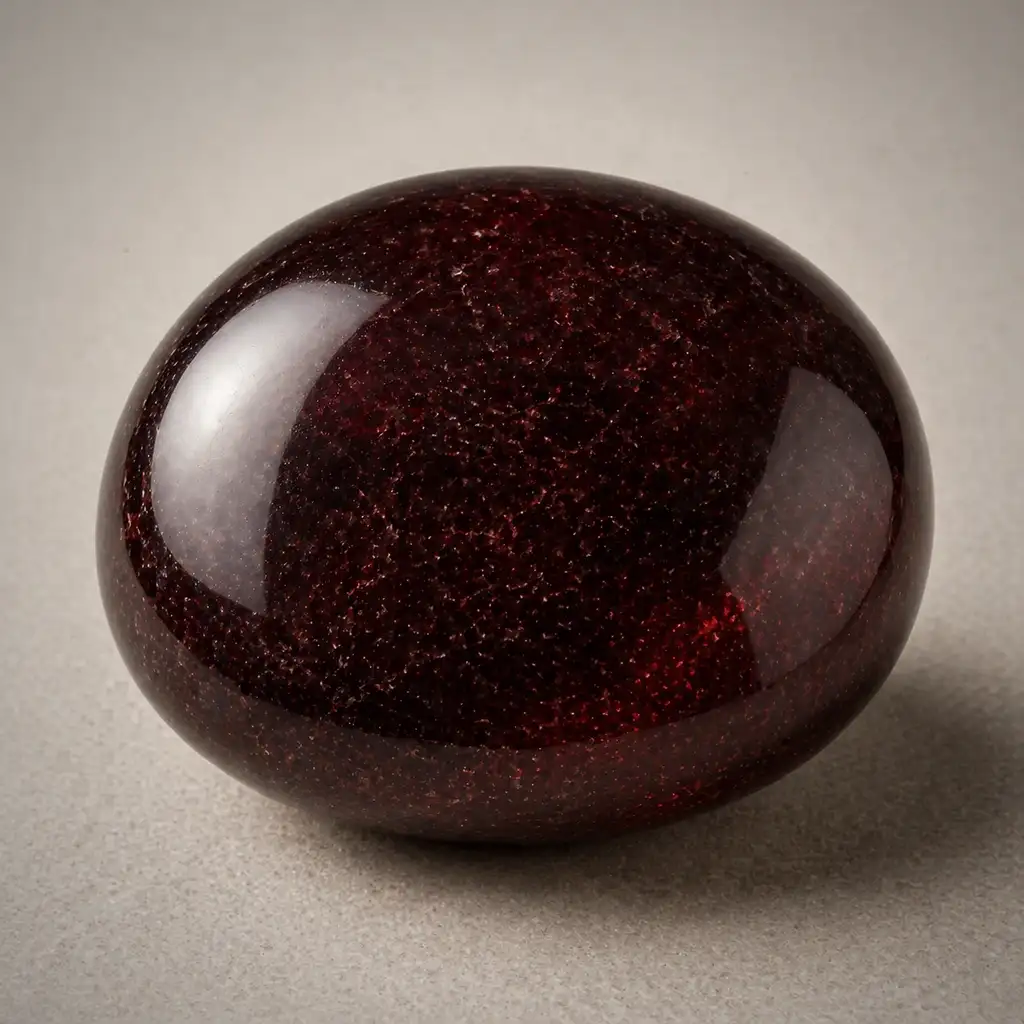
Garnet at a Glance
Garnet is the stone of passionate vitality and deep devotion — a crystal that reignites love, courage, and creative fire when they have gone quiet.
Couples deepening commitment, people recovering from burnout, Aries and Leo individuals, and anyone trying to reignite passion in career or creativity
“I am alive with passionate energy. My heart is full of love, courage, and purpose.”
Rinse under cool running water; charge in moonlight or brief sunlight; avoid harsh chemicals
Garnet Quick Answers
What is Garnet good for?
Garnet is best known for passion, vitality, and devotion. It picks up physical energy, inspires love and loyalty in relationships, and gives you the confidence and courage to push through hard situations. People also use it for success and motivation in their careers. In energy work, it activates kundalini energy, and in crystal healing it is associated with the circulatory system, heart, and blood. The energy is steady and long-lasting rather than a quick jolt.
What colors does Garnet come in?
Deep red is the most familiar, but Garnet actually comes in almost every color. Almandine and Pyrope are deep red to brownish-red. Rhodolite is purplish-red to raspberry pink. Spessartine is orange to reddish-orange. Grossular can be green (tsavorite), yellow (hessonite), or colorless. Andradite includes the rare green Demantoid and yellow-green Mali Garnet. Each variety has a slightly different energy, but they all share Garnet's basic vitality and passion.
What is the Meaning & History of Garnet?
Core Meaning
The Stone of Passion, Vitality, and Devotion — Garnet is about passion and vitality — the kind of energy that gets you moving and keeps you committed. Its deep red color connects the Root and Heart Chakras, tying physical drive to emotional depth. Garnet inspires love, devotion, and loyalty while also supporting self-confidence and personal power. It is particularly associated with awakening kundalini energy and sending a surge of vitality through the whole system.
Historical & Cultural Significance
Garnet has been treasured since the Bronze Age. Ancient Egyptian pharaohs were buried with Garnet talismans for protection in the afterlife. Roman nobles used Garnet signet rings to seal documents, believing the stone guaranteed the seal's truth. Medieval warriors carried Garnet into battle, and Crusaders set the stones into their armor. In the Bible, Garnet is one of the twelve stones in Aaron's breastplate. Islamic tradition says Noah used a Garnet lantern to light the Ark during the Great Flood. The name comes from the Latin "granatum," meaning pomegranate, because the crystals look like the fruit's seeds.
Symbolism
- ✦Passionate love and devotion — the deep red is the color of committed love
- ✦Vitality — connects the energy of blood to the Earth's primal power
- ✦Protection in travel — historically carried by explorers and soldiers
- ✦Determination — the staying power to push through obstacles
- ✦Kundalini awakening — activates dormant spiritual energy at the base of the spine
Folklore & Legends
Ancient Persians believed Garnet was a drop of the sun that had fallen to Earth, and they restricted the finest specimens to royalty. In medieval romance literature, lovers exchanged Garnet rings as tokens of fidelity — supposedly a Garnet given in true love would glow brighter when the giver stayed faithful. Native American healers used Garnet in blood-purification ceremonies, believing it could draw illness from the body and replace it with vital force.
Geological Profile
Formation Process
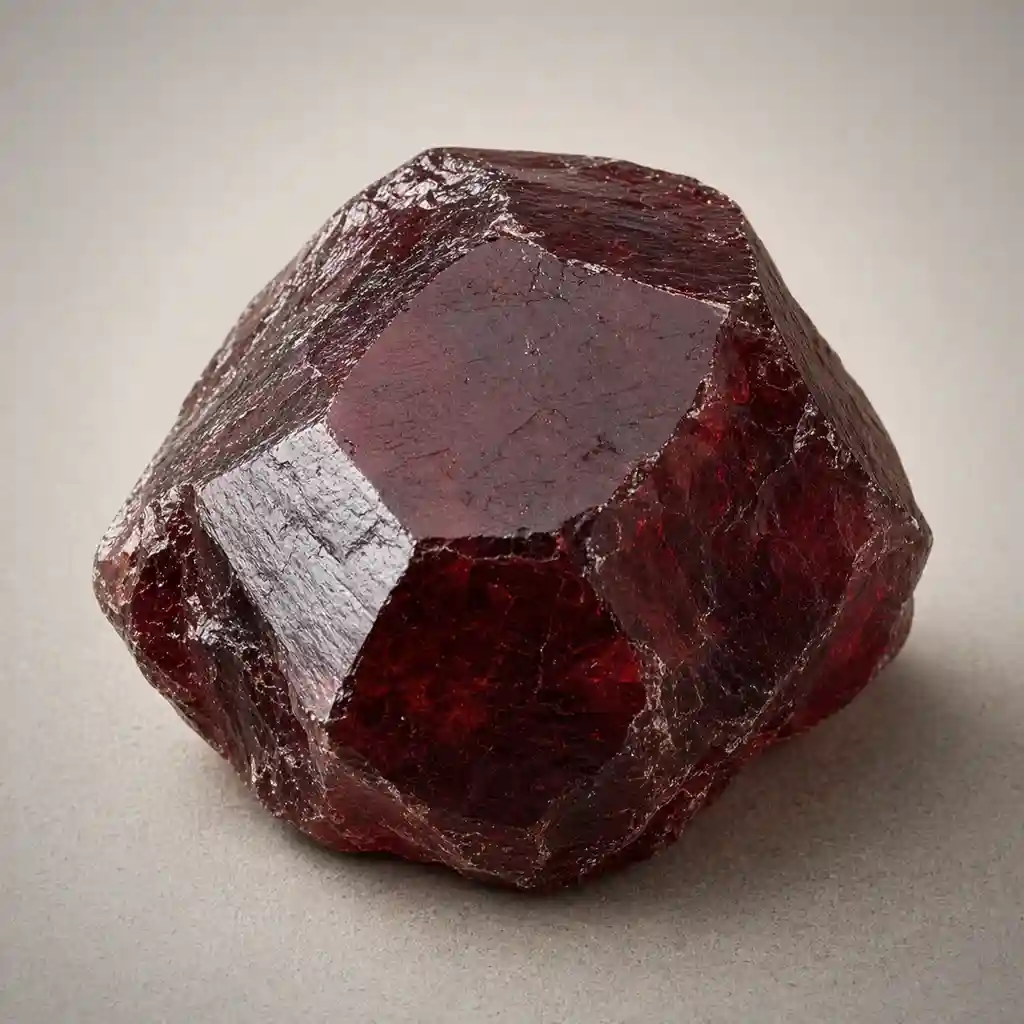
Garnet forms mostly in metamorphic rocks — schist and gneiss — under high temperature and pressure. It crystallizes when aluminum-rich minerals react with silica during regional metamorphism. Garnet also shows up in some igneous rocks and in alluvial deposits where weathering has freed crystals from their host rock. The dodecahedral (twelve-faced) and trapezohedral crystal habits are distinctive and look remarkably like pomegranate seeds. Almandine Garnet, the most common gem variety, typically forms at depths of 15-40 kilometers in the Earth's crust.
Varieties
Almandine
The most common gem Garnet, deep red to brownish-red. Iron-rich and widely available. The variety most people picture when they think of Garnet.
Rhodolite
A beautiful purplish-red to raspberry pink variety. A pyrope-almandine mix prized for its vivid, vibrant color and excellent clarity.
Tsavorite
A rare green Grossular Garnet found in East Africa. Rivals emerald in color but with greater brilliance and durability. One of the most valuable Garnet varieties.
Notable Origins
India (Rajasthan)
Major source of Almandine Garnet in deep red tones. Extensive alluvial deposits yield well-formed dodecahedral crystals. Indian Garnet has been mined for over 2,000 years.
Sri Lanka
Known for exceptional Rhodolite and Hessonite Garnets. Alluvial gem gravels produce high-clarity stones with vivid colors. Sri Lankan Garnets are prized by collectors worldwide.
Madagascar
Produces a remarkable range of Garnet varieties including rare color-change stones. Deposits yield both Almandine and Rhodolite in exceptional quality with strong saturation.
Mineral data verified via Mindat.org
Physical Properties
| Hardness | 7.5 on the Mohs scale |
| Chemical Formula | Fe₃Al₂(SiO₄)₃ |
| Crystal System | Cubic (Isometric) |
| Primary Color | Deep Red |
| Origin | India, Sri Lanka, Madagascar, United States, Czech Republic |
| Transparency | Transparent to translucent |
| Luster | Vitreous to resinous |
| Specific Gravity | 3.95-4.30 (noticeably heavy for its size) |
What Are the Healing Properties of Garnet?
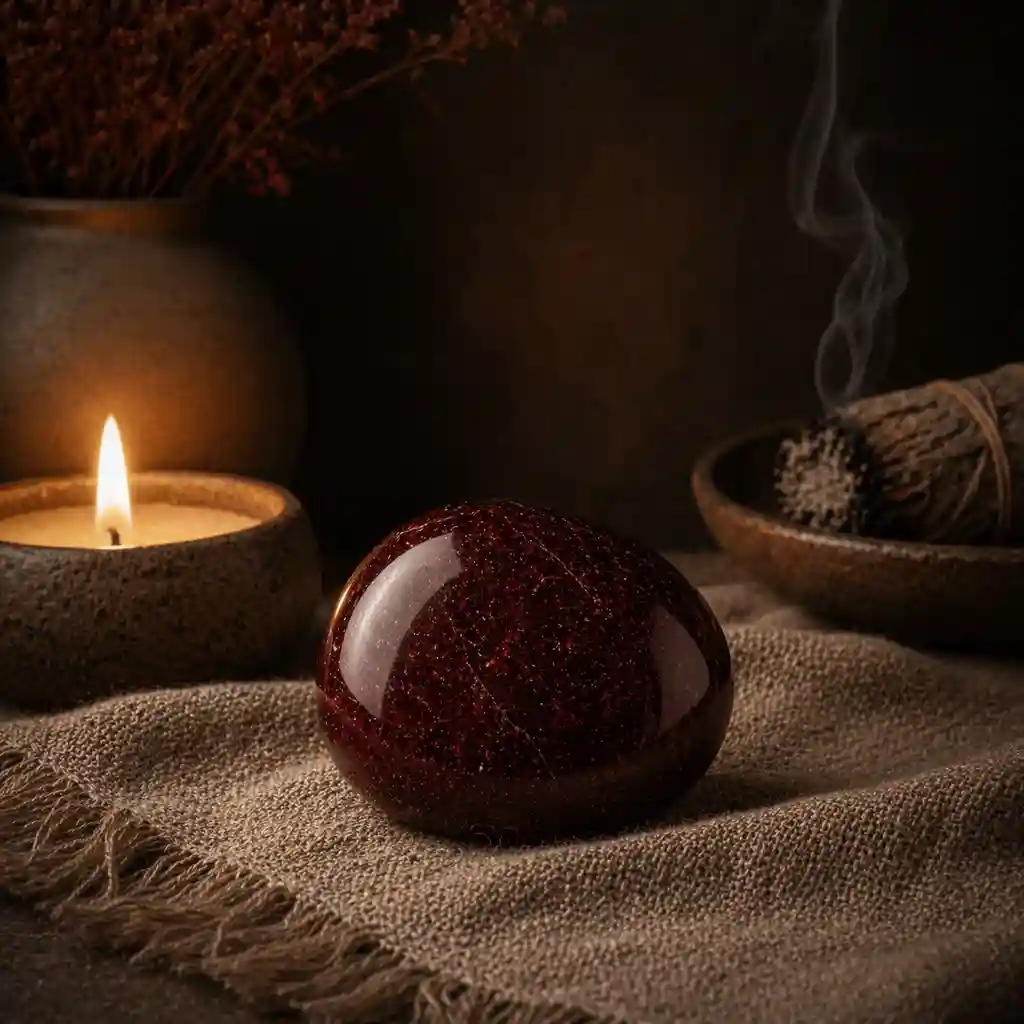
Emotional & Mental Well-being
Garnet is one of the best stones for reviving emotional passion when it has gone flat.
- ◆If you are feeling stuck, apathetic, or emotionally numb after a long stretch of stress or heartbreak, this is the stone practitioners often reach for.
- ◆Its deep red energy stimulates the life force between the Root and Heart Chakras, which can help you feel alive again.
- ◆Garnet encourages honest emotional expression and turns anger or frustration into something you can actually act on.
- ◆It works especially well for people who have shut down emotionally to protect themselves — it reopens the heart while keeping you grounded enough to handle what comes up.
- ◆Many crystal workers also find it helps people move through grief by connecting them to the cyclical nature of life.
Spiritual Properties
Garnet is associated with kundalini awakening and energetic activation.
- ◆When placed at the base of the spine, it is believed to stimulate dormant energy and send vitality upward through all the chakras.
- ◆It also strengthens the auric field and creates a protective shield that repels negative influences.
- ◆Garnet has a reputation for aiding past-life recall — practitioners use it to access memories from previous incarnations that might shed light on current challenges.
- ◆During meditation, it helps ground spiritual insights into something practical rather than leaving them abstract.
- ◆Some traditions use Garnet in commitment ceremonies because it symbolizes two spirits bound together in mutual devotion.
Physical Healing Traditions
Garnet has been linked to blood health and the circulatory system across many cultures.
- ◆Crystal practitioners recommend placing it over the heart or on areas with poor circulation to stimulate blood flow.
- ◆In folk medicine, it has been used for the spleen, lungs, and heart.
- ◆It is also associated with metabolism and cellular regeneration, which makes it popular for people recovering from illness or exhaustion.
Note: These properties are based on metaphysical traditions and are not a substitute for medical advice.
What Science Says
Garnet is a well-characterized group of nesosilicate minerals with the general formula X3Y2(SiO4)3, where X and Y are different metal cations.
- ◆The six main species — Almandine, Pyrope, Spessartine, Grossular, Andradite, and Uvarovite — form a solid solution series.
- ◆The hardness (6.
- ◆5-7.
- ◆5) and abundance of common Garnet make it useful industrially as an abrasive.
- ◆The metaphysical link to blood health has no scientific basis, though the connection is easy to understand given the deep red color and iron content.
- ◆Almandine, the most common variety, is about 35% iron oxide by weight.
Which Chakras Does Garnet Connect To?
Which Zodiac Signs Match Garnet?
How Do You Use Garnet?
Meditation
Hold Garnet in your receiving hand (usually the left) or place it at the Root Chakra (base of the spine) during meditation. Picture a deep red light rising from the Earth through your spine, filling you with warmth and energy. For heart-centered meditations, place it on your sternum and breathe into the stone, letting its energy reopen areas that have shut down. If you are working with kundalini energy, start with short sessions — five minutes — and build gradually.
Daily Wear
A Garnet ring on the left hand keeps vitalizing energy in constant contact with your body. A pendant resting near the heart supports emotional depth and devotion. Garnet earrings are associated with mental clarity and confident expression. For couples, matching Garnet pieces symbolize mutual commitment. Take off Garnet jewelry before heavy physical activity to protect the stone from impacts.
Home Placement
Place Garnet in the bedroom to reignite passion and deepen intimacy. A specimen on your desk fuels determination and career ambition. Near the entrance of your home, Garnet acts as a protective barrier against negative energy. In Feng Shui, the south sector (fame and recognition) or southwest (love and relationships) are good placements.
Crystal Grids
Use Garnet as the center stone in a grid for passion, vitality, or manifestation. Pair it with Clear Quartz amplification points and Rose Quartz for love-focused grids, or with Carnelian and Ruby for Root Chakra activation. Garnet works well in triangular grids built around commitment and loyalty.
How Do You Cleanse & Charge Garnet?
Running Water
RecommendedMoonlight Bathing
RecommendedSmudging
RecommendedSunlight Charging
RecommendedMoon Phase Charging: Charge Garnet under the full moon to restore vitality, or during the waxing moon to build passion and attraction energy. Set it on a windowsill or outdoors where it can soak up moonlight for a few hours.
Avoid the following:
- ✗Prolonged salt water soaking — can dull the polish over time
- ✗Ultrasonic cleaners — generally safe for most Garnet but can damage included or fractured stones
- ✗Steam cleaning — thermal shock can cause internal fractures in heavily included specimens
- ✗Harsh chemical cleaners — ammonia and bleach can affect surface polish
- ✗Boiling water — sudden temperature changes may crack some varieties
What Crystals Pair Well with Garnet?
Best Combinations
Rose Quartz
Rose Quartz softens Garnet's intensity with gentle, unconditional love — together they cover both the passionate and the tender sides of emotional healing
Carnelian
Carnelian amplifies Garnet's fire energy and Sacral Chakra activation — together they give a strong vitality and creativity boost
Clear Quartz
Clear Quartz amplifies and focuses Garnet's passionate energy, which is useful for manifestation grids and intention-setting rituals
Combinations to Approach with Caution
If You Like Garnet, Also Try
How Can You Tell if Garnet is Real or Fake?
Common Imitations
Identification Tests
1.Refractive Index Test
Use a refractometer to measure the stone's refractive index.
Almandine Garnet has a refractive index of 1.78-1.81, which is higher than most red glass imitations (typically 1.50-1.55). This is a reliable non-destructive test.
2.Magnet Test
Hold a strong neodymium magnet near the stone.
Almandine and Pyrope Garnets contain enough iron to be weakly attracted to a strong magnet — most natural gemstones and glass imitations will not respond.
3.Visual Inclusion Test
Examine the stone under 10x magnification with a jeweler's loupe.
Natural Garnet typically contains irregular inclusions (rutile needles, mineral crystals, growth zoning). Glass imitations often show round gas bubbles, swirl marks, or no inclusions at all.
Price Reference
Small
$3-10
Medium
$15-40
Large
$40-150
Common Almandine Garnet is very affordable. Rhodolite commands a premium for its vivid purplish-red color. Rare Tsavorite and Demantoid can exceed $1,000 per carat for fine specimens.
Is Garnet Safe? Care & Precautions
Toxicity Warning
Garnet is non-toxic and safe to handle. It contains iron and aluminum silicates that are not bioavailable through normal skin contact.
Storage
Garnet is relatively durable (6.5-7.5 Mohs) but should be stored separately from harder stones like diamond, sapphire, and ruby to prevent scratching of other gems. Store in a soft pouch or lined jewelry box.
Special Warnings
- ⚠Some Garnet varieties (Demantoid) may contain asbestos-like byssolite inclusions — handle rough specimens with care and avoid inhaling dust
- ⚠Garnet can be damaged by hydrofluoric acid — avoid contact with strong chemicals
What is Garnet Best For?
Garnet FAQ — Common Questions Answered
What is Garnet good for?+
Garnet is best known for passion, vitality, and devotion. It picks up physical energy, inspires love and loyalty in relationships, and gives you the confidence and courage to push through hard situations. People also use it for success and motivation in their careers. In energy work, it activates kundalini energy, and in crystal healing it is associated with the circulatory system, heart, and blood. The energy is steady and long-lasting rather than a quick jolt.
What colors does Garnet come in?+
Deep red is the most familiar, but Garnet actually comes in almost every color. Almandine and Pyrope are deep red to brownish-red. Rhodolite is purplish-red to raspberry pink. Spessartine is orange to reddish-orange. Grossular can be green (tsavorite), yellow (hessonite), or colorless. Andradite includes the rare green Demantoid and yellow-green Mali Garnet. Each variety has a slightly different energy, but they all share Garnet's basic vitality and passion.
Is Garnet a good engagement ring stone?+
It can work, especially if you want something non-traditional. Garnet has a hardness of 6.5-7.5 depending on variety, which is decent for daily wear but not as tough as diamond or sapphire. The deep red color is a natural symbol of passionate love and commitment. Rhodolite (pinkish-purple) and Tsavorite (green) are popular choices for engagement rings. Just know that Garnet will pick up scratches more easily than harder stones, so it needs more care.
How does Garnet connect the Root and Heart Chakras for Aries?+
Garnet bridges the Root and Heart Chakras, linking physical drive with emotional depth. Aries is naturally bold and full of initiative, but that fire can easily tip into pure aggression. Garnet helps channel it into something more heart-centered — passion with purpose rather than just force. The stone activates energy at the Root while opening the Heart, which teaches Aries that real strength involves love and devotion, not just boldness and action.
What are the different types of Garnet and where are they found?+
Garnet is actually a group of closely related minerals found in nearly every color. Common Almandine and Pyrope (deep red) come mainly from India, Sri Lanka, and Madagascar. Rhodolite (raspberry-pink) is mined in Tanzania and Mozambique. The rare green Tsavorite comes from Kenya and Tanzania. Bohemian Garnets from the Czech Republic have been mined since the Middle Ages. Common red Garnet is very affordable. The rare varieties like Tsavorite and Demantoid can cost as much as fine Emeralds.
Was this helpful?